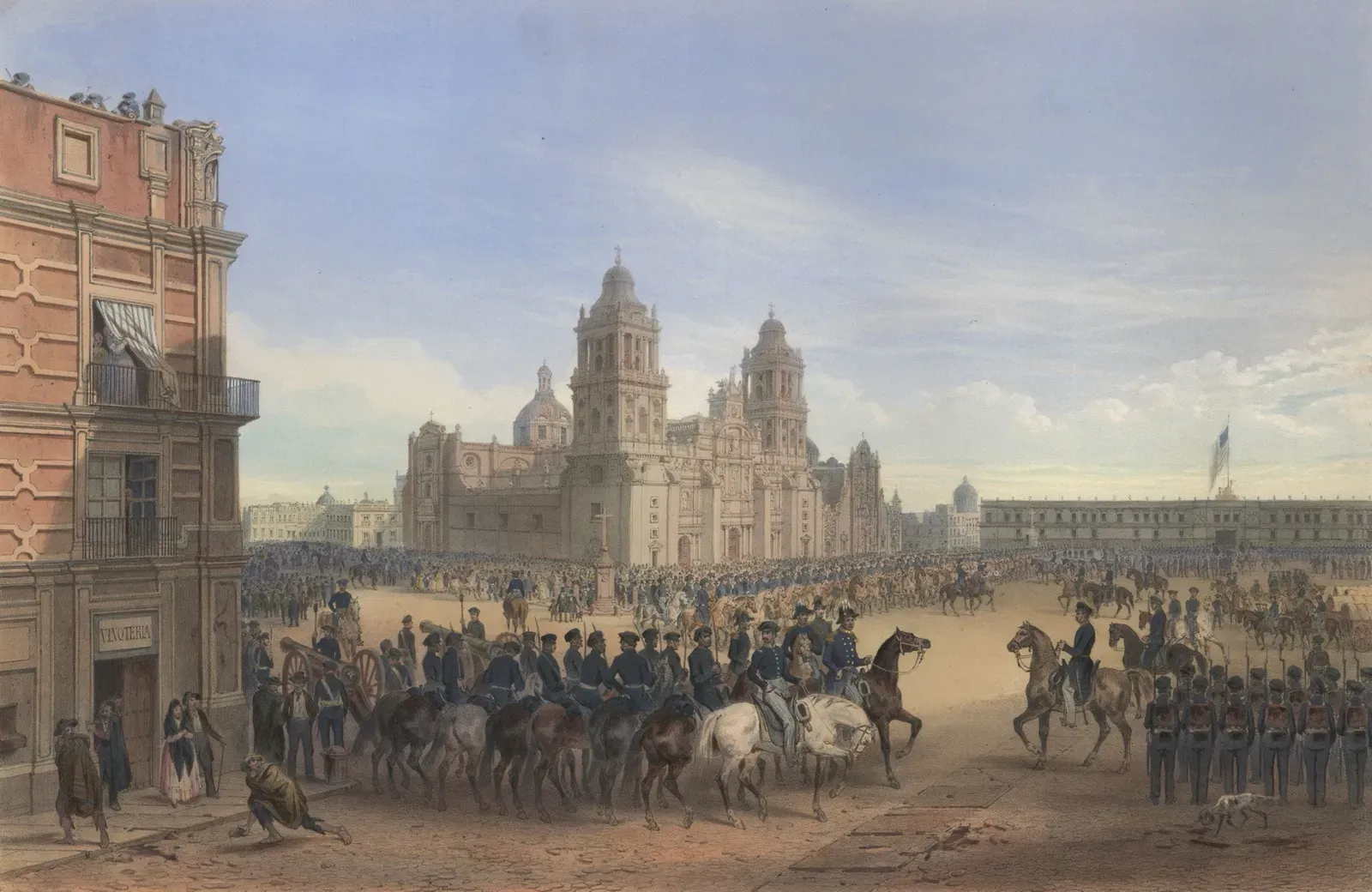
On 13 May 1846, James K. Polk got his war. Congress approved his request for a declaration against Mexico by large margins in both chambers. The official story was border defence: Texas had joined the Union the previous December, Mexico still claimed it, and each side read the boundary differently - Mexico at the Nueces River, the United States at the Rio Grande. In late April, Mexican troops had crossed what Polk called the American line and ambushed a US dragoon patrol. Polk told Congress that Mexico had “invaded our territory and shed American blood upon the American soil.” Whether the disputed strip was American soil in any sense Mexico recognised was exactly the question his opponents would not let die.
They were right to ask. When Abraham Lincoln took his seat in the House the following year, the first-term Whig from Illinois demanded that Polk identify the exact “spot” where blood had been shed - a needle Lincoln knew Polk could not thread without admitting the whole quarrel was a forward base for expansion, not a response to unprovoked attack. John Quincy Adams, Henry Clay, and a slice of the Northern press called the war unjust, even predatory. They lost the vote. The armies marched.
What followed was short by the standards of European wars, long enough to be decisive. US forces took Mexico City in September 1847. The Treaty of Guadalupe Hidalgo, signed in February 1848, confirmed the Rio Grande border and transferred to the United States more than half a million square miles of Mexican territory - the future California, Nevada, and Utah, most of Arizona and New Mexico, and slices of what became Colorado and Wyoming. Mexico lost roughly half its national area in a stroke. The resentment outlasted every general who signed the papers.
The acquisition did three things at once, each of which outgrew the war that produced it.
It made the United States a two-ocean power with a Pacific coastline and harbours that could face Asia. The timing was almost indecent: gold turned up at Sutter’s Mill in January 1848 while negotiators were still fixing terms; the treaty was signed the following month, and by the time ratifications were exchanged in May the rush was already underway. California did not slowly fill; it detonated. Statehood in 1850 rammed a new, rich, politically awkward prize into a Congress already allergic to compromise.
It also embedded a Spanish-speaking population inside the expanding republic - people whose land titles, language, and citizenship status Washington promised to respect on paper and often failed to honour in practice. That demographic fact is still the background hum of the border states.
The 1850s were worse still: the acquisition reopened the slavery question with fresh acreage and no agreed rule for what should follow. The Wilmot Proviso - a single sentence attached to a war appropriations bill in August 1846 - proposed banning slavery in any territory taken from Mexico. It never became law, but it mapped the fault line: Northern votes for it, Southern votes against, party coalitions cracking along the same line. The old Missouri Compromise line could not contain a conquest this large. Every argument that followed - popular sovereignty, fugitive slave law politics, bleeding Kansas - had this annexation in its family tree. I do not think the Civil War was “caused” by any one vote in 1846, but I find it impossible to contemplate the story of secession without the land the war added.
The Mexican War was also a finishing school for the Civil War’s commanders. Ulysses S. Grant served as a quartermaster and learned, under fire, how supply and movement actually work. Robert E. Lee was an engineer on Scott’s staff, mapping routes into Mexico City. Jefferson Davis raised a regiment. Stonewall Jackson, George McClellan, James Longstreet - the list reads like a roll call for 1861. They fought side by side. They learned the same logistics, the same maps, the same habits of command. Fifteen years later they aimed those skills at each other.
Polk’s contemporaries who opposed the war were not pacifists in the abstract. They feared what victory would require the republic to become - a nation that habitually reached for the army when diplomacy stalled, and that measured its greatness in acres taken rather than arguments settled. The expansionists were not wrong that the Pacific coast would matter economically. Their critics were not wrong that taking half a neighbour would poison the relationship for generations and strain the Union’s conscience until it broke.
The declaration of 13 May 1846 was a single day’s work in Congress. The consequences - the cities, the farms, the mines, the border, the bilingual millions, the Civil War officers who had met as comrades in Mexico - are still household names in the USA.