There is an image you have seen. Two figures reach toward each other across a pale sky — one inert, one straining forward, their fingertips almost touching. If you grew up in the Western world, you have encountered this image on posters, book covers, advertisements, films, and at least one T-shirt. You probably knew it before you knew who made it, or where, or when. That image is a detail from the ceiling of the Sistine Chapel, painted by Michelangelo between 1508 and 1512. It is called The Creation of Adam.
Art rarely shifts the world the way a battle or a revolution does. Most great artists — even brilliant ones — leave their work behind and let it age quietly, appreciated by those who seek it out. Michelangelo is the exception. His work has not aged quietly. It has become part of the furniture of Western civilisation, present in the minds of people who have never been to Rome and never set foot in a gallery. Nearly 500 years after his death, that is an extraordinary thing.
He was born on 6 March 1475 in Caprese, a small town near Arezzo in Tuscany, where his father had taken a temporary post as a local magistrate. The family returned to Florence within months. His mother was unwell for most of his childhood and died when he was six. He was sent to live with a stonecutter and his wife in the village of Settignano, where his father owned a marble quarry. He spent years watching men cut stone before he ever picked up a brush. He later told his biographer Giorgio Vasari that it was there, “along with the milk of my nurse”, that he received his feeling for marble. Whether or not that is a convenient piece of mythology, the evidence bears it out.
At 13 he was apprenticed to Domenico Ghirlandaio, then the most prominent painter in Florence. Within a year, his father had persuaded Ghirlandaio to pay the boy as a professional — something essentially unheard of for an apprentice that age. When Lorenzo de’ Medici asked Ghirlandaio for his two best pupils, Ghirlandaio sent Michelangelo. From the ages of 14 to 17, Michelangelo studied at the Platonic Academy that Lorenzo had founded: a gathering of philosophers, poets, and scholars that included Marsilio Ficino and Pico della Mirandola. Not a bad education for a boy from a failed banking family.
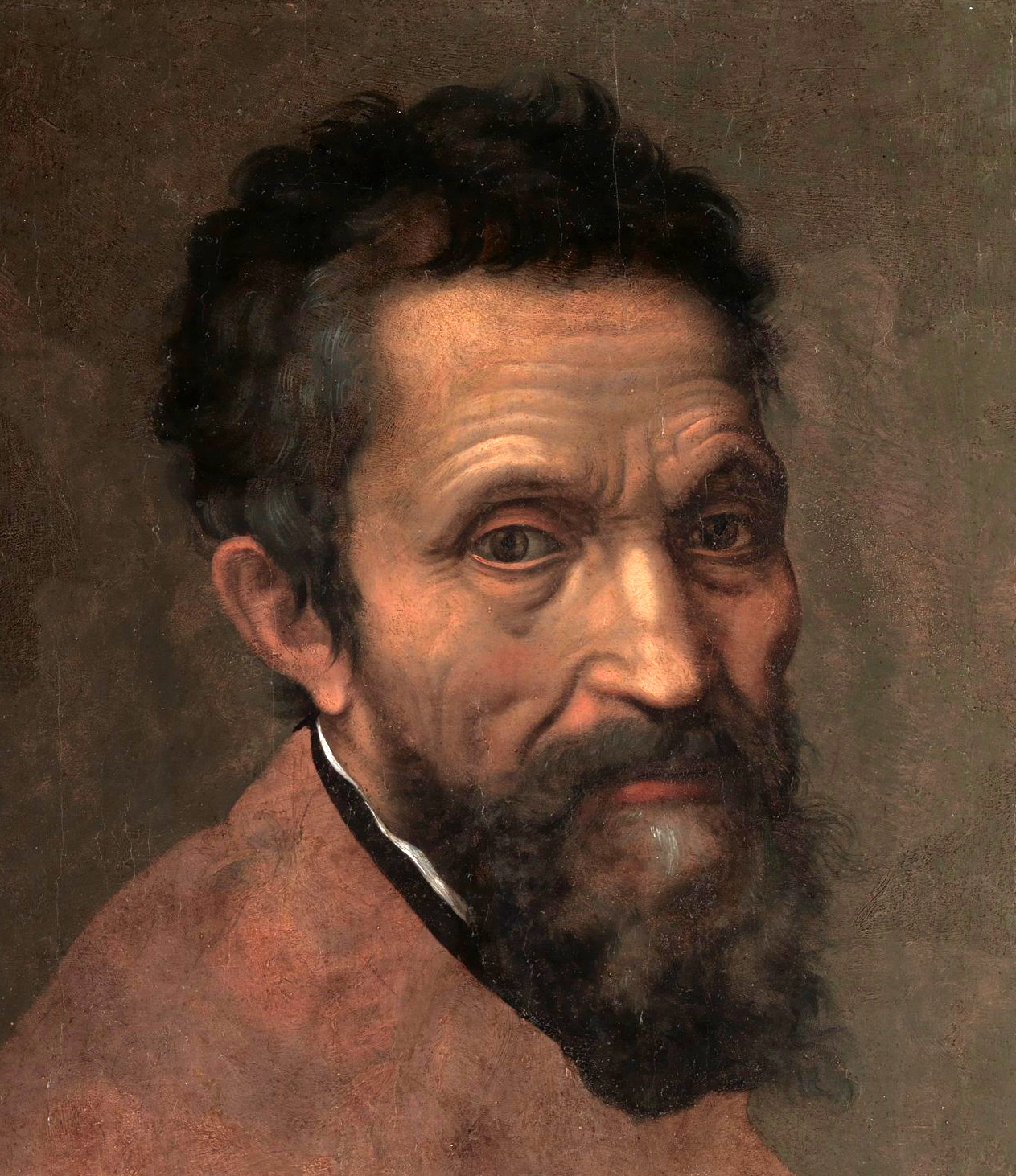
At 17, a fellow student named Pietro Torrigiano punched him in the face hard enough to break his nose. The disfigurement is visible in every portrait Michelangelo ever sat for. He never quite forgave it.
He arrived in Rome for the first time at 21, and at 24 completed the Pietà — the Virgin Mary holding the body of the dead Christ in her arms, carved from a single block of Carrara marble. Vasari, never one to undersell things, called it “a miracle that a formless block of stone could ever have been reduced to a perfection that nature is scarcely able to create in the flesh”. Contemporaries were stunned enough that Michelangelo, hearing visitors attribute the work to someone else, returned in the night and carved his name across the sash on Mary’s chest. It is the only work he ever signed. It now stands in St Peter’s Basilica.
He returned to Florence in 1499 and was commissioned to complete a project that had been abandoned forty years earlier: a colossal statue of David in Carrara marble, intended as a symbol of Florentine freedom. He finished it in 1504. The statue was so significant that a committee of consultants was assembled just to decide where to place it — the committee included Botticelli, Leonardo da Vinci, and several of the leading architects and painters of the day. They settled on the Piazza della Signoria. It now stands in the Accademia, a marble replica outside in its place.
In 1505, Pope Julius II summoned him back to Rome to build a tomb — forty statues, five years’ work. The project would occupy him, on and off, for the next four decades and was never finished to his satisfaction. What intervened, almost immediately, was the Sistine Chapel.
The commission, as Julius originally conceived it, was modest: paint the twelve apostles on the triangular pendentives of the chapel ceiling and cover the rest with ornament. Michelangelo talked him out of it and proposed something considerably more ambitious. What he ended up painting — over roughly four years, working mostly on scaffolding in extreme physical discomfort — covers 500 square metres of ceiling and contains more than 300 figures. The nine central panels trace the Book of Genesis from the creation of the earth to the story of Noah. The prophets and sibyls loom in the surrounding spaces. The whole scheme, which Michelangelo designed himself, is one of the most sustained acts of visual invention in recorded history.
He was not, by his own account, a painter. He said so repeatedly. He was a sculptor who happened to be producing two of the most influential frescoes in Western art.
A word about the man himself, because he is worth knowing.
Michelangelo was called Il Divino — the divine one — by his contemporaries, and three separate biographies were published during his lifetime. He was the first Western artist for whom this happened. His admirers spoke of his terribilità: his capacity to instil in the viewer a sense of overwhelming awe. These were not small claims.
The man who received them was famously indifferent to comfort. His net worth was approximately 50,000 gold ducats — more than many princes of his era — but he lived, as he told his apprentice Ascanio Condivi, “like a poor man”. He often slept in his clothes. He slept in his boots. His biographer Paolo Giovio said his domestic habits were “incredibly squalid”. He was solitary, melancholy, and, as contemporaries put it, bizzarro e fantastico: a man who withdrew from company. He had few close friendships and fewer students. He did not want anyone to see how he worked.
He also wrote more than three hundred sonnets and madrigals, approximately sixty of them addressed to men. The longest and most ardent sequence was written to Tommaso dei Cavalieri, a young Roman patrician he met in 1532, when Michelangelo was 57 and Cavalieri was 23. The poems predate Shakespeare’s sonnets to the fair youth by fifty years and are, if read plainly, unmistakable in their feeling: “I feel as lit by fire a cold countenance / That burns me from afar and keeps itself ice-chill.” Cavalieri replied that he had never loved a man more. He remained devoted to Michelangelo until the end.
When Michelangelo’s grandnephew published the poems in 1623, he changed the gender of the pronouns. He also removed certain words and insisted the poems be read allegorically. This adjustment stood in print for the better part of two and a half centuries, until John Addington Symonds translated them back into English in 1893, restoring the original genders.
Michelangelo was sentenced to death by Pope Clement VII — a Medici — after he had worked on the fortifications of Florence against the Medici during the siege of 1529–1530. He hid for two months in a small chamber beneath the Medici chapels, making drawings by the light of a tiny window. The death sentence was eventually lifted. Clement needed him too much.
The Last Judgment, painted on the altar wall of the Sistine Chapel between 1536 and 1541, was commissioned when Michelangelo was 61. It covers 14 metres by 13. Christ stands at the centre, massive and beardless and entirely nude, with the saved rising on one side and the damned falling on the other. Saint Bartholomew holds a flayed skin that bears the likeness of Michelangelo. Cardinal Carafa and the Mantuan ambassador campaigned immediately to have the fresco removed or censored. The Pope resisted. At the Council of Trent, shortly before Michelangelo’s death, the decision was made to obscure the genitals. His former student Daniele da Volterra was hired to do it, and was known for the rest of his life by the nickname Il Braghettone — the breeches maker. An uncensored copy of the original, painted by Marcello Venusti, survives in the Capodimonte Museum in Naples.
In 1546, at the age of 71, Michelangelo was appointed chief architect of St Peter’s Basilica. The project had been running for forty years under a succession of architects with little progress. He returned to the original design by Bramante, simplified and strengthened it, and produced the dome. The dome of St Peter’s went on to influence the building of churches across Catholic Europe, and then, through its influence on Christopher Wren, the design of St Paul’s Cathedral in London. Through St Paul’s and directly, it shaped the civic domes of public buildings and state capitals across the United States. When you look at the Capitol building in Washington, you are looking at a lineage that runs back to a man born in a hill town in Tuscany in 1475.
He worked on the Rondanini Pietà six days before he died. He died in Rome on 18 February 1564, aged 88. His body was taken back to Florence, at his request, and buried in the Basilica of Santa Croce.
Michelangelo never commanded armies or signed treaties. He did not discover anything or found anything. What he did was rearrange the visual language of Western civilisation so thoroughly that most of its consequences are now invisible — absorbed into the background, taken for granted, encountered on T-shirts. That is not a tectonic shift in the way a war is. It is something else: the kind of change that is hardest to undo because it is hardest to see.