When a state’s founding is dated to a religious conversion rather than a battle, a treaty, or a coronation, it tells you something about what that state needed to be. On 14 April 966, Mieszko I, the pagan ruler of the Polans - a Slavic tribe controlling the lands around the Warta and Vistula rivers - was baptised into the Catholic Church. He had married Doubravka, a Christian princess from Bohemia, the year before. The marriage was diplomatic. The baptism was existential.
The conversion made Poland legible to Christian Europe. Before 966, the Polans were a target. Otto I, the newly crowned Holy Roman Emperor, had been expanding German influence eastward through a combination of military conquest and missionary activity. Pagan Slavic tribes to the east of his domains were not just non-Christian neighbours; they were legitimate objects of conquest, conversion, and territorial absorption under the logic of Christianisation that governed medieval European politics. If you were pagan, you could be conquered. If you converted, you became part of the system - subordinate, perhaps, but recognised. Mieszko chose recognition.
The timing was precise. In 955, Otto had crushed a Magyar invasion at the Battle of Lechfeld and secured his western frontier. German military attention was now free to focus eastward. Mieszko’s baptism, performed under the auspices of the Latin rite and aligned with Rome rather than Constantinople, meant that any further German advance into his territories could no longer be justified as a crusade against paganism. The Polans were now Christian. They had their own bishop, appointed in 968. By 990, Mieszko had established an independent ecclesiastical structure at Gniezno. The conversion did not make the Piast dynasty immune to German pressure - it never would be - but it changed the terms. You could not conquer a Christian prince and call it God’s work quite as easily.
The sources for Mieszko’s reign are sparse and written long after the fact, mostly by outsiders who had agendas of their own. The Christianisation narrative appears in accounts by Thietmar of Merseburg, a Saxon chronicler writing in the early 11th century, who naturally emphasised the civilising mission of the Church. Polish chroniclers like Gallus Anonymus, writing in the early 12th century, presented the baptism as the true beginning of the Polish nation, the moment when barbarism ended and history began. Both versions served their purposes. What is not in doubt is that Mieszko understood the game he was playing. He converted because it offered survival. The piety could follow.
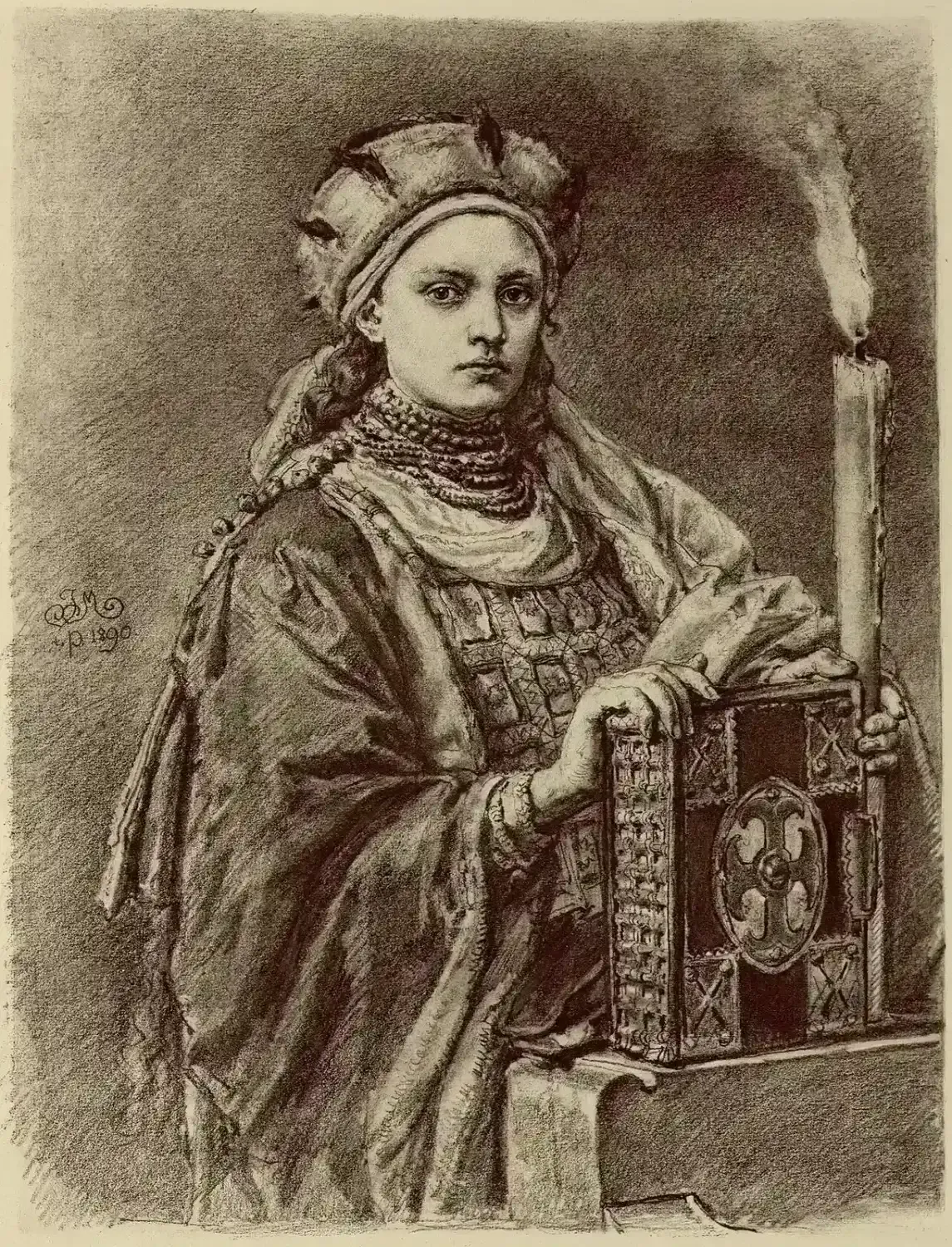
Doubravka, the Bohemian princess, brought more than a wedding alliance. She brought priests, political connections to Christian courts, and a model of how a pagan ruler could manage the transition without losing control. Her father, Boleslav I of Bohemia, had already navigated the same conversion a generation earlier and secured Bohemian autonomy within the German sphere. Mieszko was learning from the neighbouring example. When Doubravka died in 977, Mieszko remarried - this time to a German noblewoman, Oda of Haldensleben. The point was consistency: Poland would be Christian, Catholic, and connected to the western European order.
The territorial extent of Mieszko’s domain at the time of his baptism is debated, but it likely included Greater Poland around Gniezno and Poznań, Masovia, possibly parts of Silesia, and access to the Baltic coast. By the time of his death in 992, he had expanded into Pomerania, secured the Polish hold on the mouth of the Vistula, and established Poland as a regional power capable of resisting both German encroachment from the west and pressure from Bohemia to the south. His son, Bolesław I Chrobry - Bolesław the Brave - would go further, crowned as Poland’s first king in 1025, two years before his death.
The Polish state that emerged from Mieszko’s reign was fragile, contested, and surrounded. It lost and regained territories in nearly every generation. It fragmented in the 12th and 13th centuries into competing duchies ruled by rival branches of the Piast family. It was invaded by Mongols in 1241 and paid tribute to avoid worse. It was reunified in the 14th century under Casimir III, who rebuilt the kingdom’s legal and administrative structures and is remembered as the last Piast king of Poland. The dynasty that Mieszko founded ruled, in various forms, until 1370. What survived beyond the dynasty was the idea that Poland was a Christian kingdom with a right to exist.
The conversion of 966 is taught in Polish schools as the founding moment of the nation. It is commemorated every April 14th as the baptism of Poland. The date carries more weight than most medieval religious events because it anchored Poland in the western Christian world rather than leaving it vulnerable to conquest or absorption into the Orthodox sphere under Byzantine or later Russian influence. Had Mieszko chosen differently - or chosen nothing - the Polans might have been Christianised by German bishops at the point of a sword, their lands carved into margravates and governed from elsewhere. The baptism was a pre-emptive act of state-building.
Over the centuries that followed, the tale of Poland became glorious, tragic, and everything in between. It rose to dominance in the Polish-Lithuanian Commonwealth, the largest state in Europe by the late 16th century, stretching from the Baltic to the Black Sea. It elected its kings, limited royal power through a noble assembly, and became a haven for Jews fleeing persecution elsewhere. It was partitioned in 1772, 1793, and 1795 by Russia, Prussia, and Austria, and disappeared from the map entirely for 123 years. It reappeared in 1918 after the First World War, only to be invaded in 1939 from the west by Nazi Germany and from the east by the Soviet Union. Six million Polish citizens died in the war that followed. The state was resurrected again in 1945, under Soviet domination this time, and would not regain full sovereignty until 1989.
What began with Mieszko’s baptism on 14 April 966 was a state that understood survival required recognition. Poland would disappear off the map as an independent nation for long stretches, only to re-emerge in the 20th century once more, like a phoenix from ashes. The conversion that founded it was not an act of faith. It was an act of statecraft. The faith, such as it was, came later.