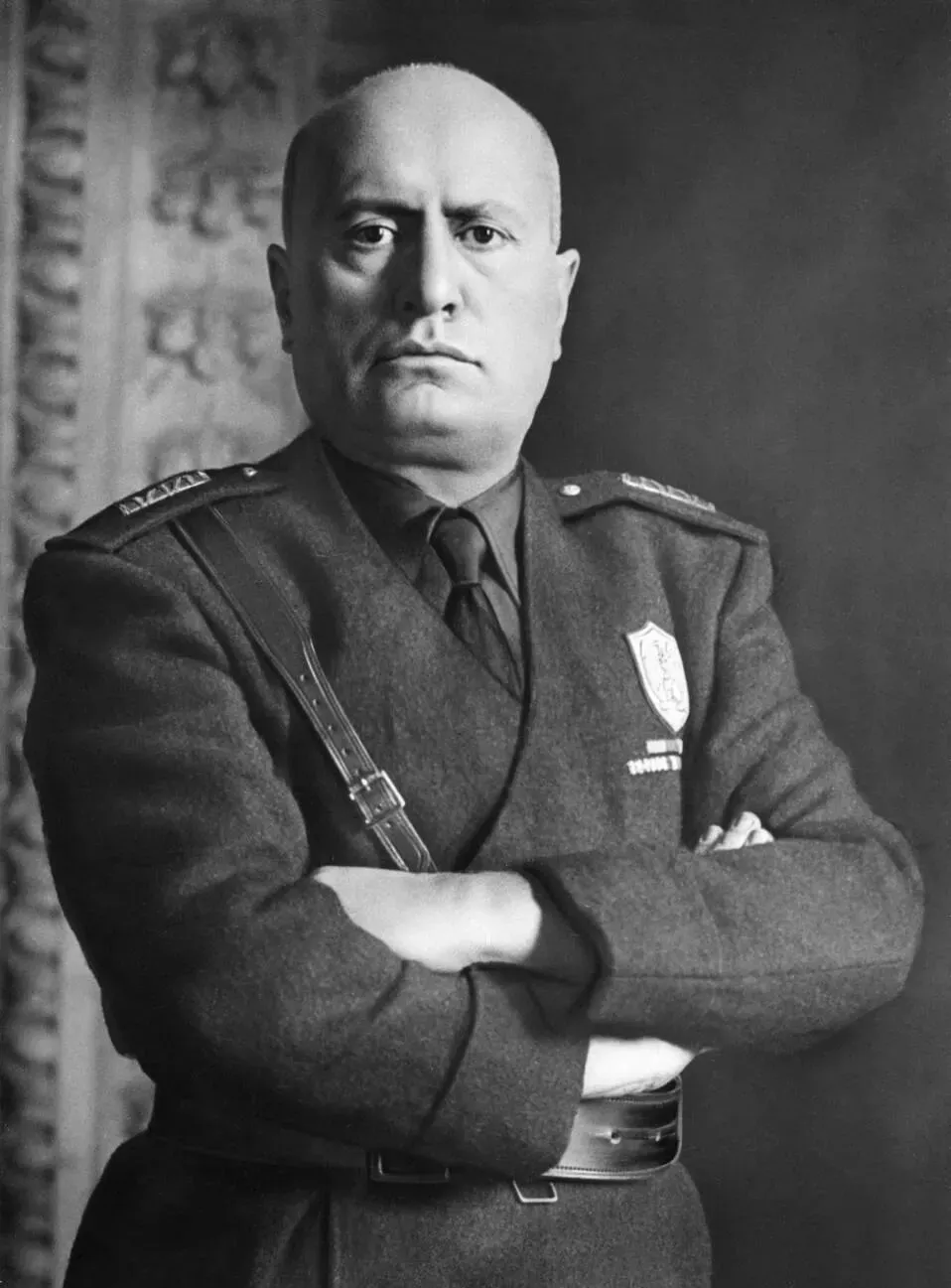
The body arrived at Piazzale Loreto in Milan at three in the morning of 29 April 1945. It was dumped on the ground alongside the bodies of Clara Petacci and fourteen Fascist officials. By dawn a crowd had gathered. People kicked it, spat on it. A woman fired five pistol shots into the corpse. Eventually the bodies were hauled up by the heels and hung upside down from the roof of a petrol station. Benito Mussolini, the man who had founded Fascism, coined the word, and ruled Italy for over two decades, ended as a public spectacle in the same piazza where Axis authorities had executed fifteen partisans the previous August.
He had been shot the day before, 28 April 1945, at a small village on the western shore of Lake Como called Giulino di Mezzegra. The previous afternoon, partisans of the 52nd Garibaldi Brigade had stopped a retreating German convoy on the lakeside road. They found Mussolini in the back of a truck wearing a Luftwaffe greatcoat and a German helmet. He was sixty-one years old. The war had four days left to run.
That disguise - a German coat, a German helmet, hiding in a German vehicle - is a precise image of what he had done to himself and to Italy. The man who had once addressed hundreds of thousands from the balcony of the Palazzo Venezia, who had proclaimed the Italian Empire in 1936 and been called “the Man of Providence” by the Pope, was trying to flee across the Swiss border dressed in the uniform of the army that had occupied his country.
He was born in July 1883 in Dovia di Predappio, a small town in Romagna. His father Alessandro was a blacksmith and a socialist; his mother Rosa was a devout Catholic schoolteacher. He was named Benito after the Mexican liberal president Benito Juárez; his middle names Amilcare and Andrea were those of Italian socialist heroes. The tension between his father’s Bakunin-inflected anarchism and his mother’s Sunday masses ran through everything that followed. He was violent from adolescence: he stabbed a classmate with a penknife at a Salesian boarding school and was expelled. He went to Switzerland to avoid military service and fell in with socialist agitators, was arrested by the Bernese police for advocating a general strike, and spent two weeks in a Swiss jail while reading Nietzsche, Sorel, and Pareto.
Back in Italy, he became a journalist - eventually editor of Avanti!, the official organ of the Italian Socialist Party, which he built from 20,000 to 100,000 in circulation. Then came the war. In 1914, when the party voted to stay neutral, Mussolini reversed his position entirely, called for intervention, was expelled, and founded his own paper, Il Popolo d’Italia, funded partly by French and British intelligence money. He fought on the Isonzo front, rose to corporal, was wounded by a mortar explosion in 1917 and left with more than forty metal fragments in his body. He came back angrier and with a new idea.
On 23 March 1919, in a hall on the Piazza San Sepolcro in Milan, he founded the Fasci Italiani di Combattimento with 200 members. His list received 4,795 votes in Milan in the November elections - a catastrophic failure. He considered emigrating. Three years later he was Prime Minister. What changed everything was the violence of his Blackshirt squads, which attacked socialist offices, beat trade unionists, and murdered opponents while the liberal government watched, preferring to use them against the left rather than suppress them. By October 1922, Mussolini could threaten a march on Rome. King Victor Emmanuel III had the army available to stop it. He declined to sign the order and handed the government to Mussolini instead. Many businessmen and conservatives believed they could manage him. They could not.
By 1925 he had disposed of democratic forms. Press censorship was total. Other parties were banned. Local elections were abolished. “Everything within the state,” he declared, “nothing outside the state, nothing against the state.” He had himself photographed constantly in uniform, on horseback, bare-chested harvesting wheat - millions of copies distributed. “Mussolini is always right” was printed and posted as a sincere instruction. In 1929, he signed the Lateran Treaty with the Vatican, resolving a standoff between the Italian state and the papacy that dated back to the unification of Italy in 1870. Pope Pius XI called him “the Man of Providence.” The Catholic press announced that Italy had been “given back to God and God to Italy.”
His highest point came with Ethiopia. He invaded in October 1935; by May 1936, after a campaign that used mustard gas and targeted civilians, Addis Ababa had fallen and he proclaimed the Italian Empire. His biographer Renzo De Felice called it “Mussolini’s masterpiece” for its effect on Italian public opinion. But the League of Nations imposed sanctions, and the resulting diplomatic isolation pushed him toward Germany. In November 1936, the Rome-Berlin Axis was announced. He visited Germany in September 1937, where three million people lined the official route. He addressed 800,000 Berliners in German: “Italian fascism has finally found a friend, and it will go with its friend to the end.” The Pact of Steel formalised the military alliance in May 1939.
He assumed war would not come before 1942. It came in September 1939. He kept Italy out initially, knowing the army was not ready - it still carried rifles from the previous war - but in June 1940, convinced Germany had already won and wanting a share of the spoils, he declared war on France and Britain. Roosevelt called him the man who “held the dagger” and “struck it into the back of his neighbour.” What followed was military collapse on every front simultaneously. Greece repelled the Italian invasion in winter 1940 and pushed his troops back into Albania. The British army destroyed an entire Italian army in North Africa at Operation Compass. East Africa was lost. Each front required German rescue, and by 1942 Italy was fighting, as his son-in-law and Foreign Minister Galeazzo Ciano noted in his diary with thinly veiled contempt, entirely in accordance with German interests and German planning. By early 1943, the Italian Army in Russia had been annihilated at Stalingrad - over 60,000 missing, most of them dead in Soviet camps. Italy was being bombed. The industrial north went on strike for the first time since 1925. Mussolini had not slept properly in years.
On 24 July 1943, the Grand Council of Fascism - the body he had created to legitimise himself - voted 19 to 8 to strip him of military command and restore constitutional authority to the king. He apparently did not believe the vote had any practical meaning and turned up for work the next morning. That afternoon, the king received him, dismissed him, and had him arrested in a Red Cross ambulance in the palace gardens. The radio announced his fall that evening. There was no resistance of any kind.
German commandos rescued him in September 1943 in the Gran Sasso raid - gliders landing on a mountain ski resort in Abruzzo where he was being held. Hitler installed him as nominal head of a puppet state in German-occupied northern Italy: the Italian Social Republic, known as the Salò Republic. He watched his son-in-law Ciano shot in the back, hands tied to a chair, for having voted against him at the Grand Council. He did not intervene. In January 1945, three months before his death, he told a journalist: “Seven years ago, I was an interesting person. Now I am little more than a corpse. I work and I try, yet know that all is but a farce. I await the end of the tragedy and - strangely detached from everything - I do not feel any more an actor. I feel I am the last of spectators.”
He was right about the farce. On 28 April 1945, he died at the side of a road near Lake Como in borrowed German clothes. The body was driven to Milan, hung upside down beside his mistress from the roof of a petrol station in Piazzale Loreto, and left for the crowd to do with what it thought appropriate. The crowd had not forgotten what Fascism was.
The word he coined has had a longer life than he deserved. It is used so loosely now - applied to parking restrictions and dress codes and politicians of all tendencies - that it has nearly lost its original content. That might be his last irony: not that his ideas were defeated, but that the term he gave them was diluted into a generalised insult. Mussolini was specific. His Italy was a specific, documented catastrophe - wars he started and lost, alliances he chose and was destroyed by, people he killed in Libya and Ethiopia and across occupied Europe. The abstract noun is not the point. The body hanging at Piazzale Loreto is the point.