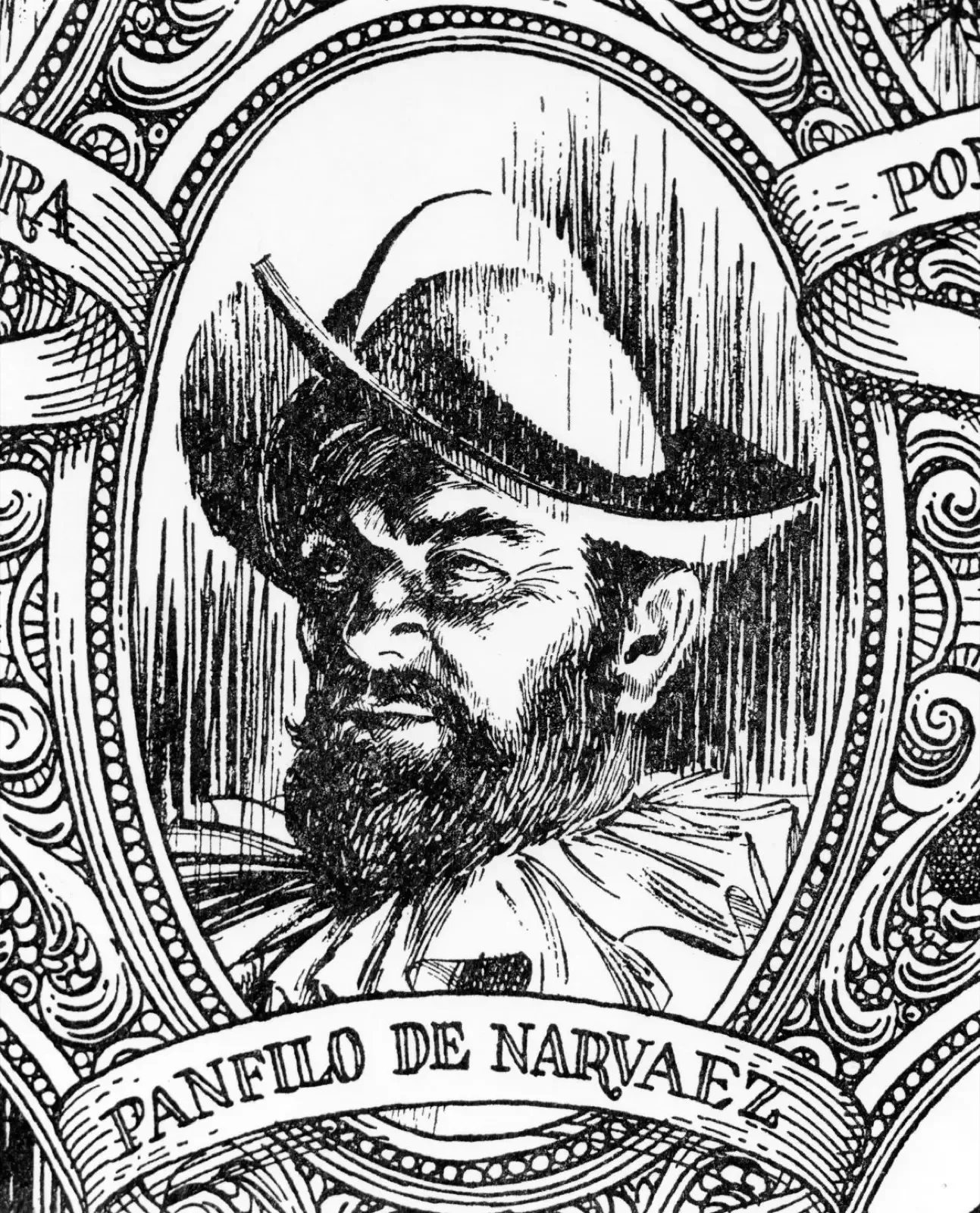
On 17 May 1527, Pánfilo de Narváez departed Spain with 600 men and a royal licence to plant Spanish settlements along the Gulf Coast of Florida. Nine years later, four of them reached Mexico City. The other 596 died somewhere between the mouth of the Guadalquivir and the swamps of the Florida panhandle, most of them in circumstances that would have been hard to predict even by the pessimistic standards of sixteenth-century exploration.
Narváez was not an obvious choice to lead anything. He had previously gone to Mexico in 1520 to arrest Hernán Cortés on charges of insubordination, ended up losing an eye in the fight that followed, and spent two years in Cortés’s jail before being released. Charles V, apparently undeterred by this record, granted him a licence in December 1526 to claim the Gulf Coast and found at least two towns of a hundred people each within a year. Narváez had to fund the expedition himself, which he did by promising investors returns comparable to the gold Cortés had just extracted from the Aztec empire. This was optimistic. What the Gulf Coast of Florida actually contained, as the expedition was about to discover, was swamps, hostile confederacies, and no gold whatsoever.
The problems started before they reached Florida. At Santo Domingo, roughly a hundred men deserted after hearing about a previous expedition to the same region in which 450 of 600 men had died. This should have been a useful data point. Narváez pressed on. In Cuba, a hurricane caught two of his ships in the harbour at Trinidad, sank them both, killed 60 men, and destroyed a fifth of the horses. The master pilot he hired, a man named Diego Miruelo who claimed extensive knowledge of the Gulf Coast, ran the entire remaining fleet aground on shoals off Cuba two days after leaving port. They were stuck there for two to three weeks while the already depleted supplies ran down further. Narváez pressed on.
They reached Florida in April 1528, landing near what is now St Petersburg, in the bay north of Tampa. There, on the shore, Narváez had the Requerimiento read aloud - the standard Spanish legal declaration informing any nearby indigenous people that their land now belonged to Charles V by order of the Pope, and that they should convert to Christianity or face war. The Timucua, who were listening, ignored it. Narváez then made the decision that ended the expedition. He divided his forces: 300 men would march north overland through the interior while the ships, carrying the remaining hundred, would sail up the coast to meet them. Cabeza de Vaca, his second-in-command, argued against it. He was outvoted. The land party and the ships never found each other again.
What followed the split was nine months of uninterrupted catastrophe. The land column marched north through swamps in near-starvation, enduring sustained guerrilla attacks from the Apalachee, whose archers could fire five or six arrows in the time it took a Spanish harquebusier to reload once. The men ate their horses - one every three days - using the hides for water bags and the hair for rope. By August 1528, they had abandoned any thought of finding the ships or founding settlements, and were trying simply to reach Mexico by sea. Working with improvised bellows made from deerskins, they reforged their armour and weapons into tools and built five crude boats. They sailed west along the coast in September, 242 men crammed fifty to a vessel, hoping to reach the Spanish outpost at Pánuco in Mexico. A hurricane drove them onto a barrier island off the Texas coast. About 80 men survived the storm. They named the place the Island of Misfortune. Narváez himself was swept out to sea during the night and never seen again.
What remained of the expedition spent the next four years dying on the Texas coast, enslaved by various indigenous nations, reduced by cold, disease, and starvation. By 1532, across the scattered remnants of 600 men who had left Spain five years earlier, only four were still alive. Álvar Núñez Cabeza de Vaca, Alonso del Castillo Maldonado, Andrés Dorantes de Carranza, and Dorantes’s enslaved Moroccan, a man named Estevanico. These four - one of whom had no legal freedom and no choice about any of this - spent the next four years walking west through Texas, possibly as far north as New Mexico or Arizona, then south along Mexico’s Pacific coast, eventually encountering Spanish slave-catchers in Sinaloa in 1536. The slave-catchers, Cabeza de Vaca later wrote, “stood staring for a long time” at the sight of him - a Spaniard, dressed like a native, arriving out of the interior with a party of Indians. He had been gone nine years.
Cabeza de Vaca returned to Spain and wrote up the expedition in a document called La Relación - the Account - published in 1542. It is the first written description of the indigenous peoples, flora, and fauna of inland North America, and it is a remarkable piece of work: meticulous, self-critical, and honest about how completely the expedition had failed at everything it set out to do. The expedition killed no one it intended to conquer, found no gold, founded no cities, and claimed no territory. It produced one survivor who could write, and that survivor used the opportunity to document in precise detail the world the expedition had stumbled through rather than conquered.
Florida today is where people go to retire. The beaches, the warm winters, the golf courses - it is one of the most visited places in the Western hemisphere and a preferred destination for anyone looking to slow down somewhere pleasant. Five hundred years ago it was somewhere you went to die. Narváez’s men walked into it expecting Aztec-scale riches and found swamps that swallowed them whole. The four who made it back had not, by any measure, succeeded. But they had walked across the continent, and they came back with something more durable than gold: a precise account of what was actually there. That counts for something, even if the 596 who did not return had no way to appreciate it.