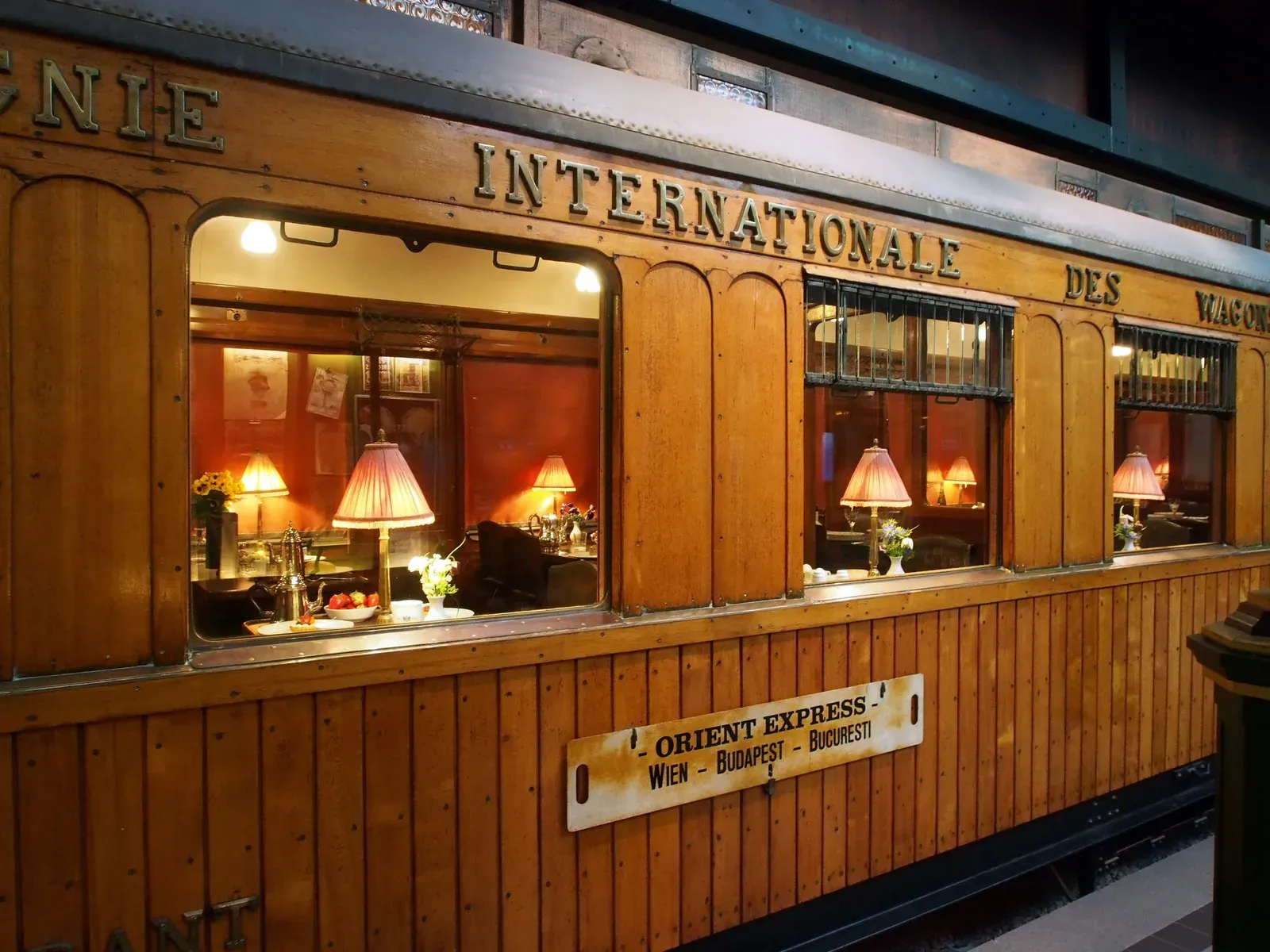
The first time the Orient Express set out from Paris, the dinner menu included oysters, turbot with green sauce, fillet of beef with château potatoes, game, and chocolate pudding. This was October 1882, a test run. Georges Nagelmackers - a Belgian banker’s son with a plan to connect the continent - had invited journalists and dignitaries aboard his Train Éclair de Luxe, lit the gas lamps, uncorked the wine, and sent the whole enterprise east towards Vienna to prove that it could be done.
The first regularly scheduled service followed on 5 June 1883. By the time the last one ran, on 14 December 2009, the company that shut it down was calling it “a victim of high-speed trains and cut-rate airlines.” It was a graceless epitaph. It was also accurate.
Nagelmackers was 27 when he conceived the idea. He had been to America, ridden Pullman’s sleeping cars, and come back to Europe frustrated. Continental rail travel was, for anyone attempting more than a few hundred miles, a sequence of border stops, gauge changes, and competing companies who owed each other nothing. His solution was the Compagnie Internationale des Wagons-Lits: a single international sleeping-car company that would operate its own carriages on other companies’ tracks, selling through tickets from one end of Europe to the other and keeping the experience consistent regardless of whose territory the train was crossing.
The ambition was enormous and it was essentially political. The route eventually ran from Calais to Constantinople - roughly 2,000 miles, crossing a dozen countries, threading through the Habsburg Empire and the fringe of the Ottoman one. By 1889, the first direct train made the Paris-to-Constantinople run in a single continuous journey of about 67 hours, with no change of carriage required. For the first time, you could board a train in France and wake up in the European East with your luggage intact and your dinner reservation honoured.
The mythology accrued in the 1930s, which were also - in retrospect - the last years that the original project was fully functioning. Three parallel services ran concurrently: the Orient Express proper via Munich and Vienna, the Simplon Orient Express via Switzerland and Italy, and the Arlberg Orient Express through Zürich. The clientele was the kind novelists reach for: royalty and their entourages, diplomats with sealed dispatches, businessmen travelling between Vienna and Istanbul, and a respectable underclass of intelligence officers who found the closed compartments and shifting borders professionally convenient. Agatha Christie had been stranded on board during a blizzard in 1929 and turned the inconvenience into a plot. Ian Fleming sent James Bond aboard in 1957. The train had become a setting - a compressed, moving version of the Europe it crossed.
What it was not, by then, was particularly stable. The Second World War interrupted services twice. When they resumed in 1945, the map of Europe had changed permanently. The Iron Curtain ran directly across the historical route. The Communist countries the train had previously passed through became ideological obstacles; the luxury Wagon-Lits carriages were progressively replaced by national railway stock as eastern European states took over their own rolling stock. By 1962 the original Orient Express had stopped running entirely. Only the Simplon Orient Express survived, replaced that same year by a slower service, the Direct Orient Express, running twice weekly to Istanbul and daily to Belgrade.
By 1977, it no longer went to Istanbul at all. The last direct Istanbul service ran on 19 May of that year, 94 years after the first. After that, the service contracted in stages: to Bucharest, then Budapest, then Vienna, then a Strasbourg-Vienna night train that connected to a TGV for the first leg. Each cut was announced quietly. Each cut removed a little more of the point.
On 14 December 2009, the Orient Express ceased to operate entirely. The announcement was not a ceremony. No heads of state attended. The name simply disappeared from European railway timetables, and a travel era ended the way most eras end: not with a dramatic finale but with a scheduling change that nobody noticed until it was already done.
There is now a Venice Simplon-Orient-Express, operated by a company called Belmond, running restored 1920s carriages on heritage routes around Europe. Tickets start at $3,262 per person. It is, by all accounts, beautifully maintained. But it is not the thing Nagelmackers built. It is a theatre version of it - the service sold as a luxury experience to people who want to feel like pre-war diplomats, rather than an actual means of getting anywhere. The distinction matters. The original Orient Express was serious European infrastructure; the revival is an expensive costume.
Accor, the French hotel group, bought the brand name from SNCF and restored 17 carriages from the 1920s and 1930s. A Paris-to-Istanbul route was announced for late 2026. The brand clearly retains commercial power, even after the thing it named has been gone for fifteen years.
What the brand cannot recover is what the service actually was: a daily connection across the full length of a confident, integrated, cosmopolitan Europe - from Calais to Constantinople, in sleeping cars with fixed dinner menus and well-pressed linens, passing through a dozen countries that had agreed, in the practical sense, to function as a single territory. That Europe went away long before 2009. Ryanair had its part in it. The Iron Curtain had a larger one. But the Orient Express, for most of its life, was evidence that the project had once existed - that there was a moment when a Belgian banker’s son could look at the entire continent, plan an oyster dinner somewhere east of Vienna, and feel confident enough to sell tickets.