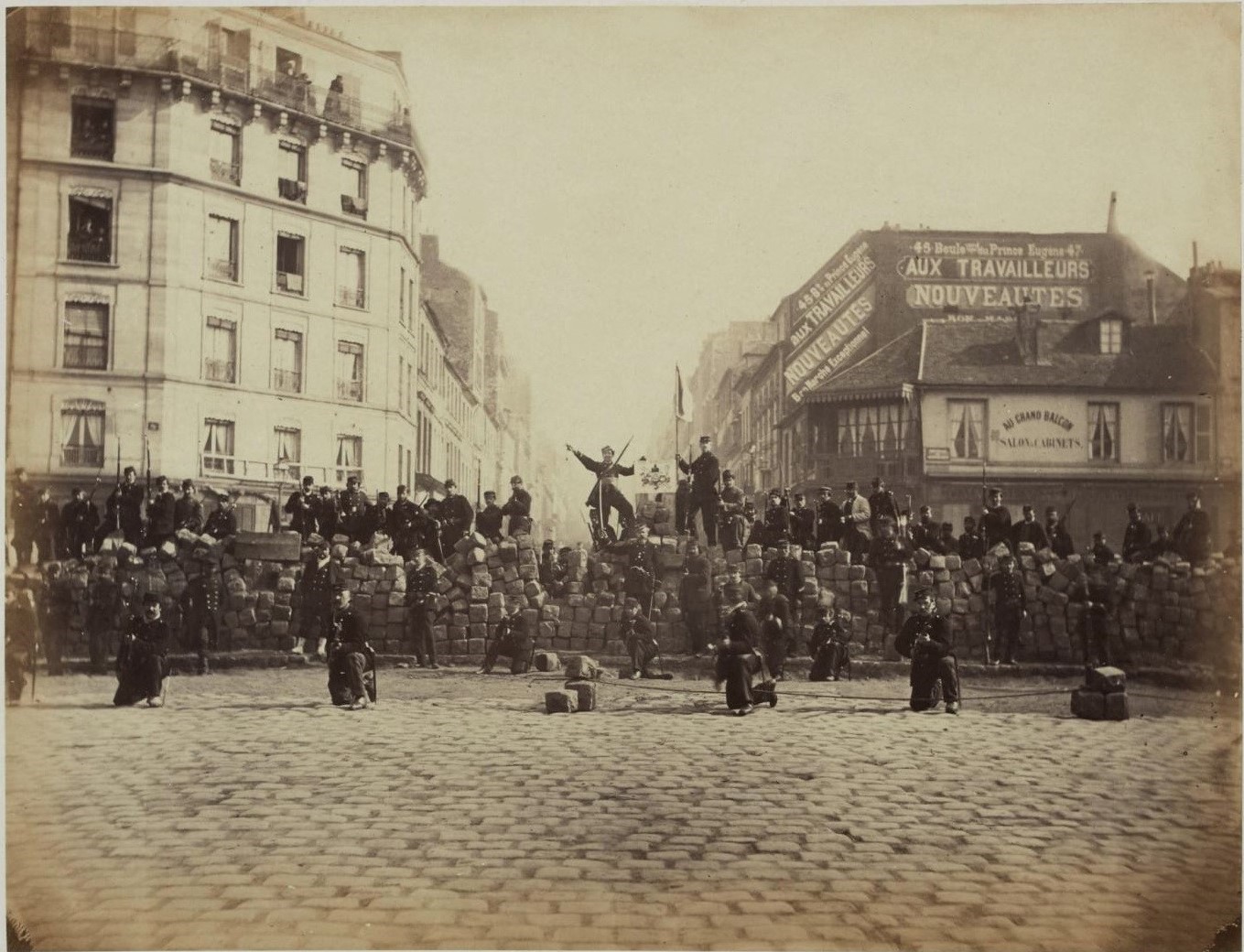
On the morning of 18 March 1871, two brigades of French soldiers climbed the hill of Montmartre before dawn, under orders from Adolphe Thiers, president of the new Third Republic, to seize 170 bronze cannons. The cannons had been dragged there by the working-class National Guard during the Prussian siege of Paris — paid for by public subscription, not the state — and they were positioned well above the city. Thiers had decided he wanted them back. By evening, both his operation and his government had left Paris.
The morning went wrong immediately. The soldiers reached the summit and secured the guns, but the horses needed to haul them away had not arrived. The delay cost everything. Word of the intrusion spread through the working-class streets of Montmartre. Women came out first, then men, then National Guard units from the surrounding neighbourhoods. The soldiers, demoralised from months of humiliation — France had just lost the Franco-Prussian War, surrendered Paris, and signed away Alsace and most of Lorraine to Bismarck — found the crowd’s appeals more compelling than their officers’ orders. General Claude Lecomte, commanding the operation, ordered his men to load their weapons and fix bayonets. He ordered them to fire. He gave the order three times, and each time the soldiers refused. Lecomte was seized by the crowd and taken under guard to the National Guard’s headquarters at the Château Rouge ballroom. A second general, Jacques Clément-Thomas — an ardent republican who had been arrested under Napoleon III and exiled, and who had come out that day dressed in civilian clothes to see what was happening — was recognised by a soldier and arrested. Both men were taken to a garden at 6 rue des Rosiers. By half past five, they were dead: forty bullets in Clément-Thomas, nine in Lecomte’s back.
Thiers ordered the withdrawal that afternoon — all forty thousand regular soldiers, the government ministries, the officials, the apparatus of the Third Republic — back to Versailles, twenty kilometres away. The National Guard filled the vacuum overnight. On the morning of 19 March, twenty thousand guardsmen were camped in front of the Hôtel de Ville. Someone ran a red flag up over the building. Paris was theirs.
To understand why the city was willing to be taken, it helps to know what Paris had been through in the six months before. The Franco-Prussian War, started by Napoleon III in July 1870 in a fit of imperial overreach, had ended in catastrophe. By September, Napoleon himself was a Prussian prisoner, his empire dissolved. A Government of National Defence declared a republic and resolved to fight on, but the Prussians surrounded Paris, cut the telegraph on 27 September, and began a siege that lasted four months. The temperature fell to minus fifteen in December. The Seine froze for three weeks. Parisians ate the animals from the city zoo, then ate rats. When the armistice came at the end of January 1871, the terms were punishing: five billion francs in reparations, the cession of Alsace and most of Lorraine, and the humiliation of a German victory parade through the capital. Paris had endured all of this under siege. The government had negotiated the peace from Bordeaux — five hundred kilometres away — and then settled itself not in the capital but in Versailles, the palace of kings, at a pointed distance from the Parisian street. The National Assembly it elected from rural, Catholic, conservative France had about four hundred monarchists and a hundred and fifty republicans. Paris had returned a different result: thirty-seven radicals out of forty-two seats.
The cannons on Montmartre were the focal point of a resentment that had been building since before the war. The National Guard had on paper 260 battalions, and the working-class battalions had done most of the defending while the middle and upper classes departed the city. The Central Committee that now ran the Guard had already voted to reject the authority of the commanders appointed by Thiers. When Thiers moved the government to Versailles, ended the moratorium on commercial debts — ruinous for workers and small tradesmen who had not earned a franc during the siege — and demanded Paris disarm, the confrontation was not accidental. It was the logical conclusion of months of class politics dressed up as military administration.
The Commune elected on 26 March governed Paris for seventy-two days. A 92-member council, chosen by proportional election at turnouts running above 65 per cent in the working-class arrondissements, introduced a programme whose radicalism shocked conservatives and inspired socialists in equal measure. Rents owed for the duration of the siege were cancelled. Night work in bakeries was abolished. Employers were forbidden to fine their workers. Any business deserted by its owner could be taken over and run by its employees. On 2 April, the Commune voted to separate church and state, seize ecclesiastical property, and convert Catholic schools to secular use. Twenty-six churches were closed; some were turned into political clubs. Within weeks, Nathalie Lemel — a socialist bookbinder — and Elisabeth Dmitrieff — a Russian exile and member of the First International — founded the Women’s Union for the Defence of Paris, demanding equal pay, the right of divorce, secular education for girls, and the abolition of the state-licensed brothels. Women built barricades, ran cooperative kitchens, and served in the National Guard. Louise Michel, who became the Commune’s most famous figure, had offered to shoot Thiers herself and would later dare the judges at her trial to sentence her to death. They sent her to New Caledonia instead.
None of it was secure enough to last. The Commune’s military structure was chaotic — officers were elected, orders disputed, strategy improvised. MacMahon’s army, rebuilt to 130,000 men from the prisoners of war released by Germany under the armistice terms, was better organised, better equipped, and motivated in ways that had nothing to do with ideology. On 21 May, a soldier inside the walls telegraphed MacMahon that the fortifications at the Porte de Saint-Cloud were undefended. Fifty thousand soldiers entered Paris by four in the morning and advanced to the Champs-Élysées before anyone rang the bells to warn the city.
What followed — seven days of street fighting, summary execution, and fire — was called La Semaine Sanglante: the Bloody Week. MacMahon’s troops had learned from 1848 how to take barricades without frontal assault; they tunnelled through adjoining houses, flanked, surrounded, forced withdrawal. As the army advanced from the west, Commune units set fire to the Tuileries Palace, the Hôtel de Ville, and the Palais de Justice — the last monuments of the governments they were losing. At Montmartre on 23 May, the army retook the same hill where the insurrection had begun, shot forty-two prisoners at the house on the rue des Rosiers where the generals had died, and executed three hundred more at a barricade near the Madeleine. On 27 May, at the Père Lachaise cemetery — the last Communard stronghold — the French Foreign Legion demolished the gates with cannon fire. The surviving guardsmen were lined up against a wall and shot. The wall is still there, still called the Communards’ Wall, and still visited annually.
The number killed in those seven days is still disputed. Cemetery records examined by historian Robert Tombs suggest between six and seven thousand buried in Paris. Jacques Rougerie, who once accepted higher figures, concluded in 2014 that “ten thousand victims seems the most plausible.” A 2021 study by the mathematician Michèle Audin put it at “certainly fifteen thousand.” MacMahon, asked at a parliamentary hearing whether the number might be seventeen thousand, replied only that “the insurgents lost a lot more people than we did.” The army took 43,522 prisoners; 13,500 were convicted, 95 sentenced to death, 1,169 deported mostly to New Caledonia. Edmond de Goncourt, watching the aftermath, wrote in his diary that the bloodletting had “killed the rebellious part of the population” and that “the old society has twenty years of peace before it.” He was almost exactly right.
Karl Marx had been watching from London. He began writing The Civil War in France during the Commune itself, and finished it within days of the last barricade falling. He called the Commune “the form at last discovered” for the emancipation of the working class — “Working men’s Paris, with its Commune, will be forever celebrated as the glorious harbinger of a new society.” In private, a decade later, he was more measured: writing to a Dutch friend in 1881, he called the Commune “simply the rebellion of a city in exceptional circumstances” in which “the majority … was in no way socialist.” But the public Marx was what moved history. The lesson he drew — that the working class could not simply inherit the old state machinery but had to smash it and replace it — became the central thesis of revolutionary Marxism. Engels called the Commune the first “dictatorship of the proletariat.” Lenin, who was seven years old when the Commune fell, spent his adult life studying it. On 19 January 1918, seventy-two days after the Bolshevik seizure of power in October, Lenin explicitly marked the date: his government had now outlasted the Paris Commune. He had calculated it in advance.
Thiers had looked at the Montmartre cannons and seen a military threat. He was not wrong, but the threat was not principally military. What he was really looking at, on that hill above the city in March 1871, was the question of who Paris belonged to — which France, the conservative rural France that had just elected a monarchist National Assembly, or the working-class Paris that had endured the siege while the bourgeoisie made arrangements elsewhere. He chose to resolve it by force, and in the short term he succeeded. The army retook Paris, shot its defenders at walls and in cemeteries, and deported the survivors to New Caledonia. The Commune was over in seventy-two days. The argument it was having, however, did not stop. It ran through Russia in 1917, through a century of revolutions and counter-revolutions, through a wall at Père Lachaise that people still come to visit. The soldiers Thiers sent up Montmartre before dawn could not seize the idea the cannons represented, because you cannot haul an idea away with horses.