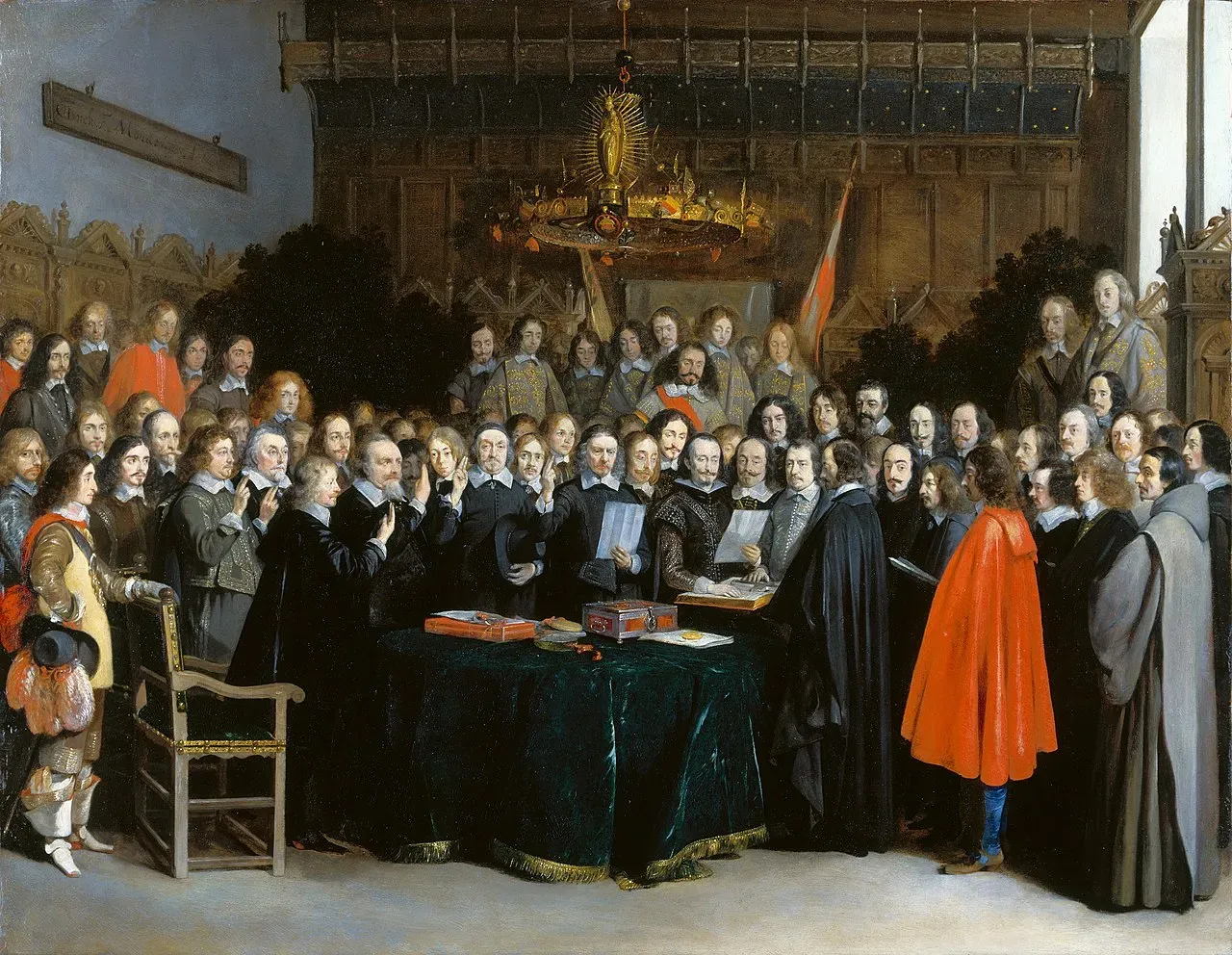
The Peace of Westphalia gets all the attention - the conferences, the academic industry, the entire theory of the sovereign state system. But the Peace of Westphalia, strictly speaking, is two treaties signed on 24 October 1648, and neither of them ended the longer war. That one finished earlier. On 30 January 1648, in the same German town of Münster where diplomats would spend the rest of the year arguing over the Thirty Years’ War, Spain signed a separate treaty with the Dutch Republic. Eighty years of fighting stopped. Spain conceded, in Article I, that the Netherlands was not and would never again be its territory.
The war had begun in 1568. William the Silent, stadtholder of Holland and Zeeland under the Spanish crown, led an armed opposition to Philip II’s campaign to enforce Catholic orthodoxy and centralised royal rule on the seventeen provinces of the Low Countries. What started as a revolt against the Duke of Alba’s Council of Troubles - which beheaded the Counts Egmont and Horne in June 1568 along with several hundred others - became a protracted war of secession. The seven northern provinces declared themselves the United Provinces in 1579 under the Union of Utrecht, and in 1581 formally renounced Philip as their sovereign through the Act of Abjuration. Spain did not accept the result. Four generations of Habsburg policy, across Philip II, III, and IV, treated the Dutch Republic as a rebellious dependency to be recovered.
The Twelve Years’ Truce of 1609 to 1621 was the first tacit admission by Madrid that the Dutch existed as an effective political entity, without conceding the point in law. When the truce expired, Philip IV reopened the war, confidently. It coincided with the outbreak of the Thirty Years’ War in Germany, which tied the Spanish treasury to campaigns in three theatres at once: the Dutch in Flanders, the Protestants through his Austrian cousins, and from 1635 against France. Olivares, Philip IV’s chief minister, had convinced himself that Spain could fight everyone simultaneously. He was wrong. By the early 1640s, Olivares had fallen from office, Portugal had rebelled and seceded under a new dynasty, Catalonia was in open revolt, and silver shipments from the Americas no longer covered the Army of Flanders’ payroll.
The decisive break was French. At Rocroi on 19 May 1643, a Spanish army under Francisco de Melo was destroyed by the Duc d’Enghien, and the Army of Flanders - whose tercios had been Europe’s premier infantry for a century and a half - was effectively broken as a strategic instrument. Spain could no longer win in the Low Countries. It could only prolong losing. Philip IV’s negotiators at Münster had instructions to settle with the Dutch on almost any terms, because the real war was now against France, and every soldier tied up in Flanders was one unavailable at the Pyrenees or in Italy. The irony, which did not escape contemporaries, was that by 1648 Spain needed peace with the Dutch more than the Dutch needed peace with Spain. The republic Madrid was trying to defeat had become, over the course of the war it was supposedly losing, the wealthiest state per capita in Europe, the largest ship-owner in the world, and the principal banking centre of the continent.
The treaty signed on 30 January did the obvious things. Article I recognised “the Lords the States General of the United Provinces … to be free and sovereign States, Provinces and Countries, upon which he” - meaning the King of Spain - “makes no pretension.” Every legal claim was abandoned. Territorial lines were drawn at positions held: the Dutch kept what they had conquered in Brabant, Flanders, and Limburg; Spain retained the southern provinces that became, eventually, Belgium. The Dutch received explicit permission to trade in the East and West Indies, which legitimised three decades of Dutch East India Company operations against Portuguese possessions now formally under the Spanish crown. Dutch ships could enter Iberian ports. Dutch merchants received favourable terms in Spain itself.
The quieter clause was the closure of the Scheldt. Antwerp, once the greatest port in northern Europe, was cut off from the sea by the Dutch forts at Lillo and Liefkenshoek, which blocked the estuary above the city. The blockade had been a de facto Dutch measure during the war. The treaty made it permanent. Antwerp could trade only by riverboat, and only down to the Dutch ports that had taken its business. Amsterdam had already overtaken it in size and commercial weight; the treaty formalised and locked in what the war had done. The Scheldt would not be reopened for seagoing traffic until 1863, by which point Belgium had been independent for thirty years and Antwerp was a shadow of the city that had been the commercial capital of the Habsburg Netherlands under Charles V. Two centuries of closure had given Amsterdam and Rotterdam an uncontested run at becoming the busiest trading axis in the world. They used the time.
The treaty was ratified at Münster on 15 May 1648, after rancorous debate in the States General - Zeeland refused to sign, preferring continued war - and an elaborate oath-taking ceremony between Spanish and Dutch diplomats who had spent years avoiding each other in the same corridor. Nine months later, in October, came the Peace of Westphalia proper: the twin treaties of Münster (between the Empire and France) and Osnabrück (between the Empire and Sweden) that ended the Thirty Years’ War. The Westphalian system - sovereign states as legal equals, religious choice as a matter of domestic authority, no supranational church or emperor with enforcement power - rests conceptually on the assumption that the principle had already been established somewhere else. It had. At Münster. In January.
What the Dutch had done was something unusual in early modern history. They had outlasted a superpower. Spain had more men, more territory, a longer institutional history, and access through Seville to the largest silver flows the world had ever seen. It lost because it could not afford to win in three places at once, and because the republic it was trying to crush had built a commercial system that generated more tax revenue per head each year than the Habsburg machine could extract from the Americas. The treaty that admitted this was signed in a German town by men taking their instructions from Madrid and The Hague. The generation of Dutchmen who signed it had grandfathers who had fought under William the Silent. Eighty years is a long time to keep a war going. Spain kept it going, in the end, because it could not think of anything else to do, and then it stopped.