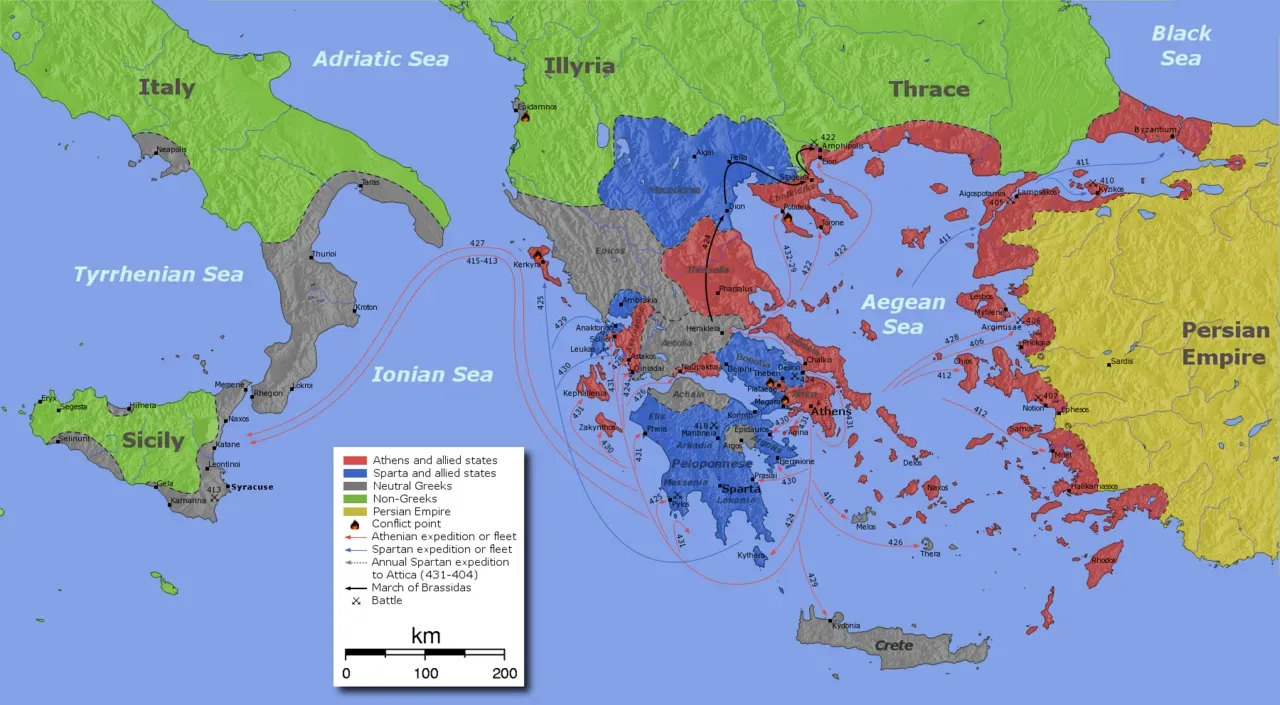
When Lysander sailed into Piraeus on 25 April 404 BC, someone brought out flute-girls. Xenophon records the scene in his Hellenica: the Spartan allies stood around announcing that this was the beginning of freedom for Greece, and the long walls of Athens - the fortifications that had connected the city to its harbour and kept it alive through twenty-seven years of siege, plague, and catastrophic military adventure - came down to music.
Corinth and Thebes, Sparta’s loyal allies through the whole war, demanded that Athens be destroyed entirely. Every man killed, every woman and child enslaved, the city levelled. Sparta refused - partly sentiment, partly calculation. A Greece with no Athens would be a weaker Greece, and someone had to deal with Persia. So instead, Athens lost its fleet, its walls, its overseas empire, and its democracy, replaced by a junta of thirty men that the Spartans installed and history has remembered as the Thirty Tyrants. They ruled for thirteen months, executed an estimated 1,500 Athenians, and were overthrown by a democratic counter-coup in 403 BC. Which is how Athens ended twenty-seven years of war: its walls demolished, its empire gone, its democracy briefly suppressed and then restored, and a city it could no longer afford to feed.
The war’s origins were well understood even by those living through them. Thucydides, who fought in the early campaigns and spent the rest of the conflict in exile collecting testimony from both sides, opened his history with the clearest statement of cause he could manage: “The growth of the power of Athens, and the alarm which this inspired in Lacedaemon, made war inevitable.” No conspiracy, no single incident, no individual villain. Fifty years of Athenian expansion - first against Persia, then against anyone who stood in the way - had built an empire in the Aegean that Sparta’s allies watched with deepening unease. Corinth, whose trade routes Athens was throttling with economic sanctions. Megara, under what amounted to a commercial blockade. The states of the Peloponnesian League, which had watched Athens absorb the Delian League’s independent members one by one and use their tribute to build the Parthenon.
The first ten years demonstrated why the war would take twenty-seven: the two sides could not hurt each other decisively. Sparta had the finest infantry in the Greek world and could devastate Attica every summer, but could not knock down the long walls or stop Athenian ships raiding the Peloponnesian coast. Athens had the finest navy and a maritime empire paying tribute, but could not force Sparta to fight at sea. Then the plague arrived. Between 430 and 426 BC, a disease - typhoid fever is the leading candidate, though no modern diagnosis is certain - killed somewhere between a quarter and two-thirds of the Athenian population. The range reflects genuine uncertainty. Among the dead was Pericles, who had designed the entire Athenian strategy of limited war and naval harassment. Athens kept fighting, but without its architect.
It kept fighting, and eventually made the decision that ended it. In 415 BC, Athens dispatched 134 triremes and more than twenty thousand men to conquer Syracuse in Sicily. The logic, as sold to the Athenian assembly by Alcibiades, was that Sicily would deliver extraordinary resources and those resources would fund the final defeat of Sparta. What actually happened was that Alcibiades was recalled mid-voyage to face charges of religious desecration, defected to Sparta rather than stand trial, and told the Spartans everything. The expedition, left under the cautious Nicias, spent two years being ground down. The survivors were enslaved in the stone quarries. Athens had spent its reserve fleet and a generation of soldiers in a single failed gamble.
It survived another decade through the stubbornness of its naval tradition and the disorganisation of its enemies. Between 410 and 406 BC, Athens won a string of naval victories and recovered much of its empire. Then it executed six of its admirals following a victory at Arginusae in which twenty-five ships and their crews were lost in rough seas - the generals’ crime being that they had not rescued the drowning sailors after the battle. Among those watching was Lysander, who had just been handed a Persian-funded fleet and who filed the lesson away.
At Aegospotami in 405 BC, Lysander destroyed 168 Athenian ships in a single afternoon. The ships were beached on the Hellespont while their crews foraged ashore. Athens had been cut from its grain route. By April 404 BC, there was nothing left but surrender.
The war transformed Greek warfare permanently and for the worse. Before 431 BC, conflict between city-states had been largely seasonal and conducted between citizen-soldiers in pitched battles. The Peloponnesian War introduced prolonged sieges designed to starve civilians, systematic enslavement of captured populations, and routine political violence during regime changes. The Athenian destruction of Melos in 416 BC was the clearest example: every male killed, women and children sold into slavery, because the Melians refused to abandon their neutrality. Athens - democracy’s great champion - did this during a truce. Thucydides recorded the Athenian justification with the deadpan that was his house style: the strong do what they can and the weak suffer what they must.
The broader consequence was that the war fought to prevent one power from dominating Greece ensured that all of them would eventually fall to an outside one. Sparta’s hegemony after 404 BC lasted thirty years before Thebes broke it at Leuctra. By 338 BC, Philip II of Macedon had absorbed the exhausted remnants. The golden age of classical Greece - the half-century of democratic experiment, philosophical innovation, and artistic ambition that produced the Parthenon, Sophocles, Socrates, and Thucydides himself - ended in a generation of self-destruction.
What survived was the record. Thucydides wrote his history expecting future readers to find it useful, noting that human nature remains constant and so does the pattern of events. He was right. The dynamic he described - a rising power alarming an established one, the established power deciding that pre-emptive war is safer than accommodation, both sides discovering that the war they chose is harder to end than it was to start - has been labelled the Thucydides Trap by modern political scientists and applied to every major great-power contest since. It remains unresolved, two and a half millennia later. The history gets read. The trap gets sprung anyway.
On 25 April 404 BC, the walls of Athens came down to the music of flutes. The Spartans said it was the beginning of freedom for Greece. Within a generation, Greece had lost that too.