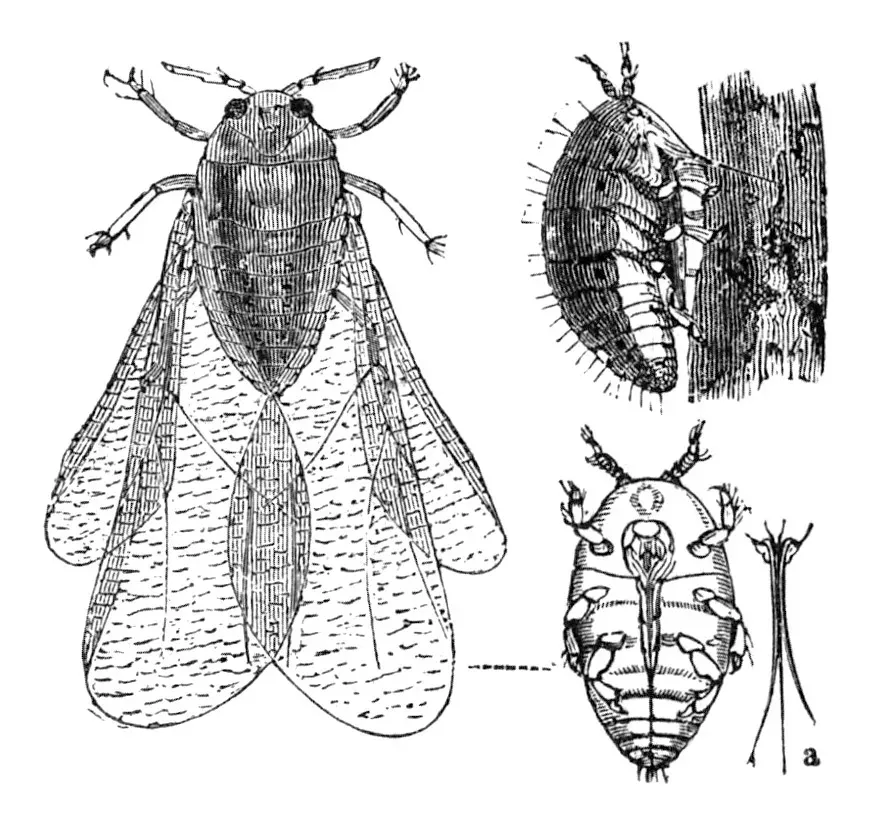
The wine you drink at a European restaurant is, in all probability, produced by vines planted within living memory of anyone born before the First World War. The idea that Europe’s vineyards are ancient - that the Burgundy in your glass descends in some unbroken line from vines worked by medieval monks - is a comfortable fiction. Almost all of them were replanted after the 1880s. The reason is a creature smaller than a sesame seed and uglier in its ambitions than almost anything else on the planet.
Phylloxera - Daktulosphaira vitifoliae - is an aphid-like insect native to the eastern United States, where it has coexisted with native grapevines for millions of years. It feeds on them in two ways. It can attack the leaves, producing characteristic galls, but the damage there is manageable. What it does to the roots is on another scale. The insect’s larvae attach to the root system, drill in, and drink. The wounds they leave behind do not heal cleanly. Pathogens - fungi, bacteria, a whole queue of opportunistic invaders - follow the larvae in through the lesions, and the vine begins to die from beneath the soil. The first sign visible above ground is usually yellowing leaves and declining yield. By then, the root system is already collapsing.
The insect arrived in Europe around 1858 to 1863, carried in on American vine specimens imported by botanists and nurserymen who were doing, by the standards of their time, perfectly reasonable things. Importing plant material for study and hybridisation was normal scientific practice. Nobody screened for microscopic insects living on the roots. The first confirmed outbreak was identified in the Rhône valley in 1863 by a botanist named Jules-Émile Planchon, who noticed that vines were dying in ways he could not initially explain. He found the culprit when he dug up a dying vine and examined the roots under a microscope. The insect was already there in enormous numbers.
From that first foothold, phylloxera moved fast. It spread through Bordeaux, through Burgundy, through the Languedoc. It crossed the Pyrenees into Spain and the Alps into Italy. By 1900, roughly 6.2 million acres of European vineyards had been destroyed - more than forty per cent of all French vineyards alone. Entire appellations that had been producing wine for centuries went silent. The economic damage was enormous; the cultural damage is harder to quantify but was real. Communities built entirely around viticulture over generations lost the thing they were built around.
What makes the situation stranger is that there was no cure then, and there is no cure now. This ought to be more surprising than it is. A century and a half of industrial chemistry, of pesticides engineered to kill insects down to the molecular level, and nothing reliably kills phylloxera in an established vineyard. The core problem is spacial. The insect lives underground, attached to roots that sit a foot or more beneath the surface. Delivering a chemical agent to that environment in concentrations high enough to kill the insect, while leaving the vine alive and the soil chemistry undisturbed, and without ruining whatever ends up in the bottle, is a problem nobody has solved. And there is a problem of detection. By the time a grower notices the symptoms - the yellowing, the decline, the small harvests - the infestation has usually been running for years, quietly, invisible, fatal - too late to do anything.
The solution the nineteenth century arrived at was not a cure. It was a workaround elegant enough to deserve a better name. American grapevines had lived alongside phylloxera for long enough to develop mechanisms the insect cannot simply overcome. Their roots release compounds that interfere with the insect’s feeding. Their tissue responds to wounding differently. They are not immune - phylloxera will colonise them too - but the damage is manageable rather than terminal. So growers began grafting European varietals onto American rootstocks, producing a plant with the roots of one species and the fruit-bearing canes of another. The Cabernet Sauvignon grows above the graft; the Vitis riparia or Vitis rupestris is what’s keeping it alive below ground.
The question this arrangement raises - and that it has been raising among wine enthusiasts ever since - is whether the wine tastes the same. The assumption behind grafting is that the graft union is essentially invisible to the fruit: that what you taste in a Pinot Noir reflects the vineyard, the weather, the winemaker’s choices, the age of the vines, and not the species of rootstock keeping everything alive underground. This is probably broadly true. It is not certainly true. The rootstock affects how water and nutrients move through the vine. It influences vigour, yield, and how the vine responds to drought. Whether it affects flavour in ways that are detectable in the glass is a question the phylloxera epidemic made almost impossible to answer, because it destroyed most of the control group. The old ungrafted vines that could have provided the comparison are largely gone.
A few pockets survived. Phylloxera, it turns out, dislikes sandy soils - the insect cannot easily move through loose sand to reach roots - and volcanic soils seem to offer similar protection. The old vineyards of Colares, on the Atlantic coast of Portugal, sit on sand dunes and were never affected. Madeira’s volcanic geology protected its vines. Parts of Cyprus and certain Greek islands have ungrafted plots of some age. Chile, which imposed strict quarantine on vine imports early enough, has vineyards that were never infected. These are genuinely unusual wines, produced from plants that have never been cut and reattached to something foreign. Whether they taste demonstrably different from their grafted equivalents is a debate that generates more heat than light, partly because the surviving ungrafted plots are producing from old varietals under specific conditions that cannot be easily compared with anything else. The variable you’re trying to isolate refuses to sit still.
The broader lesson is one that agriculture keeps learning and then forgetting. Phylloxera worked so effectively because it found millions of acres of the same plant, planted in dense rows, year after year. Monoculture is efficient. It allows specialisation, mechanisation, economies of scale. It also creates a target. A pathogen or pest that can exploit a single weakness gets access to everything, all at once, across an entire continent. The Irish potato blight of the 1840s was the same phenomenon in a different crop. The Panama disease that destroyed the Gros Michel banana in the 1950s - the variety that banana-flavoured candy still impersonates - was the same phenomenon again. Each time, the cause was the same: a vast acreage of identical plants, with identical vulnerabilities, sharing soil. Each time, the solution was not to rethink monoculture but to find a workaround and carry on.
The wine in your glass is very probably the product of vines planted by someone who remembered the plague, grafted onto roots from a continent that caused it. The monks whose cellars stocked the wines that phylloxera destroyed are four or five generations gone. The vineyards that replaced what they cultivated are now called old. Time passes, memory fades, and the comfortable fiction reconstitutes itself. The insect, meanwhile, is still there in the soil, still drinking, still waiting for a vine that somebody forgot to graft.