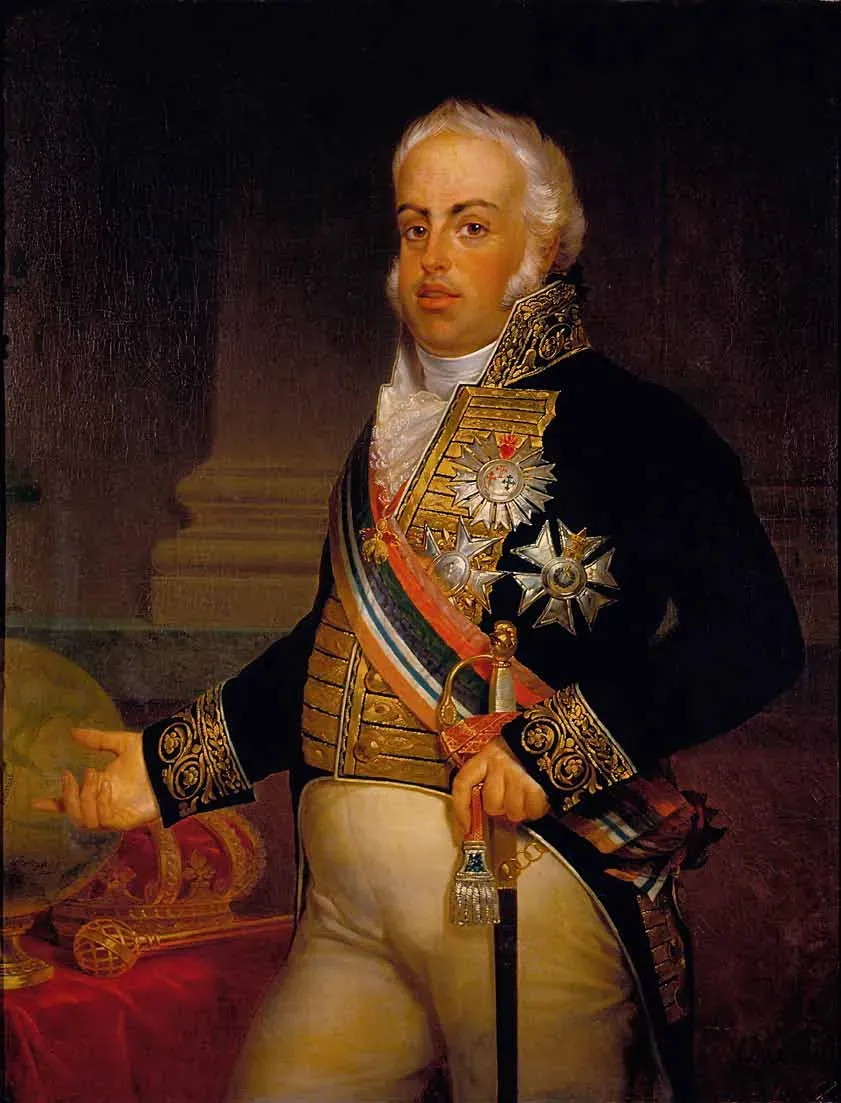
The normal arrangement between a European empire and its American colony was unambiguous: the empire governed; the colony produced. Portugal managed, in January 1808, to reverse this completely. When Prince Regent John arrived at Salvador with a convoy of thirty-six ships and roughly 15,000 court officials, nobles, clergy, servants and assorted hangers-on, the colony became the seat of the Portuguese Empire. Portugal, occupied by French troops, became the afterthought.
The sequence that led there started with Napoleon’s determination to enforce the Continental System - his embargo on British trade - across every European port. Portugal’s problem was that it had been in treaty alliance with Britain since 1386 and its economy ran on Atlantic commerce. In October 1807, Napoleon sent an ultimatum: close the ports to British ships, confiscate British property, arrest British subjects. John stalled, negotiated, stalled again. In November, General Junot marched a French army of 25,000 men across Spain into Portugal. On 27 November 1807, with the French advance guard already visible from the hills above Lisbon, the court boarded its ships. Junot entered Lisbon three days later to find the palace empty.
The crossing was appalling. The convoy hit Atlantic storms almost immediately and scattered. Queen Maria I - John’s mother, nominally still on the throne though incapacitated by mental illness - reportedly screamed throughout the voyage that she was being taken to be murdered. The fleet sailed for two months. On 22 January 1808, the first ships dropped anchor at Salvador, in the province of Bahia. The Prince Regent of Portugal had escaped Napoleon and arrived in Brazil.
What he did next was more consequential than the escape. Within six days of landing, John signed the Decree for the Opening of Ports to Friendly Nations. This ended, in a single document, three centuries of Portuguese trade monopoly over Brazil. Brazilian planters and merchants could now sell their sugar, cotton and hides directly to whomever would pay the most. “Friendly nations” was diplomatic language for one specific country: Britain, whose navy had escorted the convoy across the Atlantic and whose commercial interests in Brazil were plain. The British understood what they were being given. In 1810 they formalised it with a treaty setting preferential tariff rates for British goods entering Brazil at fifteen per cent - lower than the rates charged on Portuguese imports.
The court moved to Rio de Janeiro in March 1808, and the city’s transformation was immediate. A colonial port of roughly 60,000 people received fifteen thousand new residents who expected something closer to Lisbon. In the months and years that followed: the Bank of Brazil, the Royal Library (60,000 volumes carried from Lisbon), the Royal Botanical Garden, the Royal Military Academy, a royal press - Brazil had been forbidden its own printing press as an instrument of colonial control, and John abolished that restriction at once. Streets were widened. Public buildings constructed. An opera house commissioned. Rio began to look less like a colonial capital and more like what it was: the centre of the empire.
Portugal, meanwhile, spent six years as a battlefield. Wellington’s Peninsular War ground through the country from 1808 to 1814, at considerable cost to anyone who lived there. The Portuguese who survived French occupation found themselves governed, in the king’s absence, by a British general - William Carr Beresford, who commanded their army. Their king was in Rio, governing Brazil.
The resentment this produced inside Portugal was entirely predictable. When John finally returned to Lisbon in 1821 - seven years after Napoleon’s defeat had made the journey both possible and politically unavoidable - he was responding to a liberal revolution at home that had, among other demands, insisted the king come back. He went. But he left his son Pedro in Rio as regent, with instructions that if Brazil moved toward independence, Pedro should lead it himself rather than let it be taken by others. On 7 September 1822, Pedro declared independence by the Ipiranga river. Brazil had been the empire’s capital for thirteen years; making it a separate country was, at that point, less a rupture than a ratification.
The French invasion that set all of this in motion achieved nothing it intended. Napoleon sent Junot to capture the court and sequester the Portuguese fleet. He got an empty harbour, a burning resentment that contributed to a six-year war, and the destruction of an empire that had not previously been his to destroy. John took his fleet, his dynasty and his government across the Atlantic, and built institutions that outlasted his own return to Lisbon.
What is worth sitting with, looking back, is that those thirteen years in Brazil were not years of waiting. Governments in exile tend to sit on their hands, preserve what they have, and imagine they will restore things as they were. John governed, reformed, founded and built. The Bank of Brazil was not an emergency improvisation; it was a considered institutional creation. The Royal Library was not random cargo; it was the deliberate transfer of a monarchy’s cultural infrastructure. The Royal Botanical Garden still exists. By the time Pedro I declared independence, the state he was declaring independent already had a central bank, a legal press, a military academy and a library. He was not building a country from scratch. His father had already built it, not quite meaning to, over a decade of trying to make a colonial capital feel like home.
Brazil got everything. Portugal spent more than a decade as a colony of its own colony, then watched its largest overseas territory become independent and take most of the empire’s commercial future with it. Napoleon, who had started the whole cascade by sending an army into Lisbon in November 1807, managed to ensure that the one outcome he most wanted - the destruction of the Anglo-Portuguese commercial alliance - was instead locked in permanently, with better terms for the British than they had held before. The court that sailed too well to be caught ended up sailing too far to come back.