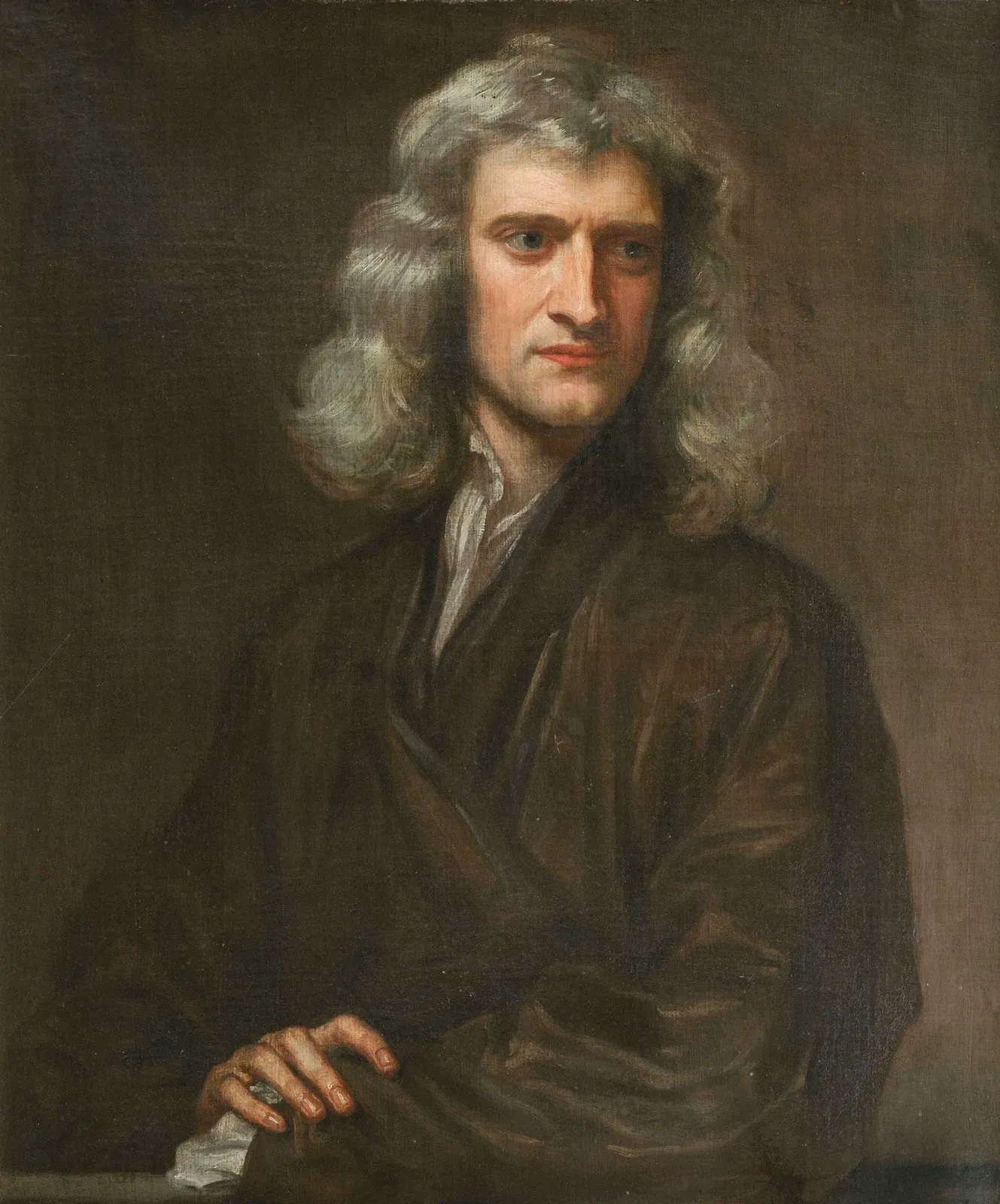
On 5 July 1687, the first bound copies of Philosophiæ Naturalis Principia Mathematica came off a London press, and almost nobody involved in producing it had the money to pay for it. The Royal Society, England’s official body for advancing science, had committed its entire publication budget the previous year to a lavish, heavily illustrated volume called De Historia Piscium - a history of fish. It sold badly. When the time came to print what would become the most consequential scientific book ever written, the Society’s coffers were empty. It fell to a thirty-year-old astronomer named Edmond Halley to pay for it out of his own pocket, and to talk its author out of cancelling the whole project halfway through, in a fit of temper, over a disputed sentence about a comet.
The book almost didn’t get written at all. In August 1684, Halley travelled to Cambridge to ask Isaac Newton a specific question that had been needling him and two other Fellows of the Royal Society, Robert Hooke and Christopher Wren, at a coffee house that January: if gravity pulled objects towards the sun with a force that weakened by the square of the distance, what shape would a planet’s orbit trace? Hooke claimed he already had the proof but declined to show anyone, which was fairly typical of him. Halley asked Newton directly. Newton answered immediately: an ellipse. He said he had worked it out years earlier and calculated it, but had misplaced the paper, and would send a fresh copy. What arrived that November was a nine-page tract, De Motu Corporum in Gyrum. Halley recognised at once that he was holding something much larger than an answer to a coffee-house wager, and he spent the following two years pushing, flattering, and occasionally begging Newton to turn it into a complete book.
Newton, once started, worked with the kind of absorption that made him forget meals. He expanded the nine pages into three books covering the laws of motion, the mathematics of orbits, and finally the application of it all to the actual solar system - the part he called “the System of the World.” Then, in the spring of 1686, with Book One already before the Royal Society for approval, Hooke resurfaced. He had mentioned an inverse-square relationship in a letter to Newton back in 1679, and he now wanted it on the record that the central idea of the Principia was partly his. Newton did not respond graciously. He went back through his manuscript and struck out nearly every reference to Hooke he could find, and threatened to withhold Book Three entirely rather than share credit with a man he had come to despise. It took Halley’s considerable tact - soothing letters, careful flattery, an appeal to what the finished work would mean - to get Newton to send the final book at all.
Then there was the small matter of paying for it. As Clerk of the Royal Society, Halley was owed a salary of £50 a year. With the Society’s funds tied up in unsold fish books, he was told part of that salary would instead be paid in copies of De Historia Piscium. He accepted the arrangement, financed the printing of the Principia himself, corrected the proofs, negotiated with the printer, and wrote a laudatory ode in Latin verse that ran as its preface. Newton got the credit. Halley got a stockroom of unwanted fish illustrations and, decades later, a comet named after him for a much smaller piece of work.
What came off the press that July was not an easy read, and Newton did not want it to be one. He said later that he had deliberately pitched it beyond the reach of casual critics, “to avoid being baited by little smatterers in mathematics.” The print run ran to a few hundred copies, in Latin, dense with geometric proofs rather than the algebraic notation that would make later physics textbooks tractable. Only a handful of people in Europe - Huygens in the Netherlands, Leibniz in Germany - were equipped to follow the argument on first reading. Most of Cambridge could not.
What the book actually did was collapse a division that had structured Western thought since Aristotle: that the heavens ran on one set of rules and the earth on another. Newton showed that the force pulling an apple to the ground and the force holding the moon in its orbit were the same force, governed by the same inverse-square law, expressible in the same equations. He derived Kepler’s empirical laws of planetary motion from first principles, rather than merely describing them. He laid out three laws of motion that remain, to this day, the working assumptions behind every bridge built and every car driven. The universe the Principia described was not mysterious. It was regular, mathematical, and predictable - a machine, not a mystery.
That single idea did more work outside physics than inside it. If the cosmos ran on discoverable, rational laws, Enlightenment thinkers reasoned, then human society probably did too. Voltaire, who spent three years in England and returned to France an evangelist for Newton, helped carry that argument into the political philosophy that fed directly into the American and French revolutions. The “clockwork universe” became the background assumption of an entire century, and it produced a spectacular practical vindication in 1846, when astronomers calculated the existence of Neptune purely from the gravitational wobble it caused in Uranus’s orbit, then pointed a telescope at the predicted spot and found it sitting there.
Newton’s physics held as the final word for over two hundred years, until Einstein’s relativity corrected it at cosmic scales and quantum mechanics corrected it at the subatomic one. Neither discovery made the Principia wrong, exactly - it made it a very accurate approximation, valid everywhere except the extremes. Every rocket sent to Mars is still plotted using Newton’s equations, not Einstein’s, because at that scale the difference doesn’t matter.
None of it happened because the system worked as intended. It happened because one Fellow of the Royal Society was stubborn enough to keep chasing an answer to a coffee-house bet, patient enough to manage the ego of a genius who wanted to bury Book Three out of spite, and broke enough that he ended up subsidising the future of physics with money he was owed and never quite got, in cash or in fish.