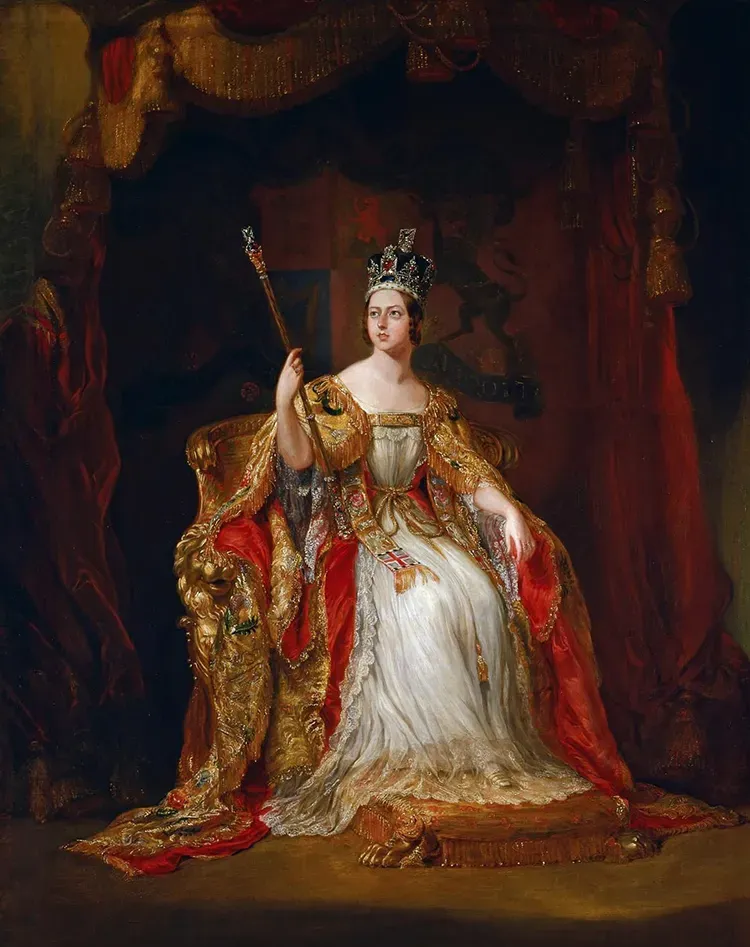
Victoria was woken at four in the morning by cannon fire. She was nineteen years old, and the guns were for her - the salute from Hyde Park announcing that London was already filling for her coronation. She got up at seven feeling “strong and well,” as she recorded in her journal. By eleven she was in the Gold State Coach, built for George III in 1762, moving through streets she estimated contained “millions” of her loyal subjects. She was not far off: an estimated 400,000 people had arrived in London from around the country in the days beforehand, many of them on the new railways, which could now shift large crowds between cities at speeds that would have seemed implausible a decade earlier. The coronation was the first public occasion to show what railways could do to a popular event.
The ceremony at Westminster Abbey lasted five hours and was, by general agreement of those present, a shambles. Benjamin Disraeli, watching from the gallery as a newly elected MP, noted that those officiating “were always in doubt as to what came next, and you saw the want of rehearsal.” The Archbishop of Canterbury forced the coronation ring onto the wrong finger so firmly that Victoria had to soak her hand in ice water afterwards to remove it. The orb was presented at the wrong moment in the liturgy. In what was nominally called St Edward’s Chapel, where the royal party retreated between segments of the service, Lord Melbourne found the altar covered with plates of sandwiches and bottles of wine. The historian Roy Strong later described 1838 as “the last of the botched coronations,” which is the kind of verdict that takes several subsequent coronations to earn.
Then Lord Rolle fell down the altar steps.
Henry Rolle, 1st Baron Rolle, was 82 and by his own description “dreadfully infirm.” He attempted the ceremonial ascent to do homage to the new queen, missed his footing, and rolled the length of the steps back to the floor. Victoria stepped to the edge of the platform to prevent him trying again. The Abbey was moved. Charles Greville, who was present and not easily moved, described it as “an act of graciousness and kindness which made a great sensation.” A nineteen-year-old queen, crowned no more than twenty minutes earlier, instinctively turned ceremony into human contact. You cannot coach that.
She would need that instinct. The historian Lucy Worsley has argued that, without Victoria’s personal popularity, the monarchy would have been “an institution in danger” at the time of her accession. Her predecessors had done real damage. George IV spent £240,000 on his own coronation - roughly £23 million in today’s terms - while his estranged wife was turned away from the Abbey doors by doormen following the king’s personal instructions. William IV reacted to the general embarrassment by staging the “Half-Crown-ation” on a budget of £30,000, and was so personally uninspiring that public republicanism, previously a fringe position, began to find a mainstream audience. Victoria came to the throne in 1837 as a Whig-associated teenager who had grown up largely away from court, insulated from the scandals of her uncles’ reigns. Melbourne’s coronation budget of £70,000 was a calibrated compromise between excess and indignity. It worked.
The larger story, though, is not about a ceremony or even an institutional rescue. It is about what sixty-three years of continuous reign does to a country and to an empire. Victoria died on 22 January 1901 as the longest-reigning British monarch on record - a record later broken only by Elizabeth II - and as Empress of India, a title she had held since 1876. That designation was the work of Disraeli, the same young MP who had sat in the Westminster Abbey gallery in 1838 making notes about the want of rehearsal. As Prime Minister for the second time, he pushed through the Royal Titles Act, conferring imperial status on a queen whose dominions by that point encompassed roughly 400 million people and a quarter of the world’s land surface. Victoria was delighted. She made Disraeli Earl of Beaconsfield the following year.
The personal losses shaped the public legacy in ways that remain visible. Albert died at Windsor Castle on 14 December 1861, aged 42, almost certainly from typhoid. Victoria wore black for the remaining forty years of her life. She withdrew from public duties so completely that republican sentiment, dormant since the early 1840s, revived in force: Charles Dilke stood in the House of Commons in 1871 and publicly questioned whether the monarchy was worth maintaining. She returned to fuller public engagement largely at Disraeli’s urging in the 1870s, and the Golden Jubilee of 1887 - fifty years after her accession - rehabilitated the monarchy’s public standing so thoroughly that it has not faced serious constitutional challenge since.
The question of what, exactly, was built on the foundations of that June morning in 1838 is not a simple one. The British Empire was an engine of extraction and exploitation that caused incalculable suffering across four continents; it was also the context in which large parts of the world’s modern institutional and legal infrastructure was laid down; it was also a fact of such overwhelming scale that its consequences are still being worked out. Victoria neither built it alone nor was she the passive figurehead she sometimes appeared to be in her later years. She was, rather, the fixed point around which it organised itself - the name it took, the reign it occurred within, the face on the coin.
I find it almost impossible to look at that June morning in 1838 and see in it the shape of what came after. A teenager woken at four by cannon fire. An archbishop fumbling with a ring. An old man rolling down the altar steps. None of it predicts six decades of rule, or a widow in permanent black, or the grandchildren of that nineteen-year-old occupying the thrones of Germany, Russia, and Greece simultaneously. But Victoria could not see it either. She knew only that she was queen, and that an old man was about to fall a second time.