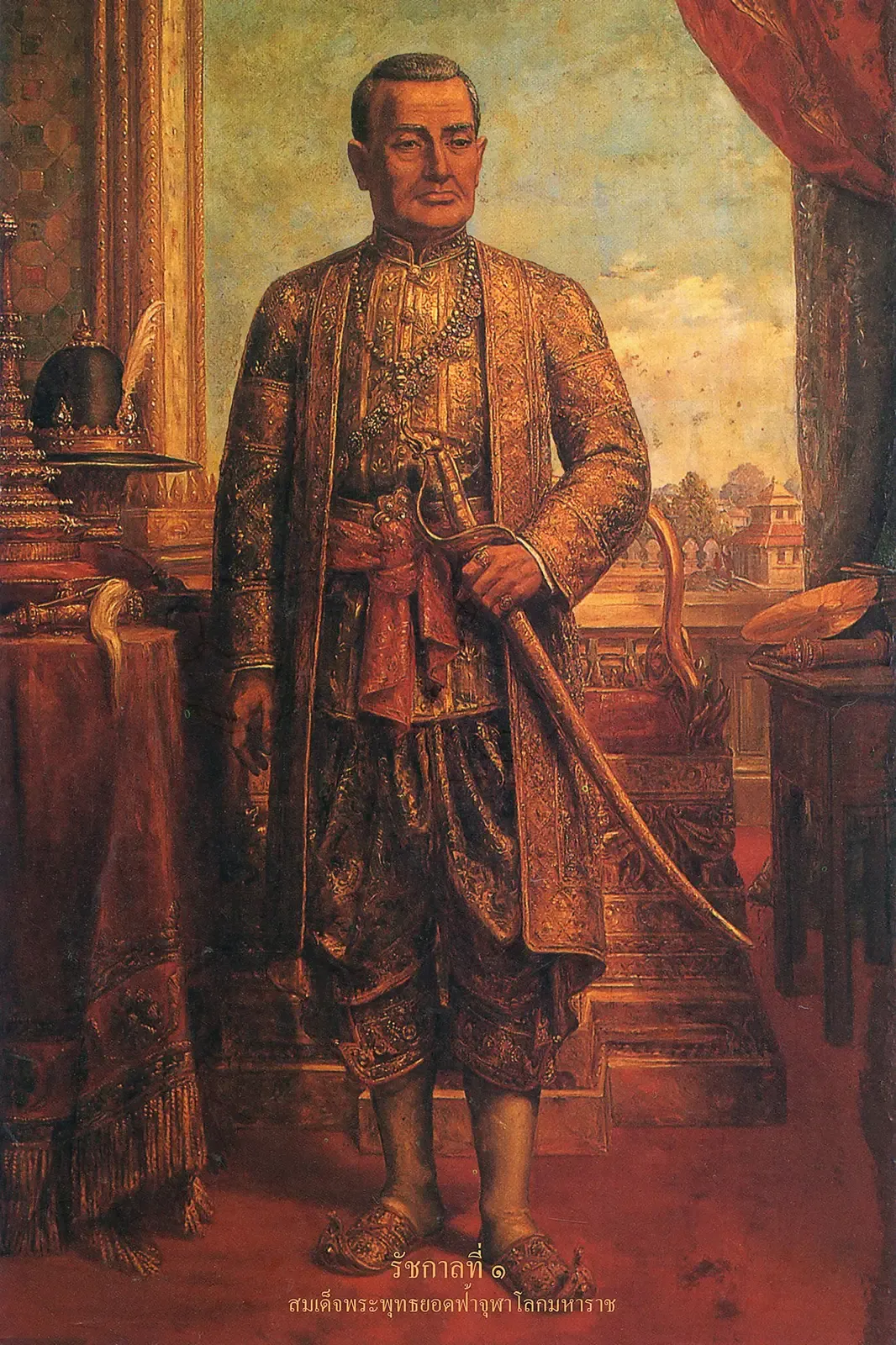
When Chao Phraya Chakri was crowned on 10 June 1782 in a pavilion on the east bank of the Chao Phraya River, the city he intended to build had not yet been named. The site was a trading settlement called Bang Makok - village of wild plums - across the water from Thonburi, where the previous king had ruled. Within a decade, the new king would raise a palace, a temple complex, and the legal foundations of a nation. The dynasty he founded that morning still reigns in Thailand.
The context for the coronation was the worst catastrophe in Thai history. In April 1767, a Burmese army under King Hsinbyushin completed a fourteen-month siege of Ayutthaya, the Siamese capital that had stood for 417 years. They burned the royal palace, stripped the temples, melted the gold from the Buddhas, and deported somewhere between 30,000 and 100,000 captives. The written records, the accumulated literature, the administrative structures of four centuries - most of it gone in weeks. Survivors scattered into the countryside. What the Burmese left behind was not a defeated state but the memory of one.
Taksin, a general of mixed Chinese and Siamese descent, reassembled enough of these fragments to expel the Burmese by 1770 and declared himself king at Thonburi. He was a genuine military talent who recovered Cambodia, northern Laos, and the Malay tributary states within a decade, fighting on multiple fronts simultaneously. But by 1782, rumours circulated that he had proclaimed himself a bodhisattva and was demanding that the monks of his kingdom prostrate before him. The nobility and the Sangha - the Buddhist monastic order whose endorsement gave Siamese kings their legitimacy - broke with him. A rebellion ended his reign. He was executed in the traditional manner reserved for royalty: sewn into a velvet sack and beaten with sandalwood clubs, to avoid the inauspiciousness of shedding royal blood.
Chao Phraya Chakri had commanded Taksin’s armies in Cambodia and returned to find the coup already underway. He was offered the throne and took it. The coronation on 10 June 1782 - he would take the regnal name Ramathibodi and is known to posterity as Rama I - was the founding of both a dynasty and a city.
The move across the river was deliberate in every detail. Thonburi’s west bank was defensible but constrained. The east bank had room, and better geography: the Chao Phraya’s wide westward bend formed a natural moat on three sides, while to the east stretched a swampy delta travellers called the Sea of Mud, almost impassable to an invading army. More than geography was at stake. Rama I was rebuilding a civilisation, and he wanted the new capital to announce the fact architecturally. The formal founding came before the coronation itself. On 21 April 1782 he raised the city pillar - a shaft of chaiyaphruek wood, set according to Brahmanical custom as the spiritual centre of the capital - and that date is still marked as Bangkok’s birthday.
The Chinese community already living on the chosen palace ground was moved downriver to Sampheng, which grew into the city’s Chinatown. He sealed Rattanakosin Island with canals that mirrored Ayutthaya’s own island layout - a spatial argument that this was Ayutthaya continued, not replaced. The walls that followed, built with bricks salvaged from Ayutthaya’s ruins and from Taksin’s old fortifications, ran four and a half miles, carried fourteen forts and sixty-three gates, and enclosed about one and a half square miles. Lao and Cambodian labourers dug the moats. Inside, most people lived along the water, many in floating houses; the canals were the streets.
Rama laid the city out on Ayutthaya’s pattern: Grand Palace and Front Palace by the river, royal temples beside them, the open field now called Sanam Luang in front, nobles’ houses south of the palace walls, government offices within. The Grand Palace and the Temple of the Emerald Buddha, completed in 1784 to house the most sacred image in Thai Buddhism, anchored the site as both political centre and ritual one. The Emerald Buddha itself had been taken from Vientiane in 1779, kept for a time at Wat Arun on the Thonburi bank, and then ferried across as a legitimising trophy - physical proof that the new king commanded divine favour. In 1785 he performed a full coronation and named the capital Rattanakosin, the Jewel of Indra. Foreigners kept calling it Bangkok anyway.
The military threats did not wait for the construction to finish. Burma attempted five more invasions during Rama I’s reign. The most serious came in 1785-86, when a force from nine separate armies advanced simultaneously from multiple directions - the Nine Armies War. Rama I co-ordinated the defence in person and turned back every column. It was the last time Burma attempted a full-scale invasion of Siam. The external frontier was settled within three years of the coronation.
The internal reconstruction took longer and went deeper. In 1788, Rama I convened a council of 218 monks and scholars to purify the Pali Canon, the scriptural foundation of Theravada Buddhism, which had been fragmented and corrupted since Ayutthaya’s destruction. The process lasted a year and produced an authoritative edition, re-establishing the alliance between the monarchy and the monastic order that had been the ideological spine of every Siamese state for centuries. In 1805, he oversaw the compilation of the Three Seals Law - the first comprehensive legal code in Siamese history, reconstructed from the surviving fragments of earlier Ayutthayan law. He sponsored the composition of the Ramakien, the Thai version of the Indian Ramayana epic, replacing the literary tradition the Burmese had burned. Every one of these projects had the same underlying logic: a state is not just its territory or its army, but its texts, its temples, its shared stories. Rama I rebuilt each of them.
He died in 1809, twenty-seven years after his coronation. In that time, he had turned a river-bank trading post into a capital, repelled the last major Burmese campaign, rebuilt the scriptural and legal foundations of the Siamese state, and installed a dynasty. The Chakri kings ruled as absolute monarchs until a bloodless coup in 1932 produced a constitutional monarchy, and the line has continued since - through military coups, constitutional crises, and the modern era. The dynasty is now 244 years old.
Ayutthaya’s fall in 1767 was a demonstration of how completely a state can be erased - not just defeated but unmade, its institutions destroyed, its records burned, its people dispersed. What Rama I understood, crossing the river on the morning of his coronation, was that a throne is the easy part. What lasts is everything built around it. Bangkok is still there, still the capital, still the seat of the dynasty he founded. It is also one of the most recognisable cities on earth: temples, street food, river traffic, and a skyline that somehow never quite swallows the old island. In 2024, Euromonitor ranked it the world’s most visited city, with more than thirty-two million international arrivals. He planted it on the other bank when the old world had gone, and it grew into a place the rest of the world can pick out of a photograph.