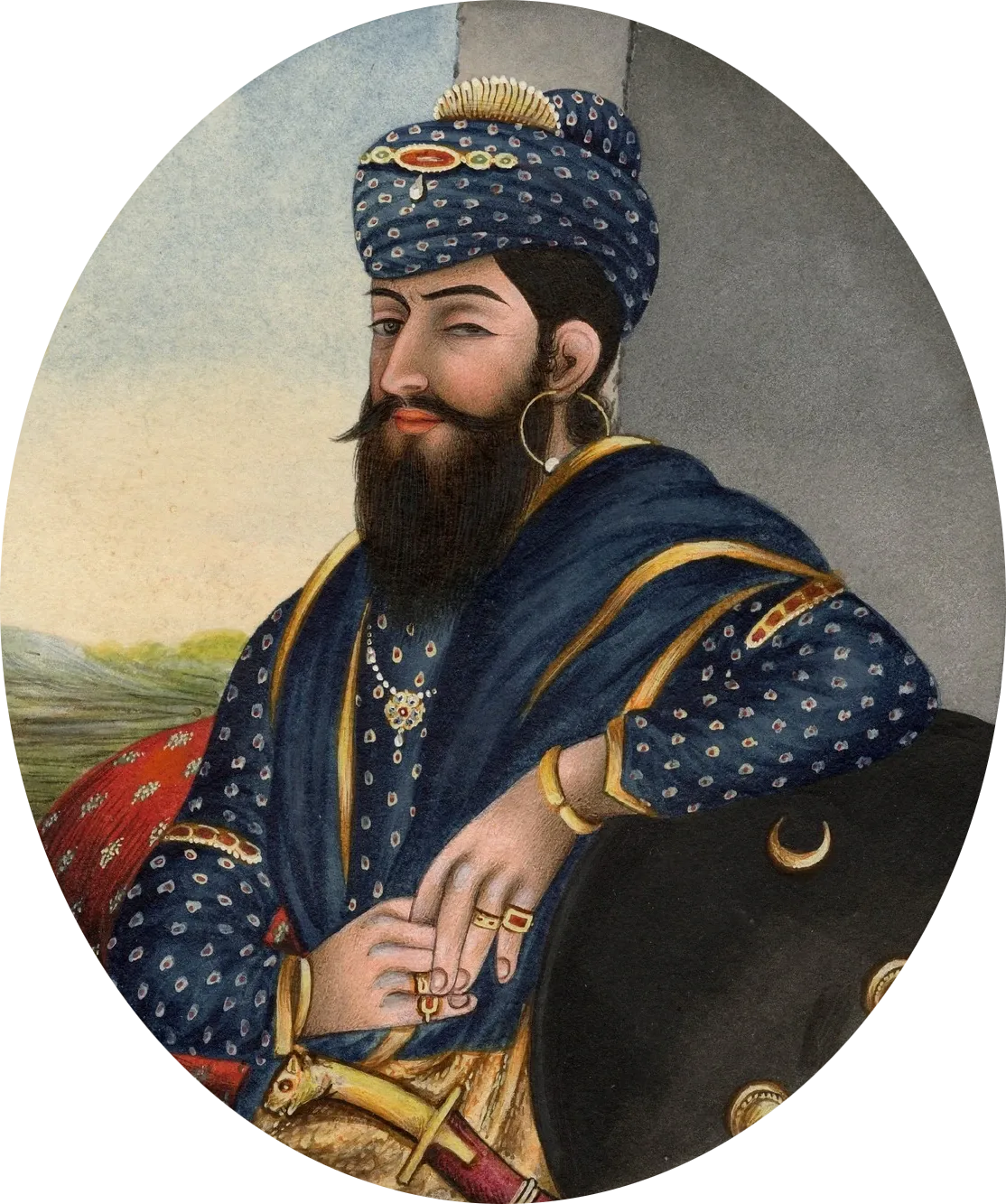
On 12 April 1801, the day of Baisakhi, a Sikh holy man named Baba Sahib Singh Bedi marked a young chief’s forehead with saffron paste in the Lahore fort and pronounced him Maharaja of Punjab. The new sovereign was twenty years old, blind in one eye from a bout of smallpox in infancy that had also pitted his face, and could not read anything beyond the Gurmukhi alphabet. He did not put his own name on the coins that followed. They were struck as the currency of “Sarkar Khalsa” - the government of the Guru’s own community - and carried the name of Guru Nanak instead. Mosques, temples, and gurdwaras across his territory offered prayers that same day for the long life of a king who had just declined, in the most literal sense available to him, to make the empire about himself.
The empire was real, though, and it was entirely his doing. Ranjit Singh’s father, Maha Singh, led the Sukerchakia misl - one of roughly a dozen sovereign Sikh confederacies then splitting Punjab between them - and died in 1792, leaving a twelve-year-old boy to inherit an estate he was in no position to run. Two regents filled the gap: his mother, Raj Kaur, and a minister named Lakhpat Rai, while a rival faction built around his own mother-in-law worked to undercut them both. Within five years, Lakhpat Rai had been assassinated by tribal enemies collecting old scores, and Raj Kaur was dead herself, whether from grief, poison, or her son’s own hand depends on which chronicler you trust. What is not in dispute is the outcome: by his late teens, Ranjit Singh had no regents left, and no misl small enough to need one.
He had also, by then, already married twice, and both marriages were transactions before they were anything else. He was betrothed at six to Mehtab Kaur, daughter of the Kanhaiya misl chief his own father had killed in battle - a match designed to paper over exactly that grievance, and one Mehtab Kaur never forgave once the muklawa brought her to his household in 1796. The marriage itself was a failure. What it delivered instead was her widowed mother, Sada Kaur, who took over the Kanhaiya misl and became Ranjit Singh’s most capable ally for the next two decades, commanding cavalry in his campaigns in her own right. A second marriage in 1797, to Raj Kaur of the Nakai misl - renamed Datar Kaur to avoid confusion with his own mother - worked rather better. She became his favourite wife and the mother of his eventual heir, Kharak Singh. Two marriages, two misls folded into his camp, and he was not yet seventeen.
Lahore fell to this combination of muscle and matrimony in July 1799. The city had been governed since 1765 by three quarrelling Bhangi chiefs, and when the Afghan king Zaman Shah invaded and then retreated, leaving the Bhangis looking weaker than ever, a group of Lahore’s citizens petitioned Ranjit Singh directly to take the city. He marched through the night of 6 July and attacked at dawn. Sada Kaur led a cavalry detachment through the Delhi Gate while Ranjit Singh took the Lahori Gate himself; the defenders barely resisted; his first act inside the walls was a visit to the Badshahi Mosque, a calculated gesture to the Muslim majority he had just inherited. Two years of consolidation later came the coronation, and with it a title that made official what the last decade of marriages, assassinations, and one very efficient siege had already accomplished.
Everything that followed ran on the same two engines. On the military side, he built the only indigenous force on the subcontinent that gave the East India Company genuine pause: the Fauj-i-Khas, trained by European officers he recruited on the explicit condition that they not be British, men like the Frenchman Jean-François Allard and the Italian Jean-Baptiste Ventura. His court ran on the same mixed principle - a Hindu prime minister, a Muslim foreign minister, a Brahmin finance minister, Muslim artillery commanders - and it worked well enough that nineteenth-century observers on all sides argued about whether he was a secular visionary or merely too pragmatic to care who served him, so long as they served well.
On the marital side, he never stopped. He took widows of a defeated Bhangi rival under his protection by the cloth-sheet rite of chādar andāzī in 1811, absorbing his enemy’s household along with his enemy’s territory. He married Rajput princesses from the hill states his armies annexed and, in 1802, a Muslim courtesan named Moran Sarkar, a match so unorthodox that the Akal Takht’s own commander hauled him in for public discipline - and let him go once the assembled pilgrims decided he’d been embarrassed enough. Sources disagree on how many wives he accumulated in total, anywhere from sixteen to thirty depending on who is counting and how generously the word “wife” gets used, but the logic behind every single one was the same: a marriage was a treaty with a person attached, and a person was worth more to Ranjit Singh than any parchment.
He died in his own bed in Lahore on 27 June 1839, worn down by years of alcohol, opium, and a stroke that had already half-disabled him. Four of his Hindu wives and seven concubines climbed onto his funeral pyre and committed sati, a practice his own faith rejected by scripture and one he had tried, without much success, to regulate through a legal code he commissioned for the purpose. It did not survive his own household’s example, and his empire did not long survive him either: without an heir capable of holding the jagirdars together, the throne changed hands five times in the decade that followed, through coups and assassinations, before the British annexed what remained in 1849. But for four decades, a man who could not sign his own name had built a state that Britain treated as an equal rather than a client - one married, mile by mile and misl by misl, into existence, and never once claimed as his in the metal that paid for it.