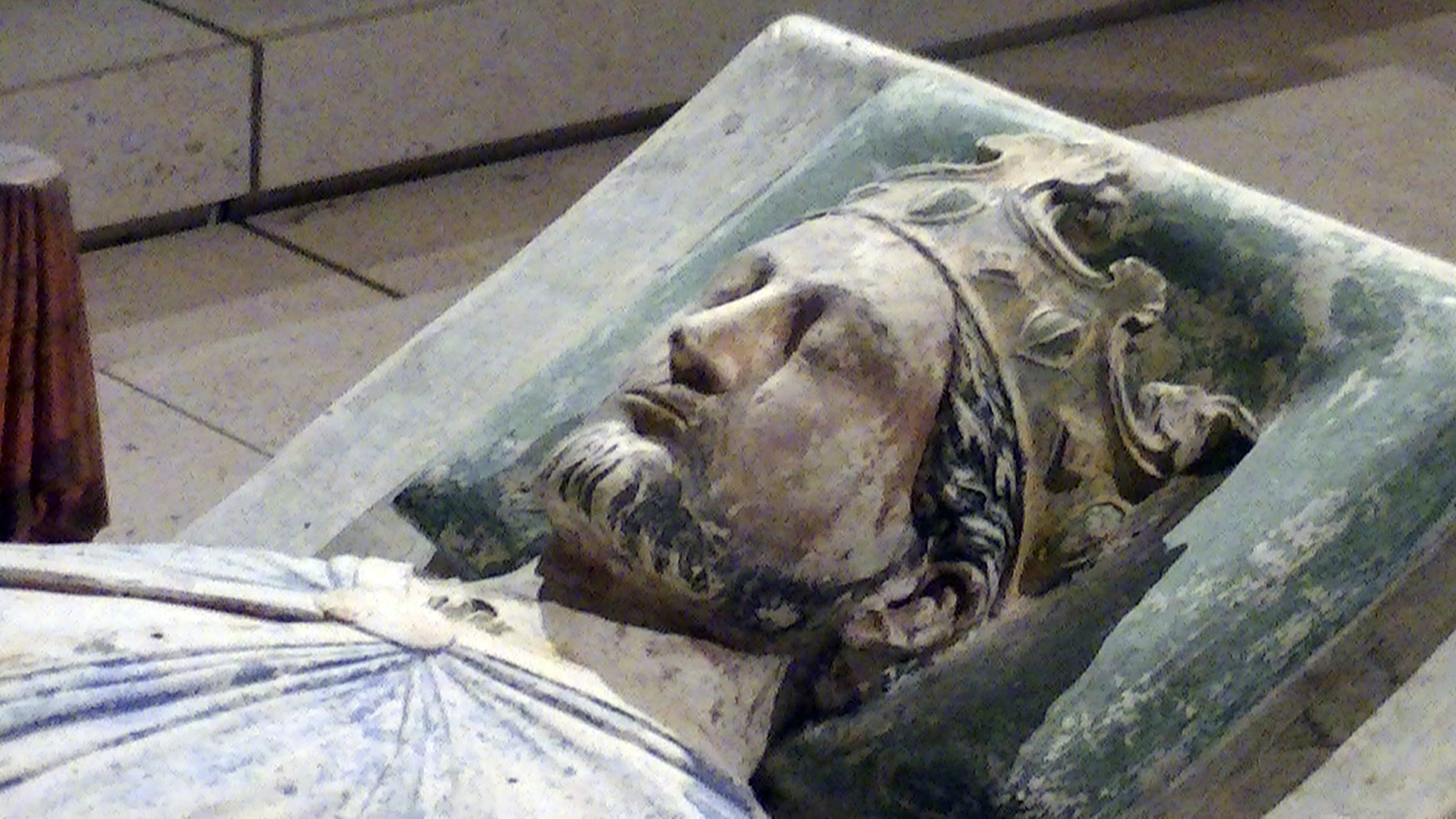
The greatest soldier-king of his generation died from a shoulder wound received at a siege so minor it barely rates a footnote. Not in the Holy Land, not fighting Saladin, not in some grand last stand for the Angevin Empire. At Châlus-Chabrol, a small castle in the Limousin, possibly in a dispute over a cache of buried Roman gold - a single crossbow bolt on 24 March 1199, eleven days of watching the wound turn gangrenous, and then death at forty-one in his mother’s arms. One of the chronicles records it almost as an aside: “the Lion by the Ant was slain.”
That line is not wrong.
Richard I - Cœur de Lion, the Lionheart - was born in September 1157 in Oxford, the third surviving son of Henry II and Eleanor of Aquitaine. He was never meant to be king. His elder brother Henry was crowned heir apparent; Geoffrey held Brittany; Richard was given Aquitaine, his mother’s duchy, and proceeded to spend his youth subduing it. He was commanding his own forces at sixteen, earning the name Lionheart in campaigns against the Charente Valley barons in the late 1170s. When his brothers allied against him in 1183, Richard and his army held them off and executed prisoners. He was not a gentle ruler of a gentle duchy. By the time Henry II died in 1189, Richard was a seasoned warrior.
He became king of England, duke of Normandy, and count of Anjou. He spent roughly six months of his ten-year reign in England. He sold titles, rights, and offices to fund what he actually cared about, and reportedly remarked he would have sold London if he could find a buyer. He appointed regents, left his brother John in nominal charge of arrangements he was already undermining, and set off for the Holy Land. The Third Crusade was the thing for him.
At the crusade he was genuinely exceptional. He defeated Saladin at Arsuf and Jaffa, captured Acre after a brutal siege, drove his army within twelve miles of Jerusalem twice - and retreated both times. The weather in November 1191 was appalling, the roads were mud, and the fear of being trapped by a relieving force while besieging the city was a rational one. The failure to take Jerusalem was not incompetence; it was a correct reading of a near-impossible position. Richard himself reportedly covered his eyes when his troops crested the hill that brought Jerusalem into view, unwilling to look at a city he could not capture.
He left the Holy Land in October 1192, never to return. Travelling home through Europe in disguise after storms wrecked his planned sea route, he was captured near Vienna by Duke Leopold of Austria - the same Leopold whose banner Richard’s men had torn down and thrown into the moat at Acre after an argument over precedence. Leopold sold him to Holy Roman Emperor Henry VI. The ransom was 150,000 marks, something like 100,000 pounds of silver, two to three times the annual income of the English crown. England was taxed at a quarter of all property values to raise it. Churches lost their gold plate. Eleanor, in her seventies, managed the collection. When Philip II of France heard that the money had been paid and Richard was free, he sent a message to Prince John: “Look to yourself; the devil is loose.”
Back in France by the spring of 1194, Richard spent the next five years fighting to recover territories Philip had seized during his captivity and trying to prevent the slow fracture of the Angevin holdings on the continent. He was winning. He built the Château Gaillard above the Seine - a fortification so architecturally innovative that military historians still discuss it, probably designed by Richard himself - and constructed an alliance of northern counts and princes to apply pressure on Philip from multiple directions. By 1198 and into 1199 the war was going his way. It was exactly the kind of campaign Richard understood, the kind he had been running since before he was twenty.
Then the revolt in the Limousin. Viscount Aimar V of Limoges had rebelled, and Richard moved to suppress it with his usual efficiency. At Châlus-Chabrol he found a small, lightly defended castle. Some chroniclers say a peasant had uncovered a hoard of Roman gold coins on the viscount’s land, which by feudal right belonged to Richard as overlord, and the garrison had refused to hand them over. Others are vaguer about the cause. What all sources agree on is this: on the evening of 26 March, Richard was reconnoitring the walls without full armour - careless, for a man of his experience - when a crossbowman on the battlements spotted him.
The bolt struck his left shoulder near the neck. The wound itself was survivable; the extraction was not. The shaft came free but the iron bolt-head remained in the flesh, and the surgeons who dug for it in poor light made the wound worse. Gangrene set in within days.
Richard asked to meet the man who had shot him. The crossbowman was brought before the dying king. He said that Richard had killed his father and two brothers, and that he had taken his shot in revenge. Some accounts call him Pierre Basile; others give different names; at least one source describes him as a boy. Richard pardoned him. He ordered the man freed and given a hundred shillings. It was, by any standard, a remarkable act of mercy from a man not previously associated with the quality.
He died on 6 April 1199 in his mother’s arms.
Mercadier, Richard’s mercenary captain, waited until the king was dead. Then he had the crossbowman flayed alive and hanged.
The body was divided by medieval custom: his heart at Rouen Cathedral, his entrails at Châlus, and the rest of him at Fontevraud Abbey, at the feet of his father - the same father Richard had spent most of his life fighting. He left no legitimate heir. His wife Berengaria had spent almost no time with him after their marriage in Cyprus in 1191, the union producing nothing and going nowhere; Richard acknowledged one illegitimate son, Philip of Cognac. He was succeeded by John, who would lose most of what Richard had spent five years defending and a king’s ransom recovering.
Steven Runciman, writing in the twentieth century, produced the verdict that has stuck: “a bad son, a bad husband, and a bad king, but a gallant and splendid soldier.” It is accurate as a summary of the man’s contradictions, though perhaps unfair to the complexity of what it meant to govern an Angevin Empire in the 1190s. Richard was not ignoring England out of frivolity. He was managing a vast territorial holding - from Scotland’s border to the Pyrenees - according to the priorities of that system. The crusade was not a distraction from governance; it was, from a twelfth-century perspective, the central obligation of a Christian king. He was also a poet, a patron of troubadours, and a man whose emotional intensity left a strange trace in the sources - the reported grief over Jerusalem, the song he composed in captivity at Dürnstein, the pardon given to a boy with a crossbow and a grievance.
The bolt does not care about any of this. What ended at Châlus-Chabrol was a life built almost entirely around military action, the personal performance of kingship through combat, and an inability to stop moving long enough to sit still and govern. Richard had been fighting since he was sixteen. He fought his father, his brothers, the barons of Aquitaine, Saladin, Leopold of Austria, Philip of France, and a long succession of Limousin lords. He was shot in the shoulder at a minor siege while strolling near a wall without armour, by a man with a personal grievance who was not going to get a better opportunity.
The Lion by an Ant. The irony is medieval, almost cosmic, and entirely deserved.