The counterintuitive thing about Roman expansion is how long it took Rome to bother with France. Gaul, as it was then called, lay directly to Rome’s north-west, separated from Italy by the Alps and, in the south, by barely anything at all - the coastal strip between the mountains and the sea was so narrow that a Roman army could march from Italy into what is now Provence without meaningful obstruction. Yet Rome had soldiers stationed in Spain for over a century before Julius Caesar crossed into Gaul. The reason has nothing to do with strategic preference and everything to do with Carthage.
In 218 BC, Hannibal Barca marched an army from Cartagena, in southern Spain, over the Pyrenees, through southern Gaul, across the Alps, and into Italy. He then proceeded to destroy three Roman armies in quick succession, including at Cannae in 216 BC, where roughly 50,000 Roman soldiers were killed in a single afternoon - the worst military defeat in Roman history up to that point. The Roman response was not to pursue Hannibal through Italy and wait him out, but to attack his base. Publius Cornelius Scipio - or rather his brother Gnaeus, to whom Publius delegated the Spanish mission after encountering Hannibal already crossing the Rhône - landed at Empúries on the Iberian coast in 218 BC specifically to cut off Hannibal’s supply lines and prevent his brother Hasdrubal from sending reinforcements north. Rome did not go to Spain to acquire Spain. It went to Spain because Spain was where the enemy came from.
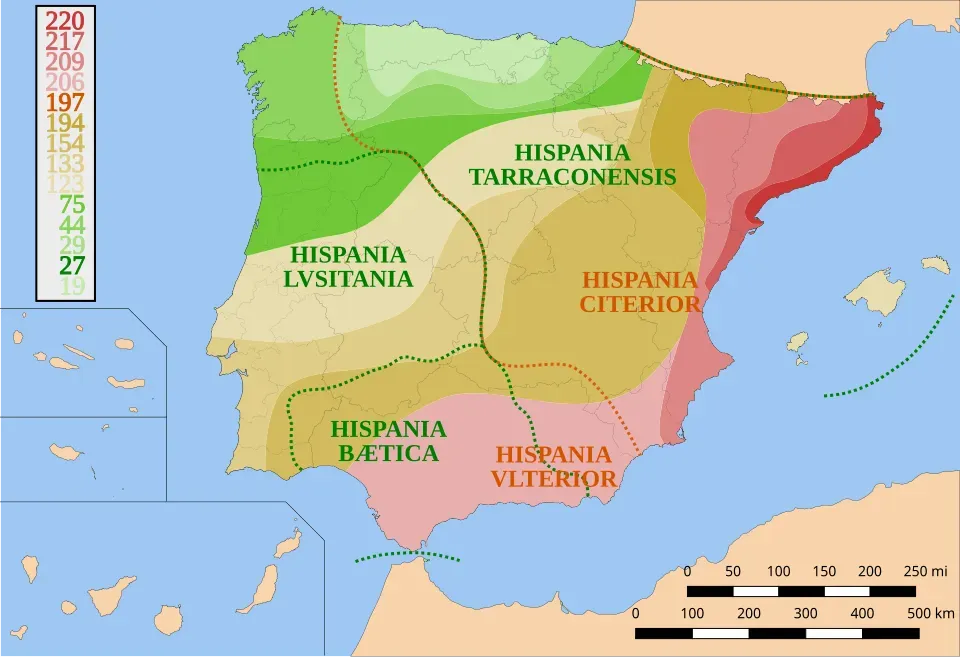
What followed was seventeen years of grinding, inconclusive warfare up and down the peninsula. Scipio’s father and uncle were both killed there, in 211 BC, after a Carthaginian bribe caused their Celtiberian allies to abandon them mid-campaign. The peninsula nearly fell back to Carthage entirely. Then Scipio the younger - the future Africanus, at that point just 25 years old with no formal command experience - was given the Iberian command, took Cartagena by surprise in 209 BC, and in the spring of 206 BC annihilated the last significant Carthaginian force in Spain at the Battle of Ilipa, near modern Seville. Carthage’s western empire evaporated. Rome was now standing in it.
The two provinces of Hispania Citerior (nearer) and Hispania Ulterior (further) were formalised in 197 BC - not because Rome had planned to add Iberia to its empire, but because, having won the war, it needed to administer the territory it was standing in. This is worth sitting with for a moment. Rome became the governing power in much of the Iberian Peninsula not through deliberate conquest but through inheritance. Carthage built the empire. Rome took it by fighting Carthage. The distinction matters because it explains why the Romans were in Spain at all rather than somewhere closer to home.
Gaul was a different proposition entirely. The coastal strip - what became Gallia Narbonensis in 123 BC - was pacified mainly to secure the overland route to Spain that Rome was already using. But Transalpine Gaul beyond that, the Celtic interior covering hundreds of kilometres of forest and river valleys, was not a Roman concern. It was not a Carthaginian concern either. Nobody had given Rome a reason to go there, and without a reason, Rome did not particularly want to. The Republic was not in the business of expansion for its own sake. It expanded in response to threats, rivalries, and the personal ambitions of its commanders.
Caesar gave himself that reason in 58 BC. The Gallic Wars were not a response to an existential threat or a grand strategic plan. They were a decade-long campaign conducted by a man who needed the money, the troops, and the victories that conquest would bring - and who had arranged an unusual ten-year command with which to pursue them. He fought Vercingetorix to a surrender at the siege of Alesia in 52 BC, and the bulk of the fighting was done. By 50 BC, Gaul was Roman. The Rhine to the Pyrenees, subdued in less time than Rome had spent fighting a single one of its Iberian wars.
Which brings us to the other half of the story, because Spain was not “conquered” in any ordinary sense before Gaul fell. Rome held its coastal provinces from 197 BC but the interior resisted for generations. The Celtiberian Wars of the 2nd century BC were brutal and unresolved; the siege of Numantia, a hilltop town in the central meseta, required Scipio Aemilianus to starve the place into submission over eight months in 133 BC - and when the garrison finally gave out, the survivors burned the town and themselves rather than walk in a triumphal procession through Rome. The Lusitanians of the west, led for a decade by Viriathus - a man the Roman sources describe as a shepherd who had watched his people massacred under a fraudulent peace agreement and who became, in response, one of the most effective guerrilla commanders Rome ever faced - held the Roman legions to a standstill on multiple occasions. Full control of the Cantabrian mountains in the north was not secured until 19 BC, under Augustus. That is 178 years after the Spanish provinces were formalised, and nearly four decades after Caesar had wrapped up Gaul in eight.
The pattern looks paradoxical only if you assume Rome was making coherent strategic decisions. It was not. Spain came first because Carthage had built its western empire there, and defeating Carthage meant taking it. Gaul came later because Caesar needed a war and Gaul was available. The interior of Spain resisted longer than all of Gaul combined because Iberian and Celtiberian tribes fought in dispersed, mobile formations, in terrain that negated Roman tactical advantages - the same meseta that baked the legions in summer and froze them in winter, where a supply line was a liability and a pitched battle was something the enemy simply declined to offer. Gallic confederations, whatever their courage, tended to mass their forces in ways that made them possible to destroy in a single decisive engagement. Caesar was good at those.
Rome’s presence in France is, in that sense, an artefact of late-Republican ambition: one man’s bid for the resources and prestige he needed to dominate Roman politics, dressed up as strategic necessity. Rome’s presence in Spain is something older and stranger - an empire that arrived to fight someone else’s war and found itself, after seventeen years, holding the territory it had come to deny its enemy. Carthage had built it. Rome had taken it. The taking took another two centuries to finish.
Hannibal crossed the Alps to destroy Rome. Instead, he inadvertently handed it the western Mediterranean.