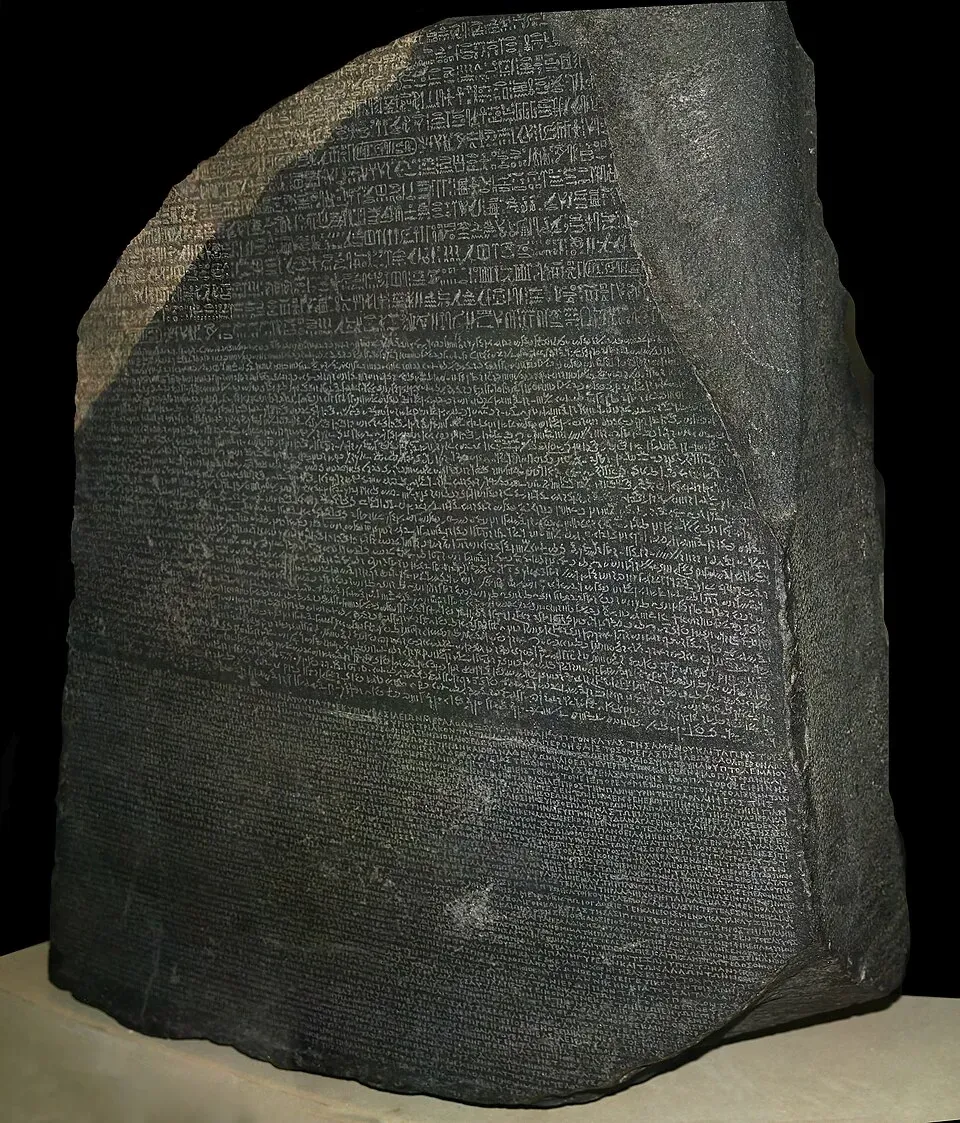
On 27 March 196 BC, a council of Egyptian priests assembled at Memphis and issued a decree. The Ptolemaic kings - Macedonian Greeks who had ruled Egypt since Alexander the Great’s conquests - had learned early that the native priesthood needed to be bought rather than coerced, and they paid regularly: tax exemptions, grain donations, temple restorations. In return, the priests endorsed the king’s legitimacy in the language their congregations understood. The Memphis decree was one of at least four such transactions the Ptolemaic dynasty had issued in the previous fifty years. Nobody present would have thought it more than a necessary administrative exercise.
The king being honoured was Ptolemy V Epiphanes, thirteen years old and already seven years into a reign that had started under catastrophic circumstances. His parents - Ptolemy IV and his sister-wife Arsinoe - had been murdered when Ptolemy V was five, their deaths arranged by a court faction led by the king’s mistress Agathoclea. Agathoclea and her family subsequently ran Egypt as regents until a mob in Alexandria lynched them two years later. The country was meanwhile losing territory on every front: the Seleucids had taken Coele-Syria, including Judaea, after the Battle of Panium in 198 BC; Philip V of Macedon had seized islands and cities in Caria and Thrace; and a native revolt in the south of Egypt, running since the previous reign, was not yet suppressed. The coronation at Memphis - delayed seven years because the priests had declined to crown a five-year-old - was as much a political transaction as a religious ceremony.
The decree records what each side was getting. Ptolemy had reduced taxes for the army and the general population, donated silver and grain to temples, rebuilt sanctuaries, granted amnesty to prisoners, and banned the impressment of sailors. In return, the priesthood would install cult statues of the king in every temple, establish two new feast days in his honour, and ensure that priests throughout Egypt celebrated him alongside the other gods. Then came the final clause: copies of the decree were to be placed in every temple across the country, inscribed in “the language of the gods” - hieroglyphs - “the language of documents” - Demotic, the everyday administrative script - and the language of the Ptolemaic government, Greek. A practical instruction. The literate priesthood read all three; the administrative classes needed the Greek; formal religious context required hieroglyphs. Nobody recording that clause was thinking about posterity. They were thinking about distribution.
The stone carrying one of those copies ended up in a temple - probably at Sais, in the western Nile Delta - until around 392 AD, when the Emperor Theodosius I ordered all non-Christian temples closed. In the six centuries between the Memphis decree and that edict, Egypt had been remade beyond recognition. Alexander’s successors gave way to Rome in 30 BC; Rome converted to Christianity; Arab armies would arrive in 641 AD, bringing Islam and eventually Arabic as the language of daily life. The native tongue survived into Coptic, but the scribal class who had maintained the knowledge of hieroglyphs - the very priests who inscribed the Memphis decree - had long since disappeared. The last known hieroglyphic inscription was carved at Philae in 394 AD, two years after Theodosius closed the temples. When the priests went, so did the knowledge. By the time the stone was being broken for building material in the fifteenth century, not a person on earth could read it. Its largest fragment ended up in the foundations of a fortress built by the Mamluk sultan Qaitbay near the Nile port of Rashid - known to Europeans as Rosetta. There it sat for another three centuries, doing the work of a wall.
In July 1799, during the Egyptian campaign, French soldiers strengthening the defences of Fort Julien near Rosetta were demolishing an old wall when they uncovered a dark-grey slab covered in inscriptions. Lieutenant Pierre-François Bouchard saw it might be significant and reported it up the chain of command. Napoleon had brought 151 scholars and scientists with his Army of the Orient, and within days one of them noted that the slab appeared to contain three versions of the same text. Lithographic copies were dispatched to Paris. The journalist who reported the find in the occupation’s official newspaper wrote that the stone might “one day be the key to deciphering hieroglyphs.” People thought that the prediction was too optimistic. It turned out to be correct.
When the British defeated the French in 1801, the stone transferred hands under the Capitulation of Alexandria. Colonel Tomkyns Hilgrove Turner later claimed he had personally seized it from General Menou’s baggage on a gun-carriage. It arrived in Portsmouth in February 1802 aboard the captured French frigate HMS Égyptienne. The inscriptions painted on its sides today still read “Captured in Egypt by the British Army in 1801” and “Presented by King George III.” It has been in the British Museum since June 1802, and is now its most visited single object - more popular than any Greek vase or medieval manuscript, more visited than the Elgin Marbles in the next gallery.
The decipherment took another twenty years. Thomas Young, a British polymath, made the first real breakthrough in 1814: he identified phonetic characters in the hieroglyphic cartouches spelling out the name Ptolemaios, and noticed that the hieroglyphic and Demotic scripts shared as many as eighty structural similarities - previously they had been assumed entirely different. Jean-François Champollion, a French scholar who had been studying Coptic since childhood, pushed further. In September 1822, working from the Rosetta Stone’s hieroglyphic text combined with inscriptions on the Philae obelisk - where the names Ptolemaios and Kleopatra appeared in both scripts - he reconstructed a phonetic alphabet for hieroglyphics and announced his findings on 27 September 1822 to the Académie royale in Paris. Within a year, he had identified the names of Ramesses and Thutmose at Abu Simbel, confirming that phonetic characters applied to all Egyptian names, not just Greek ones. Three thousand years of Egyptian writing was suddenly readable again.
The Young-Champollion rivalry outlasted both men. British critics accused Champollion of plagiarising Young’s work; the accusations were translated into French and published as a book in 1827. Young reasserted his contributions in 1823. Both died young - Young in 1829, Champollion in 1832 - without settling the question. Decades later, visitors to the British Museum complained that Champollion’s portrait was smaller than Young’s on a nearby information panel. English visitors complained the opposite. The portraits were the same size.
The stone itself had one more adventure. In 1917, German bombing raids targeting London prompted the British Museum to move its portable valuables underground. The Rosetta Stone spent two years fifteen metres below ground in a Post Office underground rail tunnel near Holborn. It has left the British Museum only once since, for one month in 1972, displayed at the Louvre on the 150th anniversary of Champollion’s announcement. Egypt has been asking for it back since 2003. The British Museum, along with thirty other major institutions, signed a joint statement in 2002 arguing that objects “acquired in earlier times must be viewed in the light of different sensitivities and values reflective of that earlier era.” John Ray, a Cambridge Egyptologist, noted dryly: “The day may come when the stone has spent longer in the British Museum than it ever did in Rosetta.”
“Rosetta Stone” has entered the language as a phrase for any small, representative thing that unlocks a much larger one. A 1902 chemistry paper applied it to glucose analysis; H. G. Wells used it in a 1933 novel; Nobel laureate Theodor Hänsch called the hydrogen spectrum “the Rosetta Stone of modern physics”; the European Space Agency named a comet-chasing spacecraft after it. The priests who issued the Memphis decree had no such ambitions. They were completing a transaction - cult worship exchanged for tax breaks, written in three scripts so that every literate Egyptian in the country would know exactly what the young king had done for them. History, characteristically, had other ideas.