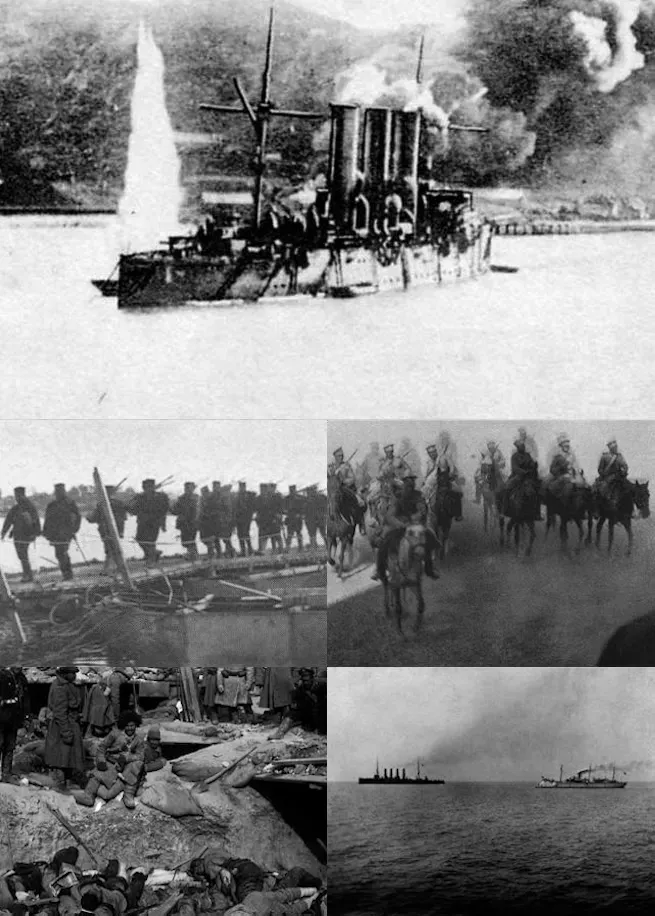
On the night of 8 - 9 February 1904, before any formal declaration of war, Japanese destroyers struck the Russian fleet at Port Arthur. That is the unofficial beginning of the Russo-Japanese War, and it exposed more than a military imbalance in Manchuria. It exposed a hierarchy of assumptions. In Europe, the default view was that an Asian power could modernise to a point, fight with discipline, and still lose once a “real” empire pushed back. Japan demolished that fantasy in eighteen months.
What happened was not a miracle. It was statecraft. Meiji Japan spent decades doing the unglamorous work that wins modern wars: reforming the bureaucracy, building industry, professionalising command, and learning from foreign models without becoming a copy of any one of them. Russia did almost the opposite. It relied on prestige, mass, and inherited status while underestimating an enemy that had prepared seriously for exactly this fight. Geography hurt Russia, yes. The war was fought at the far eastern edge of its empire, far from its industrial core and dependent on long, fragile supply lines. But distance alone does not explain why an empire with vast resources looked so administratively clumsy and strategically slow.
The campaign kept proving the same point. Japan landed troops efficiently, sustained operational tempo, and forced Russian armies into reactive warfare. At Mukden, Russia fielded enormous numbers and still failed to shape the battle. At sea, the humiliation became total. In May 1905, the Baltic Fleet, sent on a grotesquely long voyage around the world, was annihilated at Tsushima by Admiral Togo’s navy. You can lose a battle because the enemy is better on the day. You lose like that when the system behind you is broken.
I think this is the real lesson of 1904 - 1905: defeat on the military front became a diagnostic test on the home one. The war did not invent Tsarist corruption or incompetence. It made both impossible to deny. Procurement failures, patronage appointments, brittle command culture, and a court insulated from reality all came into view at once. The shock fed directly into the 1905 Revolution - strikes, mutinies, mass protest, and a monarchy forced into concessions it neither believed in nor intended to honour for long. The regime survived the immediate crisis, but in a damaged state.
That damage mattered in 1914. When the First World War imposed a much larger stress test, the same structural weaknesses reappeared at scale: logistical failures, military mismanagement, and political paralysis at the centre. The Romanov system collapsed in 1917 under pressures that had been visible since the war with Japan. In that sense, Port Arthur and Tsushima were not side stories before the “main” Russian tragedy. They were the warning shot.
There is one more point worth making. Japan’s victory was heard far beyond St Petersburg. Across Asia, and across colonised societies more broadly, it signalled that a non-Western state could defeat a European great power in modern industrial war. That did not end empire overnight, but it cracked the myth of European invincibility. Russia should have treated 1905 as a final chance to reform seriously. It patched, postponed, and carried on. History, as usual, sent a bigger bill later.