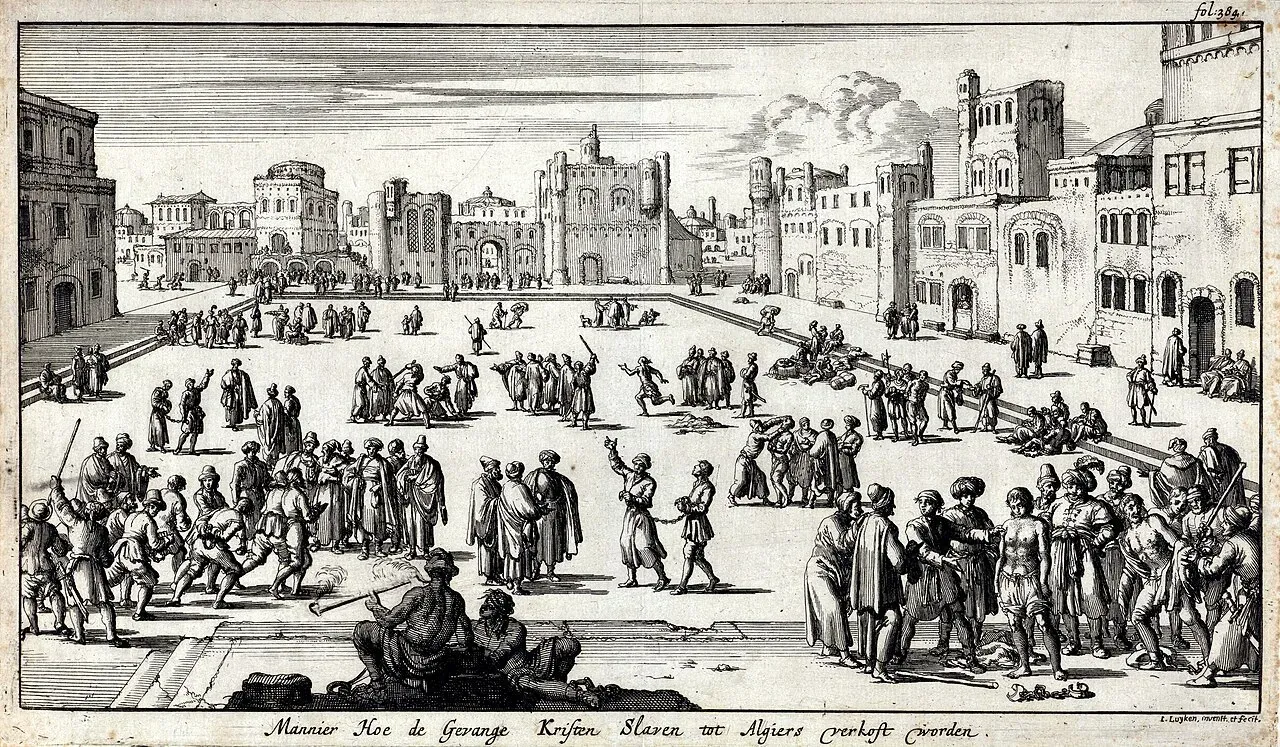
The people of Baltimore were asleep when the boats arrived. In the early hours of 20 June 1631, roughly two hundred corsairs came ashore on the coast of County Cork, divided into two columns, and moved through the village in the dark. They worked quickly. By the time the sun was up, around 107 men, women, and children had been loaded onto ships and were at sea. The village behind them would remain effectively abandoned for a generation.
The man who led the raid was not an Ottoman or a North African. He was Dutch. Jan Janszoon van Haarlem had been a privateer in the North Sea before he crossed into the other side of the Mediterranean equation - accounts disagree about whether he was captured first or went willingly - and by 1631 he was operating as Murad Reis, one of the most effective corsair commanders of his generation. He had already struck Iceland in 1627, taking some 400 captives from the Westman Islands. Baltimore was a target of opportunity: a prosperous fishing settlement on a sheltered harbour, populated largely by English Protestant settlers from the Munster Plantation, with a minority of local Irish Catholics. Someone had to give him the precise approach in the dark. Local tradition names a Dungarvan fisherman called John Hackett as the pilot who guided the ships in. Hackett was later found, tried, and hanged. The corsairs were long gone.
Baltimore was one incident in an operation of considerable scale. Between roughly 1530 and 1780, Barbary corsairs from the North African ports of Algiers, Tunis, and Salé enslaved somewhere between one and one and a quarter million Europeans. The historian Robert Davis, whose work on the subject is the most thorough, calculated that this figure at times exceeded the simultaneous volume of the European transatlantic slave trade. These were not isolated raids; they were a sustained, organised system. Coastal communities from the Canary Islands to Iceland lived under permanent threat. Spain, Italy, and England supported redemptionist religious orders whose entire purpose was raising ransoms. The ransoms rarely arrived in time.
The Baltimore captives were mostly English, which created an awkward diplomatic problem. The crown under Charles I was at that moment negotiating a trade agreement with Morocco - not the ideal political context for demanding the return of 107 English Protestants seized as cargo. The ransom effort that followed was desultory at best. One Irishwoman, Ellen Hawkins, reportedly managed to return years later. A handful of others may have eventually been redeemed. For the great majority, the trajectory was conversion to Islam - “turning Turk,” in the usage of the period - and whatever life could be assembled in Algiers or Salé. Some pulled oars in galleys. Some became household servants. Some, with useful skills, found a more bearable position in the system. None of it was freedom. None of it was home.
The village itself did not recover. Survivors relocated inland toward Skibbereen - which would achieve its own darker notoriety in the Famine two centuries later - and Baltimore remained nearly empty for generations. The O’Driscoll clan, whose traditional authority had already been weakening, lost whatever remained of their standing. A raid lasting a few hours emptied a community for a generation.
The event entered Irish cultural memory slowly and never achieved the prominence it deserves. Thomas Davis wrote “The Sack of Baltimore” in 1842, two hundred years after the fact. It is a melancholy poem. It did not make the raid a household name in the way that Lindisfarne or the Spanish Armada are known to anyone who passed through a school. Part of the reason is that the Barbary slave trade occupies an uncomfortable position in the contemporary moral accounting of history.
The transatlantic slave trade, which moved roughly 12.5 million Africans across the Atlantic over three centuries, is a defining atrocity of the modern period - rightly documented, rightly examined, with consequences still visible in the racial and economic architecture of the Americas. None of what follows is an argument against that. But the insistence on treating that trade as the only slave trade worth discussing has produced a genuinely false picture of what slavery looked like in the early modern world. Slavery was not a European invention exported outward. It was a practice conducted by many societies, in many directions, for centuries, and the Barbary corsairs were among its most active practitioners during the 16th and 17th centuries. Their victims were Spanish, Italian, French, English, Portuguese, and Irish. They were white, Christian, and mostly poor. Their suffering left no descendants whose political interests require it to be remembered.
The hundred and seven people taken from Baltimore in 1631 were pawns in a geopolitical competition between the Ottoman world and Christian Europe that neither they nor their neighbours had any meaningful ability to influence. Their king was negotiating trade arrangements with one of the relevant parties. Their village was exposed, their coast was unpatrolled, and the political will to ransom them back from across the Mediterranean was approximately zero. This is not an exotic corner of history; it is a straightforward story about who gets enslaved when no one is watching and no one cares to intervene.
No one came for Baltimore. That is how the story ends, and it is enough to know it happened.