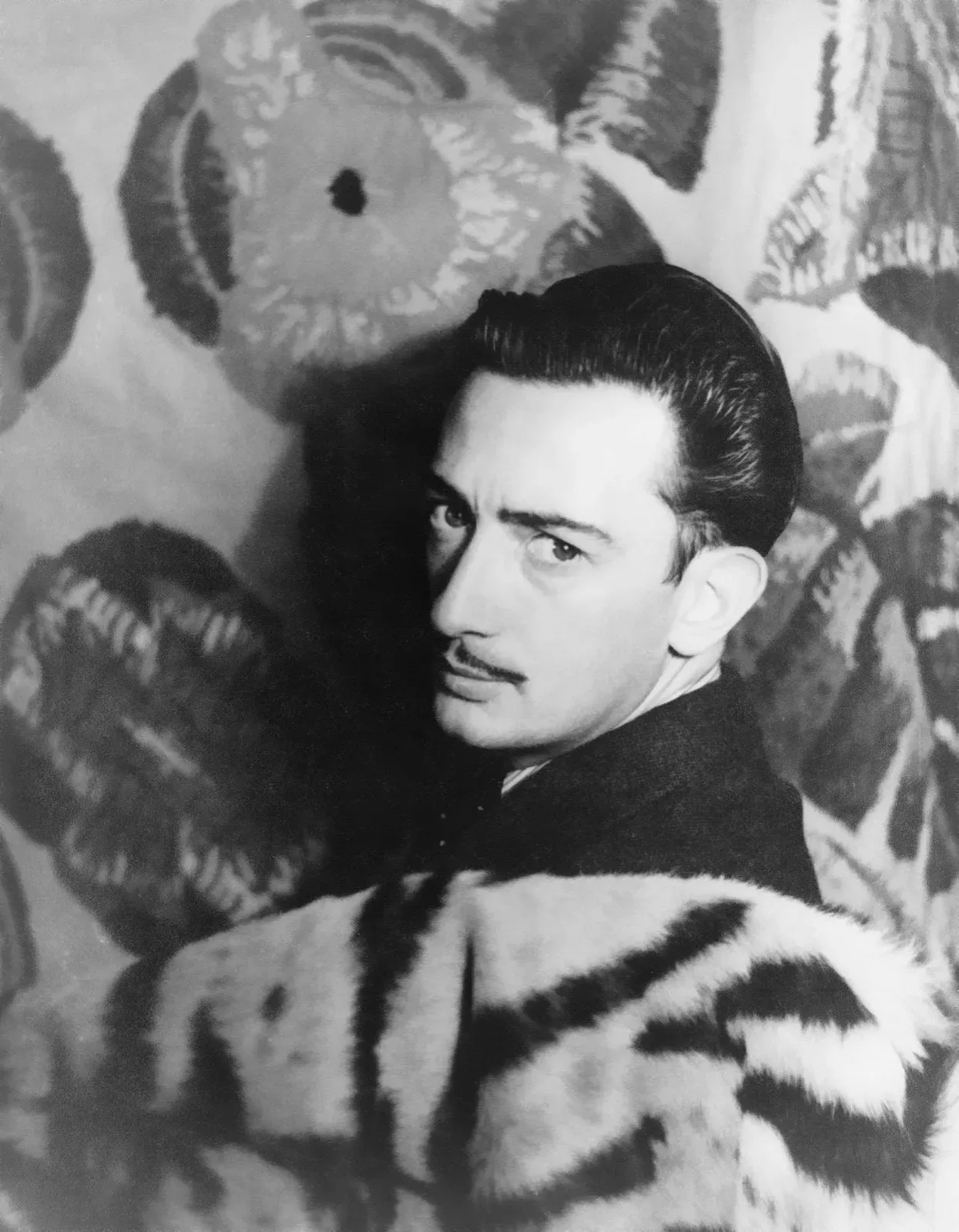
There is a man you have seen. Waxed moustache curled upward in two precise points, walking stick under one arm, an ocelot named Babou on a lead, and an expression of total self-satisfaction. You have seen him on posters, in documentary footage, in the corner of every survey of twentieth-century art. You probably knew the image before you knew much about the paintings. That was not an accident. Salvador Dalí designed himself as carefully as he designed anything else.
He was born on 11 May 1904 in Figueres, a market town in northern Catalonia just 25 kilometres from the French border. His family had money, and his father — a notary — expected the boy to apply himself to something sensible. The boy did not. Salvador the elder also had a dead son, born in 1901 and also named Salvador, who had died nine months before the painter’s birth from gastroenteritis. Dalí would spend the rest of his life haunted by this predecessor, writing about him and painting him, calling him “the first version of myself but conceived too much in the absolute.” He was already living in someone else’s shadow before he could walk.
By the time he arrived at the Residencia de Estudiantes in Madrid in 1922, he had already concluded that being conspicuous was a form of survival. He wore his hair long, dressed in knee-breeches and stockings in the style of Victorian aesthetes, and made himself impossible to ignore. It worked. The Residencia was the most intellectually fertile address in Spain at the time, and within a year he was close friends with Luis Buñuel and Federico García Lorca. Lorca fell in love with him. Dalí — complicated about many things, but mostly frank about this — said he rejected the advances. The friendship remained the most emotionally charged of his early life, right up until Nationalist forces shot Lorca in August 1936 and Dalí’s reported response was, inexcusably, to shout “Olé!”
His technical formation was rigorous. Every Sunday in Madrid he went to the Prado with a pencil and drew from the masters — Velázquez, Vermeer, Zurbarán, Raphael. He described it as a “monk-like period.” The technical precision this produced would become the most distinctive quality of his mature work: the ability to paint dreamlike images with the exactitude of a seventeenth-century Dutch interior. That combination — content from the unconscious, execution from the academy — is what made The Persistence of Memory, painted in 1931, so permanently unsettling. The melting watches drooping over a barren Catalan landscape are famously difficult to shake. Dalí claimed the idea came to him while staring at a piece of runny Camembert. Whether true or not, it is exactly the sort of thing he would say.
He joined the Surrealists officially in 1929, the same year he met Gala. She was Elena Ivanovna Diakonova, a Russian immigrant ten years his senior, then still married to the Surrealist poet Paul Éluard. She moved in with Dalí. She never entirely left. Gala became his muse, his model, his business manager, and the person who kept him from financial catastrophe through decades of extravagant spending. She also had affairs throughout the marriage, which Dalí either tolerated or encouraged depending on the account. He painted her obsessively for fifty years. When she died in 1982, he fell apart.
The Surrealists welcomed him initially with something close to awe. André Breton, writing the catalogue for Dalí’s first Paris exhibition in 1929, called his new work “the most hallucinatory that has been produced up to now.” Dalí repaid the compliment by being impossible. He refused to denounce fascism. He made ambiguous statements about Hitler. He resisted the group’s left-wing political orthodoxy, insisting Surrealism could exist “in an apolitical context” — which meant, in practice, that he could do whatever he liked. Breton eventually expelled him in 1939, and christened him with a nickname that has followed him ever since: “Avida Dollars,” an anagram of Salvador Dalí, meaning hungry for money. Dalí’s reply, which he repeated often, was: “The difference between the Surrealists and me is that I am a Surrealist.”
The persona meanwhile grew more elaborate by the year. In 1936 he delivered a lecture at the London International Surrealist Exhibition wearing a deep-sea diving suit and helmet, carrying a billiard cue and leading two wolfhounds. He had to be unscrewed from the helmet as he gasped for air. He explained that he had merely wanted to show he was “plunging deeply into the human mind.” In 1934, aged thirty, he had told an audience at MoMA: “The only difference between me and a madman is that I am not mad.” That same year he appeared on the cover of Time. He was a genius at the nineteenth-century art of celebrity — of making himself the subject, so that the work and the man became indistinguishable.
Not everyone approved. George Orwell reviewed Dalí’s autobiography in 1944 and described him as a person of “exhibitionism and necrophilia” — a man whose talent was real and whose character was repellent. Orwell’s complaint was specifically that Dalí had spent the Spanish Civil War in France, painting in comfort while his country burned, and had subsequently expressed admiration for Franco. It was a fair charge. Dalí returned to Spain in 1948 and publicly backed the regime. Picasso refused to speak his name for the rest of his life. Dalí attended official meetings with Franco three times. In 1975, he publicly supported the execution of Basque militants and declared himself “against freedom.” His house in Port Lligat was stoned. He fled to New York.
The late years were not generous. By 1980 he had severe tremors in his right hand. When a fire broke out in his Púbol bedroom in 1984 under circumstances that were never fully explained, he was hospitalised with serious burns. Two years before, he had made a brief public statement that served as something close to a self-written epitaph: “When you are a genius, you do not have the right to die, because we are necessary for the progress of humanity.” He died on 23 January 1989, of cardiac arrest, at the age of eighty-four.
He is buried in the crypt beneath the stage of his own Theatre-Museum in Figueres. The museum was his largest single project, a building he spent fourteen years constructing and filling with his own work and obsessions. The crypt is 450 metres from the house where he was born. The church across the street is where he was baptised, took his first communion, and had his funeral. He designed his monument, placed himself inside it, and built it on the street where he started. Whatever else you say about Salvador Dalí, he knew how to finish a sentence.