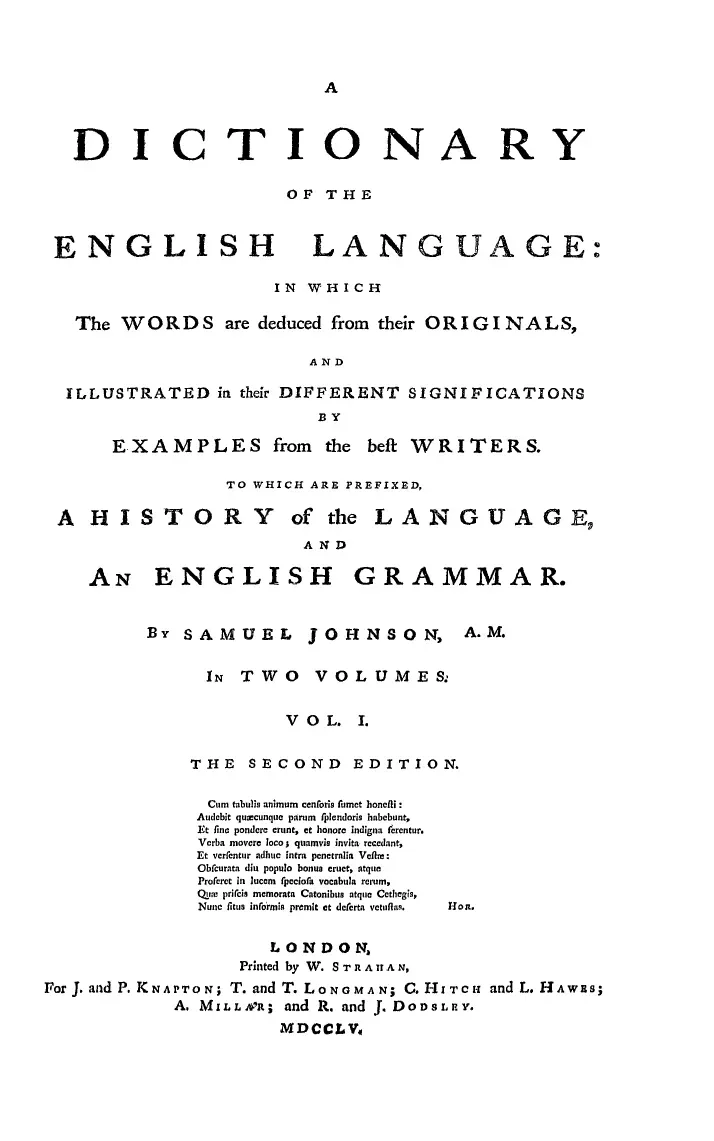
On 15 April 1755, Samuel Johnson published A Dictionary of the English Language from his home at 17 Gough Square, London. It defined 42,000 words, drew on 114,000 quotations from authors stretching back to Philip Sidney and Edmund Spenser, and took nine years to produce. Johnson had promised his publisher, Robert Dodsley, that he would have it ready in three. He was wrong by six years and right about everything else.
The scale of the thing requires context. In 1694, the Académie française published a dictionary of the French language after fifty-five years of institutional labour involving forty scholars and the full weight of royal patronage. When a group of prominent English booksellers, alarmed by the disorder of their own language, approached Johnson in 1746 with £1,575 and a contract, the general assumption was that a comparable English project would need something similar: an institution, a committee, a government. Johnson thought one sufficiently motivated man and a garret in Fleet Street would do. He rented the top floor of 17 Gough Square, hired six amanuenses to copy out quotations he had marked in books, and got to work.
The method was particular. Johnson read widely and eclectically, marking passages in pencil wherever a word appeared in a usage he judged worth preserving, then had his assistants copy the quotations onto slips of paper to be filed under the relevant word. He then wrote the definitions himself. Five of his six assistants were Scottish, which amused him. His own definition of oats — “a grain, which in England is generally given to horses, but in Scotland supports the people” — suggests he was not above settling scores with the material. He defined lexicographer as “a writer of dictionaries; a harmless drudge, that busies himself in tracing the original, and detailing the signification of words.” He was not a man who lacked self-awareness.
The Chesterfield episode gives the project its best story. When Johnson submitted his original plan in 1747, he dedicated it to Philip Dormer Stanhope, the fourth Earl of Chesterfield — the obvious patron to court, a man of fashion and letters who had considerable influence and, in theory, the disposition to support literary endeavour. Chesterfield largely ignored him. Johnson waited in the Earl’s anteroom on more than one occasion and was turned away. He received £10 in the course of a nine-year project that very nearly broke him financially. He was forced to sell part of his copyright for ready cash. A friend had to bail him out of a sponging house — a holding pen for debtors — in 1756, the year after publication.
Then, as the Dictionary was nearing completion and its reception was becoming clear, Chesterfield published two flattering essays in The World effectively endorsing it and positioning himself as its patron. Johnson wrote him a letter. It runs to four paragraphs and contains one of the more devastating sentences in the English language: “Is not a Patron, my Lord, one who looks with unconcern on a man struggling for life in the water, and, when he has reached ground, encumbers him with help?” He sent the letter in February 1755. Chesterfield reportedly left it on his table for visitors to read, claiming it was “well done.” Johnson did not pursue the relationship further.
The Dictionary was not perfect and Johnson knew it. He famously admitted in the preface that he had “indulged expectation which neither reason nor experience could justify” — the expectation, shared by his contemporaries, that a good dictionary might fix the language and prevent its further change. He abandoned this idea somewhere around the fourth year of the project and concluded, with characteristic bluntness, that those who imagine a dictionary can embalm the language “have dreamed of an undertaking which neither reason nor experience could justify.” The preface is one of the better pieces of prose in the English language, in part because it is an extended acknowledgement of everything he set out to do that could not be done.
What he did achieve was more practical and, in the long run, more durable. He gave English spelling a standard. Before 1755, the same word might appear in three different forms in a single pamphlet — musick, music, musique — without any authoritative convention to prefer one over another. Johnson chose, and his choices stuck. He gave English usage a literary anchor: a demonstration that the language could be traced and illustrated through its best writers rather than merely listed. He gave the reading public a single volume they could consult. The Dictionary went through four editions in Johnson’s lifetime and remained the authority on English for over a century, until James Murray and the Philological Society began assembling what eventually became the Oxford English Dictionary in 1879.
Johnson was given a royal pension of £300 per year in 1762, which allowed him to stop worrying about money and start worrying about other things. He spent the next twenty years being Samuel Johnson — talking at the Club, biographing the poets, writing the Lives of the Most Eminent English Poets, and furnishing James Boswell with enough material for one of the great biographies in the language. He died in 1784 and was buried in Westminster Abbey. The harmless drudge, in the end, turned out to be neither harmless nor, by any fair measure, a drudge. He was simply a man who sat down, for nine years, and did the work.