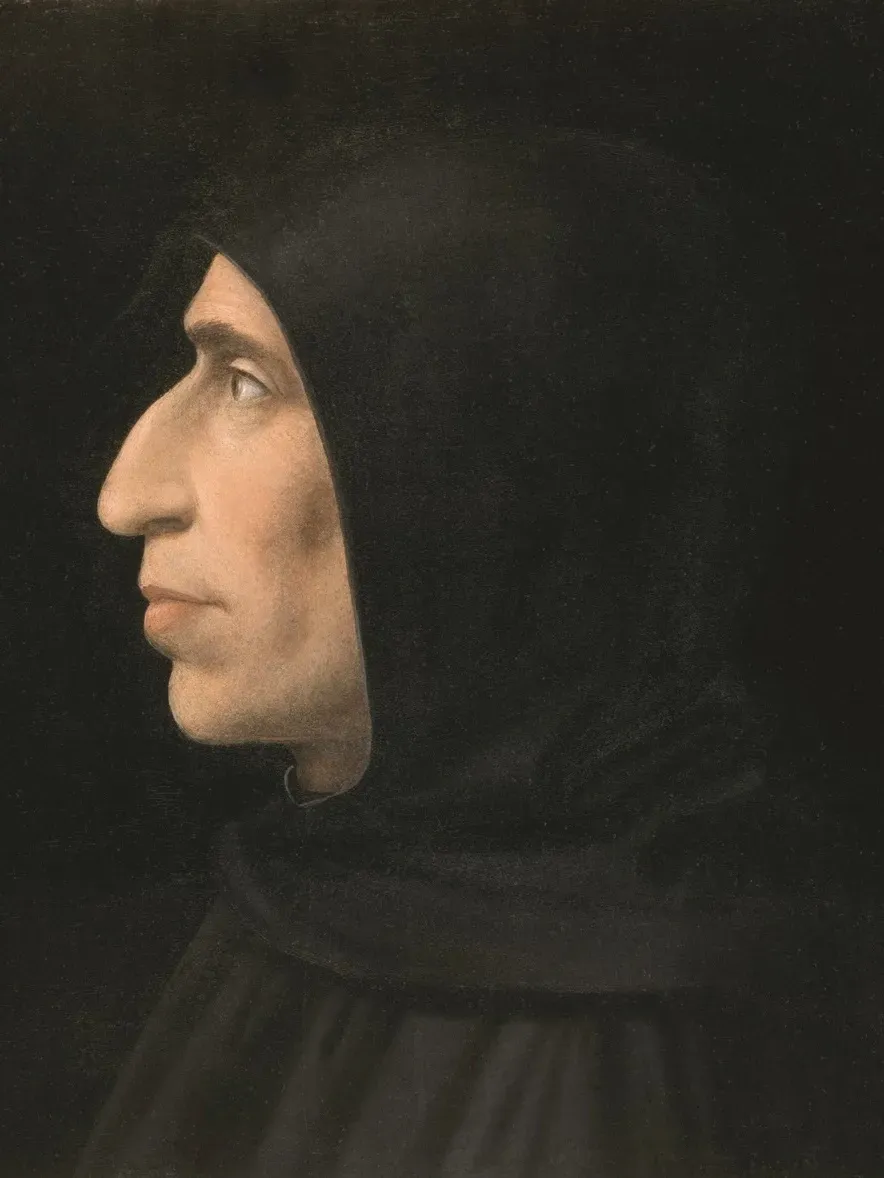
On 23 May 1498, a wooden scaffold stretched across the Piazza della Signoria in Florence, ending at a pile of dry faggots. Hanging from the gallows were three Dominican friars, their necks broken, their bodies soon to be consumed by the flames below. The central figure was Girolamo Savonarola, the man who for four years had ruled Florence as God’s own deputy. A few years later, Michelangelo’s colossal statue of David would stand in this very square, a symbol of civic liberty and humanist pride. But on that spring morning, the Florentines were busy watching their former prophet turn to ash. I have always found a peculiar irony in this transition: the city that gave the world the Renaissance spent its morning performing a medieval execution, throwing the ashes of its moral dictator into the River Arno to prevent his followers from collecting holy relics.
The conventional historical narrative treats Savonarola as a dark, puritanical anomaly - an unwelcome medieval ghost haunting the sunny playground of Renaissance humanism. In this view, he is the fanatic who briefly turned off the lights in Florence, bullying Sandro Botticelli into burning his own paintings, before the sensible citizens finally woke up, dragged him to the gallows, and turned the lights back on. But this caricature misreads both Savonarola and the Renaissance. Florence was never a sunny humanist playground; it was a paranoid, highly unequal state cit, ruled by the Medici, a banking dynasty that used art patronage as a highly effective public relations campaign. Savonarola did not interrupt the Renaissance; he was its direct, almost inevitable product.
When the Medici fled Florence in 1494 ahead of the invading French army of Charles VIII, a massive power vacuum opened. It was Savonarola, a Dominican friar from Ferrara, who stepped into the void. What he built was not just a grim, monastic dictatorship, but the most democratic government Florence had ever seen. He spearheaded the creation of the Consiglio Maggiore - the Great Council - which expanded political participation to over three thousand citizens, shattering the narrow oligarchy of the wealthy guilds. He abolished arbitrary taxation and established a system of progressive tax. He preached in the vernacular Italian rather than Latin, giving the working-class citizens - whom the patricians mockingly called the Piagnoni, or “Weepers” - a direct stake in the republic. I suspect the wealthy merchants of Florence hated Savonarola’s democracy and their own loss of power far more than they hated his puritanism.
Yet, the puritanism was real, and it carried a dark, modern edge. Savonarola did not rely on medieval inquisitors to enforce his moral reforms; he weaponised public opinion. He organised bands of young boys - the fanciulli - into a holy police force. These teenagers patrolled the streets of Florence, knocking on doors to demand the surrender of “vanities”: cosmetics, mirrors, secular books, musical instruments, and paintings of pagan myths. In 1497 and 1498, these confiscated goods were piled high in the Piazza della Signoria and set alight in the famous Bonfires of the Vanities. This was not a traditional medieval crusade; it was a populist cultural revolution, complete with youth leagues, public shaming, and the systematic purging of elite culture. It feels less like the thirteenth century and more like the cultural cleansings of the twentieth. It turns out that Mao’s Red Guards were in fact copying a medieval Italian monk.
The friar’s ultimate undoing was his confrontation with Rome. In Pope Alexander VI - the infamous Rodrigo Borgia - Savonarola had the perfect foil. Alexander was a pope who had bought the papacy, kept mistresses, fathered illegitimate children, and carved up Italy to enrich his family. Savonarola’s denunciations of papal corruption were entirely accurate, but he made the fatal mistake of believing that having truth on his side made him invincible. He forgot that the Borgia pope possessed a weapon far more potent than theological debate: money. When Savonarola ignored Alexander’s excommunication, the Pope threatened to place Florence under an interdict. This was not a spiritual threat; it meant European monarchs would have the legal right to seize Florentine merchant assets abroad. In a city of bankers and traders, the threat of bankruptcy is always more terrifying than the threat of damnation. The Florentine elite quickly realised that their prophet was costing them too much money.
The final collapse arrived in April 1498 with a bizarre spectacle. A rival Franciscan friar challenged Savonarola’s followers to a trial by fire to prove whose doctrine was correct. Thousands of Florentines crammed into the Piazza della Signoria, eager for a miracle or a slaughter. But as the rival factions bickered over the rules - whether they could carry crucifixes into the flames, whether the rain would spoil the wood - the hours dragged on. A sudden rainstorm soaked the pyre, and the officials cancelled the event. The crowd, wet, bored, and feeling cheated of their entertainment, turned on the prophet. Populism is a beast that must be fed with spectacles, and when the miracle fails to materialise, the crowd’s devotion turns to rage overnight.
The next day, a mob stormed Savonarola’s monastery at San Marco. He was arrested, subjected to weeks of torture - his shoulders repeatedly dislocated on the strappado - and forced to sign confessions that his prosecutors liberally altered. Among the crowd watching his execution on 23 May was a young, twenty-nine-year-old Florentine diplomat named Niccolò Machiavelli. For him, Savonarola became the ultimate intellectual case study. In The Prince, he famously labelled Savonarola the archetype of the “unarmed prophet” who is doomed to ruin. Machiavelli observed that the friar fell because he had no means of keeping those who had believed in him steady in their belief, nor of making the unbelievers believe. He had no army, no physical force, and no institutional mechanism to compel obedience once the religious ecstasy faded. He relied on the shifting sands of public opinion, forgetting that a crowd will cheer your burning just as loudly as they cheered your sermons.
The ashes of Girolamo Savonarola were swept into the Arno, but the currents carried them far beyond the borders of Tuscany. Within two decades, a German monk named Martin Luther would nail ninety-five theses to a church door in Wittenberg, citing Savonarola as a precursor and a martyr. Even the Catholic Church eventually executed a quiet about-face; his theological treatises were declared orthodox, and in 1997, the Archdiocese of Florence opened his cause for beatification. Five hundred years after burning him as a heretic, the Church is considering making him a saint. It is a final, cynical twist that Machiavelli would have thoroughly appreciated: the prophet who tried to burn the worldly corruption of his age was ultimately co-opted by the very institutions he sought to destroy.