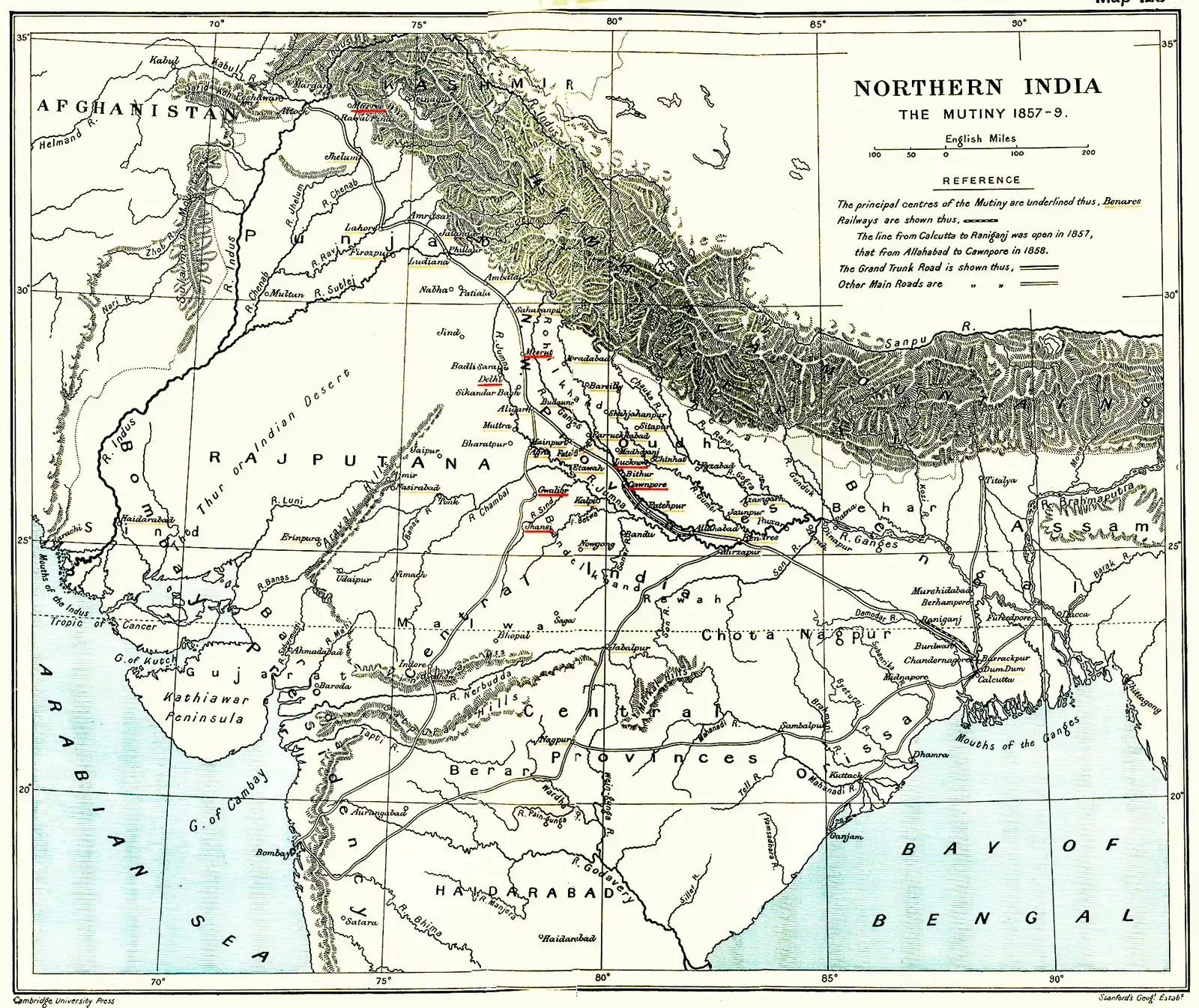
On the morning of 29 March 1857, a 29-year-old sepoy, a soldier of the native Indian troops in EIC employ, named Mangal Pandey walked onto the parade ground at Barrackpore, near Calcutta, with his musket loaded and his mind made up. He shot at his Sergeant-Major, who ducked. He shot at his Adjutant’s horse, killing the animal. He called on his fellow soldiers of the 34th Bengal Native Infantry to rise against their British commanders. None of them moved. When he finally pressed the barrel to his own chest and pulled the trigger with his toe, he managed only to wound himself. He was court-martialled on 6 April and hanged two days later. The Jemadar who had refused orders to arrest him was hanged three weeks after that. The regiment was disbanded in disgrace, its soldiers stripped of their uniforms on parade.
Individually, Pandey’s act was a failure by almost every measure. He killed no officers, started no uprising, and was betrayed - if that is the right word - by the inaction of the very men he was trying to lead. Yet within six weeks, the garrison at Meerut had mutinied. Within seven, Delhi had fallen to rebel sepoys. Within months, Bahadur Shah Zafar, the 81-year-old Mughal emperor, had been proclaimed ruler of Hindustan by soldiers who marched 64 kilometres through the night to put their case at his palace window. And by November 1858, the East India Company - which had governed much of the subcontinent for over a century - had been dissolved by Act of Parliament. Britain was not leaving India. It was taking over directly.
The question of why one failed mutiny at a parade ground triggered the largest challenge to British rule on the subcontinent is less mysterious than it seems. Pandey was not an isolated lunatic. He was the product of conditions that had been accumulating for years.
The immediate trigger was a cartridge. The new Enfield Pattern 1853 rifle required soldiers to bite open a paper cartridge before loading. Rumours spread through the Bengal Army in early 1857 that the cartridges were greased with cow tallow and pig lard - deeply offensive to Hindu and Muslim soldiers respectively. Modern historians note there is little direct evidence that such greased cartridges were actually being issued at scale. It did not matter. The belief had taken hold, and the belief stood in for something much larger. The Company had been systematically stripping away the privileges it had once extended to its sepoys: cutting foreign service allowances, requiring overseas postings that high-caste Hindus considered ritually polluting, annexing kingdoms under the Doctrine of Lapse and dispossessing their nobility. Oudh, home to a significant portion of the Bengal Army’s recruits, had been absorbed in 1856. The cartridge did not cause the rebellion. It made visible a distrust that had been growing for a decade.
The Bengal Army numbered over 300,000 sepoys against roughly 50,000 British soldiers. When Meerut mutinied on 10 May 1857, the rebels marched on Delhi, which had no British garrison. Fifty-four of 74 Bengal Native Infantry regiments mutinied or revolted. The uprising drew in not just soldiers but taluqdars whose estates had been seized, princes denied their succession rights, and peasants suffocating under land taxes designed to pay off treaty indemnities to British creditors. In the cities the rebels took, they proclaimed the new order in terms that left nothing unclear: “The people belong to God, the country to the Emperor, authority to the Sepoy.”
The atrocities were considerable on both sides, and any account that dwells only on one is being dishonest. At Cawnpore in June, around 200 British women and children were killed in a building called the Bibighar, their bodies thrown down a well. The massacre inflamed British opinion and removed any appetite for negotiation. British retaliation was systematic and often pre-emptive. Colonel James Neill burned villages along the Grand Trunk Road and hanged their inhabitants on his march toward Cawnpore - before the Bibighar killings, not after. When Delhi was retaken in September 1857, the city was looted and many of its civilian residents killed indiscriminately. An officer wrote home that every person found within the walls “was bayoneted on the spot… I am glad to say they were disappointed” in their expectation of mercy. Prisoners were blown from cannon mouths. Best estimates put Indian dead in the rebellion and its immediate aftermath at around 800,000 - and very likely more - against roughly 6,000 British killed.
The British response was ultimately rapid and overwhelming. Kanpur was retaken by mid-July 1857. Delhi fell at the end of September after a siege of nearly three months, during which the Company’s own forces were often outnumbered and nearly broke. Lucknow was finally cleared in March 1858. The last organised rebel force was defeated at Gwalior on 20 June 1858. In the fighting, notably, the Madras and Bombay armies barely wavered; Sikh regiments and Gurkha units fought alongside the British. The rebellion was regional, largely confined to the upper Gangetic plain, and fractured along caste, religious, and local lines that the rebels never managed to transcend. That it came as close as it did to seriously threatening British control was a shock that London did not forget.
The East India Company was dissolved by the Government of India Act 1858. Parliament transferred its governing powers directly to the Crown, created the title of Viceroy of India, and had Queen Victoria issue a proclamation promising equal treatment under law for all subjects regardless of race or religion. It was a generous document. The practice it described was considerably more selective. Within a generation, the Ilbert Bill of 1883 - which would have allowed Indian judges to try British subjects - provoked what was called a white mutiny among European officials and settlers, who forced its emasculation. In 1886, restrictions on Indian entry into the civil service were tightened. The colonial administration, reformed after 1858 to be more respectful of Indian social and religious structures than the Company had been, was still a colonial administration. The new conservatism was strategic: preserve hierarchy, limit interference with custom, and govern more quietly. But govern.
What the rebellion produced was not a weakened British presence but a more entrenched one. The army was rebuilt from the ground up. The Bengal Army’s Brahmin-heavy composition was broken; recruitment shifted toward communities deemed more loyal - Sikhs, Gurkhas, Punjabi Muslims. The ratio of British to Indian artillery was improved. The post-rebellion Indian Army was better organised, better integrated with British officers, and designed to prevent 1857 from happening again. It largely succeeded. There was no comparable uprising for the rest of the century.
It took two world wars to finally dislodge British rule. The First depleted imperial manpower and confidence; the Second bankrupted the empire entirely and brought to power a Labour government in Westminster that had neither the means nor the will to hold India by force. On 15 August 1947 - ninety years after the Bengal Army rose at Meerut - Britain lowered its flag. India was independent. Pakistan had been created days earlier, the subcontinent partitioned along borders drawn in five weeks by a British lawyer, Cyril Radcliffe, who had never visited it and arrived with no maps. In the violence that followed partition, around one million people were killed and fifteen million displaced.
Pandey’s mutiny failed the morning it happened. He started no rebellion, saved no tradition, inspired no colleagues. What he did was make visible, in a single public act of insubordination on a parade ground outside Calcutta, exactly how far the relationship between the Company and its army had decayed. The rebellion that came six weeks later did not avenge him. It transformed the machinery of British rule into something more direct, more determined, and considerably harder to remove. When that removal finally came, it arrived at a price that no one in 1857 - neither Pandey on his parade ground nor the Governor-General in his offices - could have measured in advance.