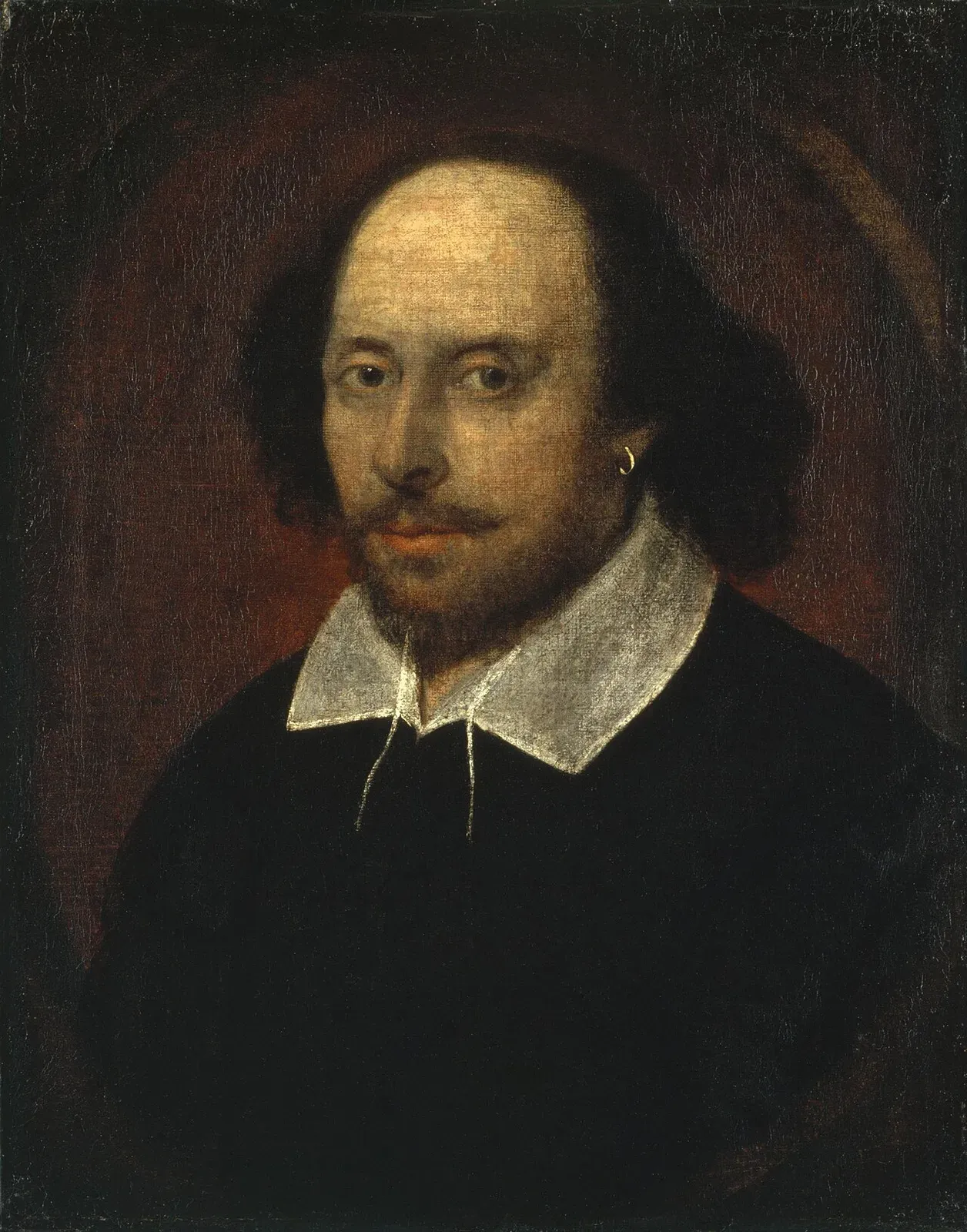
On 26 April 1564, the parish register of Holy Trinity Church in Stratford-upon-Avon recorded the baptism of “Gulielmus filius Johannes Shakspere” - William, son of John Shakespeare. The birth date is not recorded. Convention places it three days earlier, on 23 April, which would make it Saint George’s Day and symmetrically convenient, since Shakespeare died on 23 April 1616. Symmetry is not evidence. We know when he was baptized. We do not know when he was born. This gap - three days, perhaps four - has troubled a certain class of literary theorist for the better part of two centuries.
The trouble is not the dates. The trouble is that William Shakespeare’s father was a glover. He made gloves, traded in wool, and served as bailiff of Stratford - a position of local importance but hardly aristocratic. William attended the King’s New School in Stratford, a respectable grammar school that taught Latin and rhetoric to the sons of tradesmen. He did not attend university. He married Anne Hathaway at eighteen, had three children by twenty-one, and by his late twenties was working in London as an actor and playwright. By 1594, he was a shareholder in the Lord Chamberlain’s Men, one of the leading theatre companies. By 1599, he owned a stake in the Globe Theatre. He wrote approximately 38 plays and 154 sonnets. He retired to Stratford, bought the second-largest house in town, and died worth a considerable fortune in 1616. His will famously left his wife the second-best bed.
For a substantial number of people, this sequence of events is impossible. A man of Shakespeare’s background could not have possessed the knowledge displayed in the plays: the law, the classics, the Italian settings, the intimate familiarity with court life. Therefore, someone else must have written them. The most popular candidate is Edward de Vere, 17th Earl of Oxford, a nobleman, poet, and patron of the arts who died in 1604 - which requires some awkward chronology, given that several of Shakespeare’s plays were written after that date. Francis Bacon, the philosopher and Lord Chancellor, is another favourite, on the grounds that he was clever and educated, which apparently Shakespeare was not allowed to be. Christopher Marlowe, who inconveniently died in a tavern brawl in 1593, has been proposed on the theory that he faked his death and continued writing under Shakespeare’s name for another two decades. The group theory - that the plays were a collaborative effort by various educated men hiding behind a convenient front - solves the identity problem by multiplying it.
The logic is consistent, in the way conspiracy theories often are. It starts from a conclusion - Shakespeare could not have written Shakespeare - and works backwards, assembling evidence that supports the premise and discarding evidence that does not. It is also, at its core, an exercise in class snobbery. The argument rests on the assumption that genius requires aristocratic birth or university credentials, and that a grammar school education in a market town could not possibly produce someone capable of writing King Lear. This is historically illiterate. Marlowe, the son of a Canterbury shoemaker, wrote Doctor Faustus. Ben Jonson, stepson of a bricklayer, wrote Volpone. The idea that only noblemen could write great literature would have surprised every working playwright in early modern London, most of whom came from similarly humble backgrounds and learned their craft by doing it.
The evidence for Shakespeare’s authorship is not ambiguous. His name appears on the title pages of the plays published during his lifetime. Venus and Adonis (1593) and The Rape of Lucrece (1594) were both dedicated to the Earl of Southampton and signed by Shakespeare. The First Folio, published in 1623 by his colleagues John Heminges and Henry Condell, attributes the plays directly to “Mr. William Shakespeare” and includes a prefatory poem by Ben Jonson addressing Shakespeare by name and calling him “Sweet Swan of Avon.” Contemporary references - dozens of them, from playwrights, poets, and theatre managers - identify Shakespeare as the author. The anti-Stratfordians dismiss all of this as part of the conspiracy, which is a tidy way to avoid confronting the documentary record.
The supposed mysteries dissolve on inspection. Shakespeare’s knowledge of law? Standard for anyone involved in property transactions, lawsuits, or commercial contracts - and Shakespeare was involved in all three throughout his career. His knowledge of Italy? Drawn from published sources, including translations of Italian novels and travel accounts widely available in Elizabethan London. His knowledge of court life? Observed. The Lord Chamberlain’s Men performed at court regularly after 1594. Shakespeare had access. He also had eyes. The plays are not documentary accounts of aristocratic behaviour; they are drama, written for a popular audience, and they get things wrong with some regularity. The Winter’s Tale famously gives Bohemia a coastline. It does not have one. If Shakespeare were a nobleman writing from personal experience, he would presumably know where the sea was.
The authorship question emerged in the mid-19th century, long after everyone involved was dead and could not object. The first prominent doubter was Delia Bacon, an American writer with no relation to Francis Bacon, who published The Philosophy of the Plays of Shakespeare Unfolded in 1857. The book was a commercial failure and is now remembered primarily for starting an argument that refuses to die. It fed on Romanticism’s cult of the solitary genius and Victorian England’s obsession with class and education. The idea that Shakespeare was a front for someone more refined appealed to people who could not imagine that genius might emerge from Stratford-upon-Avon, of all places.
What survived is the work. The plays have been performed continuously for over four centuries. They have been translated into every major language. They have shaped English vocabulary - Shakespeare is credited with introducing roughly 1,700 words to the language, though the exact number is debated - and English idiom to an extent that makes it difficult to speak or write without echoing him. Hamlet, Macbeth, Othello, King Lear, The Tempest, A Midsummer Night’s Dream, Romeo and Juliet, Julius Caesar - the list is long, and the influence is inescapable. The sonnets remain some of the finest lyric poetry in the language. “Shall I compare thee to a summer’s day?” is the sixteenth sonnet, and it is perfect.
The man who wrote them was baptized on 26 April 1564 in a small market town in Warwickshire. His father made gloves. He attended grammar school. He did not go to university. He moved to London, learned his trade, wrote plays for money, and became the greatest writer in the English language. That this sequence of events strikes some people as implausible says more about them than it does about Shakespeare. Genius does not require a title. It requires work, talent, and a willingness to take the stage seriously. Shakespeare had all three.
On 23 April 1616 - or possibly another day near it; the records are ambiguous - William Shakespeare died in Stratford and was buried at Holy Trinity Church, where he had been baptized fifty-two years earlier. His gravestone carries a curse against anyone who moves his bones. The bones have stayed put. The plays have not. They belong to anyone willing to read them, perform them, or argue about them. The man who wrote them was the son of a glover from Stratford-upon-Avon. That will have to be enough.