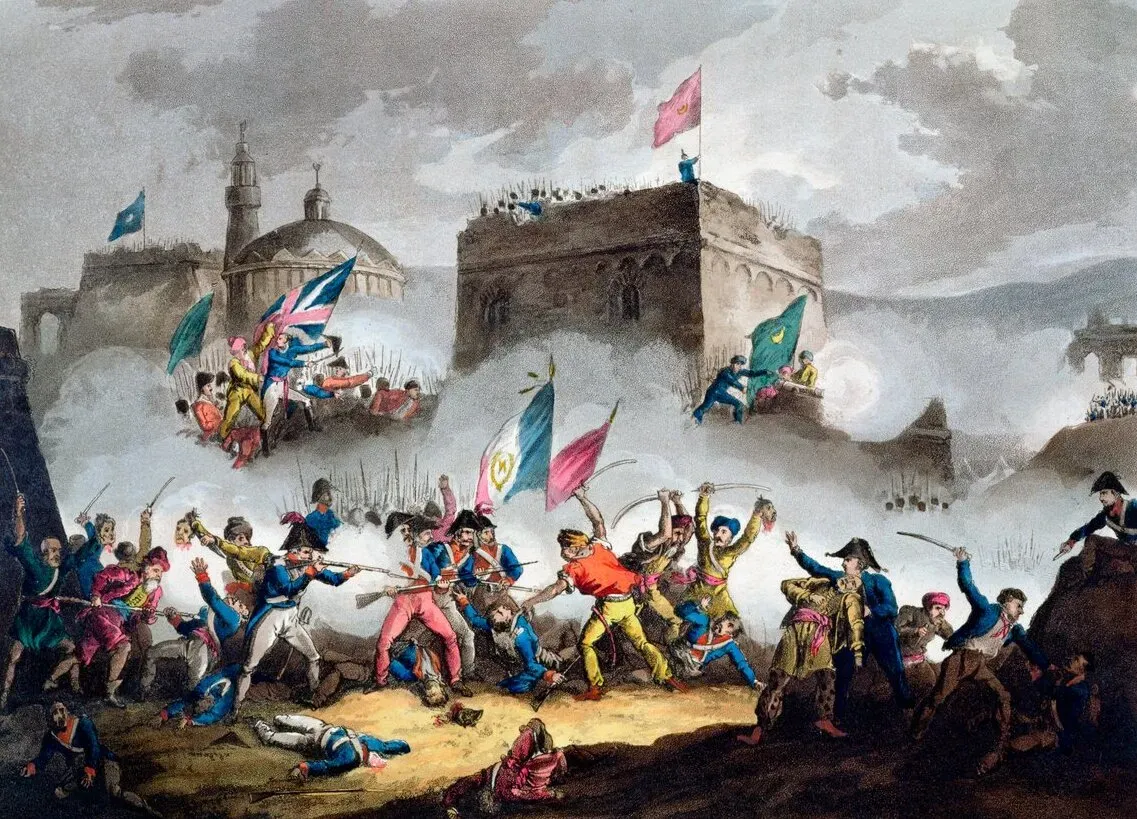
On 21 May 1799, Napoleon Bonaparte gave the order to abandon the siege of Acre and march back to Egypt. He had spent two months failing to take the city. His troops were sick with plague. His siege artillery had been intercepted at sea by the British before a single gun could be brought to bear on the walls. He had launched nine assaults and been repulsed each time. The Ottoman defenders, stiffened by British naval gunners under Commodore Sir Sidney Smith, had held. Napoleon loaded his plague-stricken men onto whatever transport he had and began the march south through Palestine in the late spring heat.
He would later claim, in the memoirs he dictated on Saint Helena, that Acre was the pivot of his whole career. “If I had taken Acre,” he said, “I would have reached Constantinople and the Indies.” Perhaps. He was not known for underestimating what he had almost accomplished. What he did not say on Saint Helena, and what the record makes considerably clearer, is that by the time he retreated from Acre, the Egyptian campaign had already been strategically finished for nine months.
It had started with enormous ambition. When Napoleon sailed from Toulon in May 1798, he brought not just 38,000 soldiers but 167 scientists, engineers, and scholars - the Commission des sciences et arts. The expedition had a civilisational logic attached to it, or at least a civilisational vocabulary: it would strike at British interests by threatening the overland route to India, and it would advance human knowledge along the way. The scholars mapped Egypt, measured its monuments, collected its artefacts, and eventually discovered the Rosetta Stone. As intellectual projects go it was genuinely remarkable. As a strategic operation it lasted until the night of 1 August 1798, when Rear Admiral Horatio Nelson found the French fleet anchored in Aboukir Bay and destroyed it. Eleven of seventeen French ships of the line were sunk or captured by morning. Napoleon’s army was now in Egypt without a means of getting home, with the Royal Navy controlling the Mediterranean, and with the Ottoman Empire about to declare war.
He won the Battle of the Pyramids and several subsequent engagements. He occupied Cairo and organised an administration. He held on. In February 1799, he led a force of roughly 13,000 men north into Ottoman-controlled Syria and Palestine on what was either a bold attempt to break the strategic deadlock or an improvised diversion from the reality that he was stuck. He took Jaffa in March - accompanied by an episode he never fully accounted for, the execution of roughly 2,400 Ottoman prisoners who had surrendered on a promise of quarter. He then marched north and sat down before Acre.
Acre was well fortified, well supplied by sea, and defended by a capable Ottoman garrison. More critically, the French siege artillery - the heavy guns that might have brought down the walls - was aboard ships that Sidney Smith intercepted before it arrived. Napoleon had infantry but no means of forcing a breach. He tried nine times with what he had. He failed nine times. Plague, which had appeared at Jaffa and spread steadily, was killing his men faster than the defenders were. He retreated on 21 May, trying to keep his columns moving through heat and disease with enough discipline to survive the journey south.
He made it back to Egypt. In July he defeated an Ottoman landing force at Aboukir Bay - a tactical victory, real enough, and the last significant military success of the campaign. Then, on the night of 22 August 1799, he boarded a frigate with a small entourage and sailed for France. He left approximately 25,000 men behind him. He did not tell his second-in-command, General Kléber, in person. He left a letter.
Kléber’s response, when he found it, was to describe Napoleon in a letter to a colleague as a man who had “abandoned the army as a deserter.” He was right in every particular. Kléber fought on with the remnant force for another two years before being assassinated in Cairo in 1800. The army that Napoleon had abandoned eventually surrendered to the British in 1801. Most of the men who had marched through Palestine and failed to take Acre never saw France again.
Napoleon arrived in France in October 1799. He was greeted as a hero. The Directory - the five-man executive council that had governed France since 1795 - was by this point so comprehensively despised that virtually no one was prepared to defend it. It had produced corruption, inflation, military setbacks in Europe, and five years of political instability. The coup of 18 Brumaire, on 9 November 1799, removed it in a day. Napoleon became First Consul. Within five years he was Emperor.
What made this possible was not military genius - the Egyptian campaign had demonstrated its limits clearly enough. It was the specific chaos of the French Republic in 1799. Napoleon had spent months carefully controlling what information reached Paris: his dispatches emphasised victories, glossed over the fleet’s destruction, said nothing useful about Acre, and were silent on the subject of the letter to Kléber. He arrived with a reputation built largely on what he had chosen to report. The Directory’s incompetence was so apparent that almost any alternative looked credible. And France had no institutional mechanism - no functioning military tribunal, no stable parliamentary oversight - capable of asking a returning general to account for the army he had left behind a sea.
In a republic with strong institutions and a functional chain of command, a general who abandons his army in a losing campaign to stage a political coup at home is court-martialed. In France in 1799, he became head of state. The walls of Acre stopped Napoleon in Syria. Nothing in Paris stopped him at all.