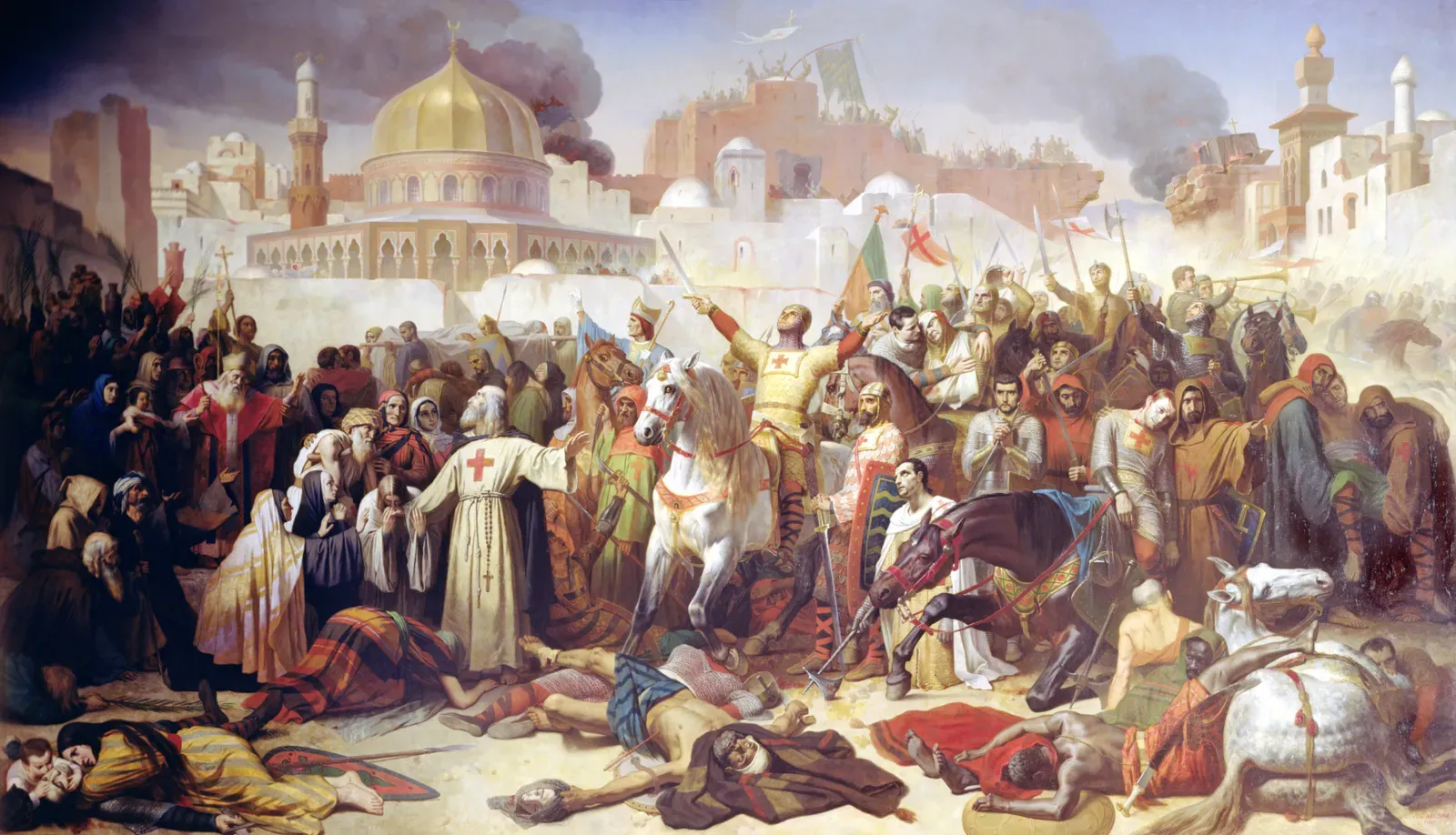
On 15 July 1099, Crusader knights broke through the northern wall of Jerusalem and, within hours, were riding through the courtyard of the Temple of Solomon in blood deep enough to reach their horses’ bridles. That is not a figure of speech invented centuries later for effect. Raymond of Aguilers, who was there, wrote it in exactly those terms: men rode in blood up to their knees and bridle reins. Fulcher of Chartres, working from accounts of men who had been there, put the death toll inside that one enclosure at 10,000. The true number is disputed and probably lower, but the men who had spent three years and roughly two thousand miles marching to retake the city where Christ was crucified spent their first afternoon inside it killing almost everyone they could reach.
The crusade had started as an argument about access. Jerusalem had been in Muslim hands since 637, and for most of that span Christian pilgrims had still managed to visit it, at a price and with difficulty. Then, in 1009, the Fatimid caliph al-Hakim ordered the Church of the Holy Sepulchre demolished to its foundations, including the cave believed to be Christ’s tomb. Reports of the destruction spread through Europe for decades, alongside stories of pilgrims robbed, enslaved, and killed on the road. When Byzantine emperor Alexios I asked Pope Urban II for military help against the Seljuk Turks in 1095, Urban turned the request into something far larger. At the Council of Clermont that November, he called for an armed pilgrimage to liberate Jerusalem itself, promising remission of sins to anyone who died on the way. The crowd is said to have answered with the cry Deus lo vult - God wills it.
What followed killed most of the people who answered that call before they ever saw the city. An unofficial rabble under Peter the Hermit set off first, pillaging its way across the Balkans and massacring Jewish communities in the Rhineland along the way, before being annihilated by Turkish archers at Civetot in October 1096. The properly assembled army of nobles that came after - Godfrey of Bouillon, Raymond of Toulouse, Bohemond of Taranto, and the rest - fared better at Nicaea and Dorylaeum, but then spent eight attritional months laying siege to Antioch, where soldiers reportedly resorted to cannibalism during the worst of the starvation and a peasant’s convenient vision of the Holy Lance had to substitute for food. By the time the survivors reached Jerusalem on 7 June 1099, an army that had left Europe somewhere between 60,000 and 100,000 strong had shrunk to roughly 12,000 fighting men, 1,500 of them on horseback. Many of them wept at the first sight of the walls. They had earned the tears.
Iftikhar al-Dawla, the Fatimid governor, had used the months of warning well. He expelled the city’s Christian population for fear of collusion, poisoned the wells outside the walls, and cut down every tree for miles so the crusaders would have no timber for siege engines. He held a four-kilometre circuit of wall, three metres thick and fifteen high, defended by an elite corps of 400 Egyptian cavalry. The first crusader assault, on 13 June, was a desperate improvisation: Tancred claimed a vision had led him to a hidden stash of wood in a cave, which produced exactly one ladder, up which a knight named Rainbold climbed and got nowhere. The attackers pulled back to wait for equipment they did not yet have.
They got it by luck rather than plan. On 17 June, English and Genoese ships put in at Jaffa carrying skilled engineers and enough timber, stripped from the ships themselves, to build proper siege equipment. Under Guglielmo Embriaco and Gaston of Béarn, the crusaders spent three weeks constructing two wheeled siege towers, an iron-headed battering ram, and rows of scaling ladders, working against the knowledge that a Fatimid relief army was already marching north from Egypt. Before the final assault, the army fasted for three days and processed barefoot around the walls in imitation of Joshua’s circuit of Jericho, ending on the Mount of Olives, where Peter the Hermit preached to men who had been squabbling among themselves for months and briefly stopped.
The assault began on 13 July and ran for two days: Raymond’s Provençals stalled against the south gate while Godfrey’s and Tancred’s men ground slowly through the defences at the north wall. On 15 July, a knight named Ludolf of Tournai was first over the top, the inner rampart gave way, and panic did the rest of the work siege engines had started. Tancred’s men pursued the fleeing defenders to the Temple Mount and cut down most of those they found there, before Tancred halted the killing and offered his personal protection to the survivors sheltering in the Al-Aqsa Mosque - a promise he could not make his own soldiers honour. Iftikhar himself struck a deal with Raymond, trading the citadel for safe passage to Ascalon, and was allowed to leave the city he had spent weeks preparing to lose.
The killing did not stop with the fighting. Jews who had fought alongside the Fatimid garrison retreated to their synagogue as the walls fell; a contemporary Muslim chronicle states that the crusaders burned it over their heads. Albert of Aachen recorded a second, deliberate massacre three days after the city fell, of prisoners who had initially been spared for ransom. Some residents did survive by negotiation and cash - a group of Jews in Jerusalem were ransomed by the Karaite community in Ascalon - but the overall arithmetic of the sack was brutal by any standard, including the standards of an age that did not flinch from sacking cities.
Godfrey of Bouillon, who had led the decisive assault on the north wall, was offered the crown of Jerusalem eight days later and turned it down, saying he would not wear gold where Christ had worn thorns. He accepted the more modest title of Advocate of the Holy Sepulchre instead. On 12 August, he led the army out to meet the Fatimid relief force that had finally arrived, and beat it at Ascalon - a victory that, ironically, most of his own soldiers treated as their exit cue. Their pilgrimage vows fulfilled, the bulk of the crusading army went home, leaving Godfrey with a garrison of a few hundred knights to hold a kingdom the size of a large duchy against every neighbour it had. It held for eighty-eight years, until Saladin broke it at Hattin in 1187. The men who wept at the sight of the city on 7 June had got exactly what they came for. What it cost, and what it looked like once they had it, was a different question entirely - one the Temple Mount, ankle-deep and then knee-deep in blood, had already answered before anyone thought to ask it.