England nearly won the Hundred Years’ War. Not “nearly” in the way that losing sides comfort themselves - genuinely nearly, with the paperwork done, the treaty signed, and the most capable army in Europe sitting outside the last city that stood between them and total victory. They did not win. What stopped them is one of the stranger stories in medieval history.
To understand why England was besieging Orléans in 1428, you have to start with William the Conqueror, or rather with the world his conquest created. The Normans who took England in 1066 did not stop being French. They held titles and estates on both sides of the Channel, attended the French court, married into the French nobility, and thought of themselves as members of a single aristocratic world that happened to have two royal thrones. For two centuries the English king was also a French duke, holder of estates from Normandy to Aquitaine. The idea that England and France were separate nations with incompatible interests was a later invention, still being assembled in 1300.
Edward III clarified things considerably. His mother was Isabella of France, daughter of Philip IV. When Philip IV’s three sons died without male heirs - the last of them, Charles IV, in 1328 - the Capetian line ended. The French nobility chose Philip VI of Valois, a cousin. Edward, as a grandson of Philip IV through his mother, had a stronger claim. The French precedent against succession through women was convenient rather than ancient, and Edward knew it. He had been biding his time since 1328; in 1337, he stopped biding and claimed the crown.
The war that followed lasted, with interruptions and truces and resignations, 116 years. England had the better of it for much of the early period. The longbow at Crécy in 1346 and Poitiers in 1356 destroyed French armies at a fraction of the cost of knights. The English had worked out that peasants with bows could kill mounted nobility at range, which was an uncomfortable discovery for the French aristocracy to process.
The high point came at Agincourt in 1415. Henry V crossed the Channel with a sick and outnumbered army, marched it through France in autumn rain, and defeated a French force perhaps three times its size at a muddy field in northern France. The English longbowmen had dug sharpened stakes into the ground and waited; the French cavalry rode into them and were slaughtered in their thousands. Henry pressed the advantage into a treaty. Under the Treaty of Troyes in 1420, he married Catherine of Valois, daughter of the French king Charles VI, and was recognised as heir to the French throne. The Dauphin Charles - Charles VI’s own son - was disinherited. England had, on paper, won the war.
Then Henry V died in 1422, followed six weeks later by Charles VI of France. The English king was now a nine-month-old infant. The disinherited Dauphin declared himself Charles VII of France, though he had neither a crown nor a cathedral to be crowned in, since Reims was in English or Burgundian hands. England held Paris and most of the north. Burgundy - the powerful duchy that had allied with England after a feud with the French royal house - held the east. Charles held the south, and his hold was weakening.
Orléans was the last French city of any consequence north of the Loire. It sat on the river at a point where north-central France narrows to a bottleneck; whoever held it controlled movement between the English north and Charles’s south. Its duke, Charles I, was also the most senior nobleman backing the Dauphin’s claim - and he happened to have been an English prisoner since Agincourt, thirteen years earlier. Taking his city would, by the logic of the day, end the war.
The Earl of Salisbury arrived outside Orléans on 12 October 1428 with around 5,000 men. He seized the fortified gatehouse complex on the south bank of the Loire - the Tourelles - which controlled the main bridge into the city. Then an English cannon shot struck the window frame of the building where Salisbury was standing, and debris took off half his face. He lasted a week and died. His replacement, William de la Pole, Earl of Suffolk, settled on patience: he would ring the city with a series of fortified outworks and starve it into submission. The problem was that he did not have enough men. His ring of bastilles left gaps, particularly to the northeast, and French men-at-arms could push supply convoys through them. The siege was a slow squeeze rather than a complete encirclement.
In February 1429, France had a disastrous afternoon. A French-Scottish relief force marching from Blois attempted to intercept an English supply convoy near Rouvray. The convoy, under Sir John Fastolf, was carrying barrels of salt fish for the Lenten season - hence the battle’s name, the Battle of the Herrings. The French opened an artillery duel; the Scottish regiments, impatient, charged without orders; the English cavalry burst out of their wagon fort and destroyed them. Dunois, Orléans’ commander, was wounded. The French relief commander, the Count of Clermont, packed up and went home. The Dauphin’s advisers began discussing whether he should abdicate and retire to Scotland.
Into this atmosphere of near-collapse, Joan arrived.
She was from Domrémy, a village on the Meuse in Lorraine, roughly seventeen years old. She had been hearing the voices of St. Catherine, St. Margaret, and St. Michael since she was thirteen, and they had been telling her, with increasing urgency, that she was to go to the Dauphin, see him crowned at Reims, and drive the English from France. She had presented herself twice to Robert de Baudricourt, the Dauphinois garrison commander at Vaucouleurs, and twice he had turned her away. On the day of the Battle of the Herrings, she appeared a third time. Baudricourt, apparently convinced of something - whether by her persistence, her reported foreknowledge of the defeat, or simple desperation - agreed to escort her to Chinon.
She met the Dauphin in March, survived a theological examination at Poitiers designed to establish she was neither a heretic nor a witch, and entered Orléans on the evening of 29 April 1429 with an escort of 200 soldiers and a supply convoy, the population coming out into the streets. She sent letters to the English bastilles ordering them to leave in the name of God. The English greeted these with derision. Some threatened to burn her messengers as servants of a witch.
Nine days later, she was gone and so were they.
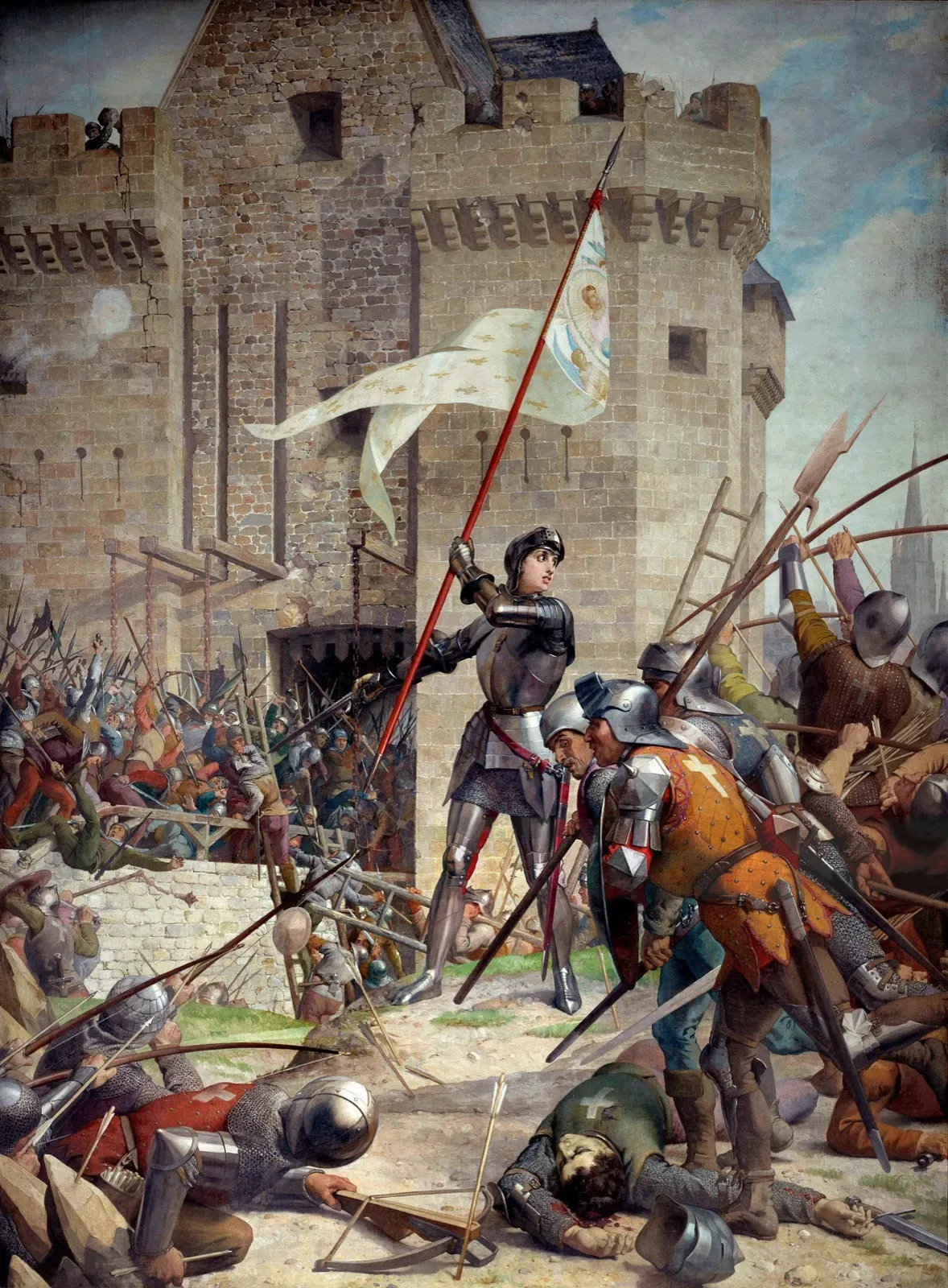
On 4 May, French forces took the easternmost English bastille, St. Loup, killing 140 of its 400-strong garrison. On 6 May, they crossed the river onto the south bank and fought their way to the Augustinian monastery, which they held by nightfall. That left the Tourelles complex - the fortified gatehouse commanding the bridge - as the last English stronghold on the south bank. Its commander was William Glasdale, who had been among the most vocal in mocking Joan from the walls.
On 7 May, Joan was struck by an arrow between the neck and left shoulder early in the assault. Rumours spread through the French lines that she was dead. Her chaplain, Jean Pasquerel, later testified that the day before the attack she had told her men that blood would flow from her body above the breast. She was carried off, pulled the arrow out herself, returned to the fighting, and told the troops that when her banner touched the wall of the Tourelles it was theirs. One soldier shouted that the banner was touching. Joan replied: “Tout est vostre - et y entrez.” All is yours - go in.
The French stormed the Tourelles. In the fighting, the drawbridge connecting the outer boulevard to the gatehouse tower gave way, and Glasdale fell into the Loire and drowned. The Tourelles was taken by nightfall.
On the morning of 8 May, the English tore down their remaining outworks on the north bank, assembled in battle formation in the field, and stood facing the French army. For about an hour, neither side moved. Then the English withdrew and marched north to join their remaining garrisons at Meung and Beaugency. Some French commanders urged an immediate attack to finish them. Joan reportedly refused. It was Sunday.
I should be honest about what Joan actually changed. England had made its own difficulties at Orléans. The Burgundian allies had withdrawn three weeks before she arrived - John of Bedford had been so certain the city was about to fall that he refused a perfectly reasonable offer for Burgundy to take it as neutral territory, and Philip of Burgundy, offended, pulled his 1,500 men out. That left Suffolk badly undermanned for an investment of that scale. The English regent’s confidence had cost him the troops he needed.
What Joan provided was not a military plan - the professional commanders had those - but the one thing the French had lacked since Agincourt: the belief that they could win. The French forces that fought from 4 to 7 May were the same soldiers who had broken and run at the Herrings two months before. The difference was who was carrying the banner. An army that believes it is fighting on the right side, with a cause it can name and a figure it can follow, fights harder than one that is merely working for a paymaster. This is not a complicated theory. It is just how it works.
Charles VII was crowned at Reims on 17 July 1429, barely two months after the siege lifted. Joan stood beside him, holding her banner. She had achieved exactly what she said she would.
She was captured the following year, tried by a church court assembled under English pressure, convicted of heresy, and burned at Rouen on 30 May 1431. She was nineteen. The French won the war in 1453, twenty-two years later. Orléans still commemorates the lifting of the siege on 8 May - which it celebrates alongside V-E Day; the city that was once the last French hold on the Loire gets to mark liberation twice in the same afternoon.
The English, in 1428, had the law, the victories, and the treaty. They had done everything right by the logic of dynastic warfare. What they had not accounted for was a girl with a banner who would not stop until the thing was done. Glasdale drowned in the Loire, and France survived.