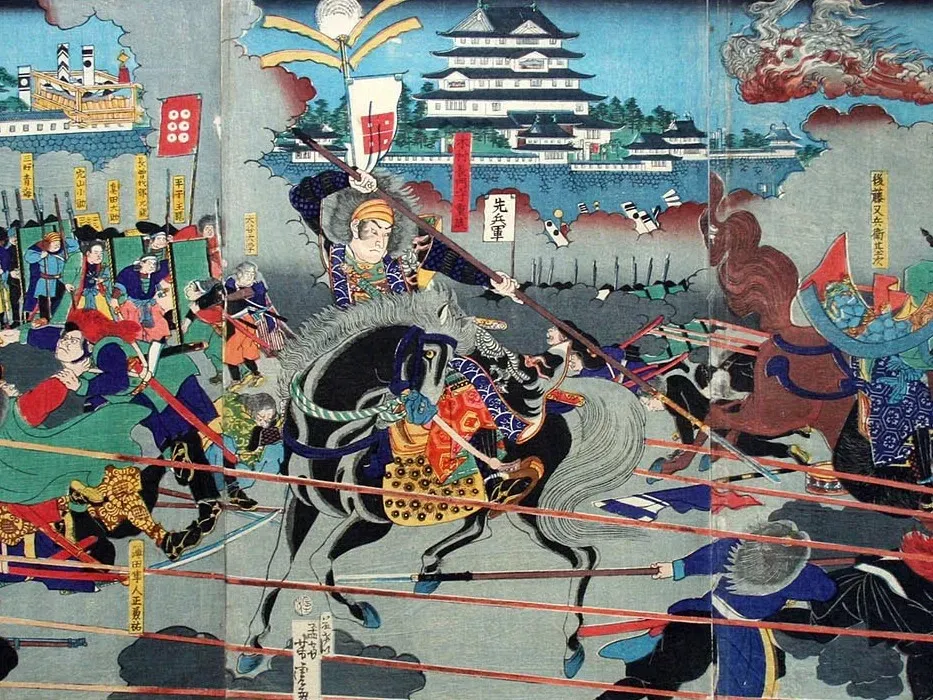
On the morning of 4 June 1615, Osaka Castle was burning. Inside its walls, Toyotomi Hideyori - the twenty-two-year-old heir to the greatest fortune in Japan - sat with his mother, Yodo-dono, as Tokugawa troops closed in. The castle his father had built in 1583 to announce the unification of Japan was collapsing around him. When there was no longer any way out, mother and son committed suicide in the ruins. With their deaths, the Sengoku period - the Era of Warring States - was over. Nearly 150 years of civil war ended in a single afternoon. What came next was not simply peace. It was the most methodically engineered political order in Japanese history, and it lasted for two and a half centuries.
To understand what Ieyasu destroyed at Osaka, you have to understand what it represented. Toyotomi Hideyoshi had risen from peasant foot soldier to the effective ruler of Japan, and Osaka Castle was his monument to that achievement. Constructed on a raised terrace above the Uemachi Plateau, surrounded by concentric moats and granite walls several metres thick, it was the largest fortress in Japan and the seat of the Toyotomi clan’s power and wealth. When Hideyoshi died in 1598, he left behind Hideyori, a young child, and a council of five regents to govern in his name. Tokugawa Ieyasu was one of those regents. He promptly ignored every obligation the role carried. By 1600, he had won the Battle of Sekigahara against the Toyotomi loyalists and claimed the shogunate for himself. But Hideyori lived on in Osaka, growing up with a legitimate claim, a full treasury, and around a hundred thousand ronin - masterless samurai from the losing side of Sekigahara - willing to rally to his banner. Ieyasu was old, and he knew it. He needed to resolve the Toyotomi question before he died.
He did so with characteristic patience. In 1614, Ieyasu manufactured a pretext for war from an inscription on a temple bell Hideyori had commissioned. The text included characters that could be read as a curse on the Tokugawa name. It was thin stuff, but it was enough. After a winter siege that achieved little militarily, Ieyasu negotiated terms requiring Osaka’s outer moats to be filled in. He then had his men fill the inner moats too, while the ink on the agreement was still wet. Hideyori, left with a castle stripped of its primary defences, had no choice but to fight or surrender. He chose to fight. By summer 1615, Ieyasu had assembled roughly 180,000 men and marched on Osaka for the final time.
The siege would have been a footnote in military history were it not for one man. Sanada Yukimura had spent fifteen years in exile after Sekigahara, stripped of his domain and confined to a monastery in Kii Province. When Osaka called for volunteers, he answered. In the Winter Siege, he constructed a fortified outwork at the castle’s southern gate, the Sanada-maru, and from it repelled assault after assault by vastly superior Tokugawa forces. His red armour became a rallying point. In the final summer battle, after Ieyasu’s men breached the walls, Sanada led a furious charge that reportedly came within striking distance of Ieyasu’s command post before he was cut down. He died fighting. The Tokugawa general who faced him called him “the greatest warrior in Japan, second to none.” He was celebrated in defeat more than most generals are in victory, and his legend has never stopped growing - in novels, kabuki plays, films, and, inevitably, video games. He represents the other side of what Osaka meant: the last roar of a way of life that was about to be bureaucratically dismantled.
What Ieyasu built on the ruins of Osaka was not simply the continuation of a military regime. It was a systematic restructuring of Japanese society designed to make another civil war impossible. Within months of the siege, he issued the ikoku ichijo law - one castle per domain - requiring the destruction of hundreds of fortifications across Japan. Lords who had maintained multiple castles as military assets had to tear most of them down. The buke shohatto, the Laws for the Military Houses, followed almost immediately, forbidding daimyo from repairing or expanding the castle they kept without explicit shogunal permission. A generation later, the sankin-kotai system compelled every daimyo to spend alternating years in the capital, Edo, leaving their wives and children behind as permanent, unacknowledged hostages when they returned to their domains. Then, between 1633 and 1639, a series of decrees locked Japan’s ports to almost all foreign trade and contact, severing the external channels through which wealth, weapons, and dangerous ideas might otherwise have flowed.
The sum of these measures was a political architecture of extraordinary precision. It did not simply suppress rebellion; it eliminated the material conditions for rebellion. A daimyo who could not fortify his domain, could not leave his family in it, could not trade freely with the outside world, and could not raise a private army without scrutiny was not a feudal warlord. He was an expensive, elaborately titled civil servant. The samurai class survived for another two and a half centuries, but their function had been hollowed out long before the Meiji Restoration formally abolished them in the 1870s. Japan did not simply end its wars. It built a cage around the people who had been fighting them and called it the natural order.
I come back to Osaka Castle burning on that June morning and find in it a compressed, brutal logic. One hundred and fifty years of civil war did not end because the Japanese grew tired of fighting, or because some genius of diplomacy forged a lasting reconciliation between rival factions. It ended because one man won, killed the last plausible alternative, and then spent the remainder of his political life designing a system in which winning was the only thing that would ever matter again. Ieyasu died the following year, but the architecture held. Japan had two and a half centuries of internal peace, of economic growth, of cultural flowering - and of a ruling class that spent its energies on calligraphy and tea ceremony because every other outlet had been closed. The war Japan decided to end stayed ended. The question history keeps asking is what it cost to keep it that way.