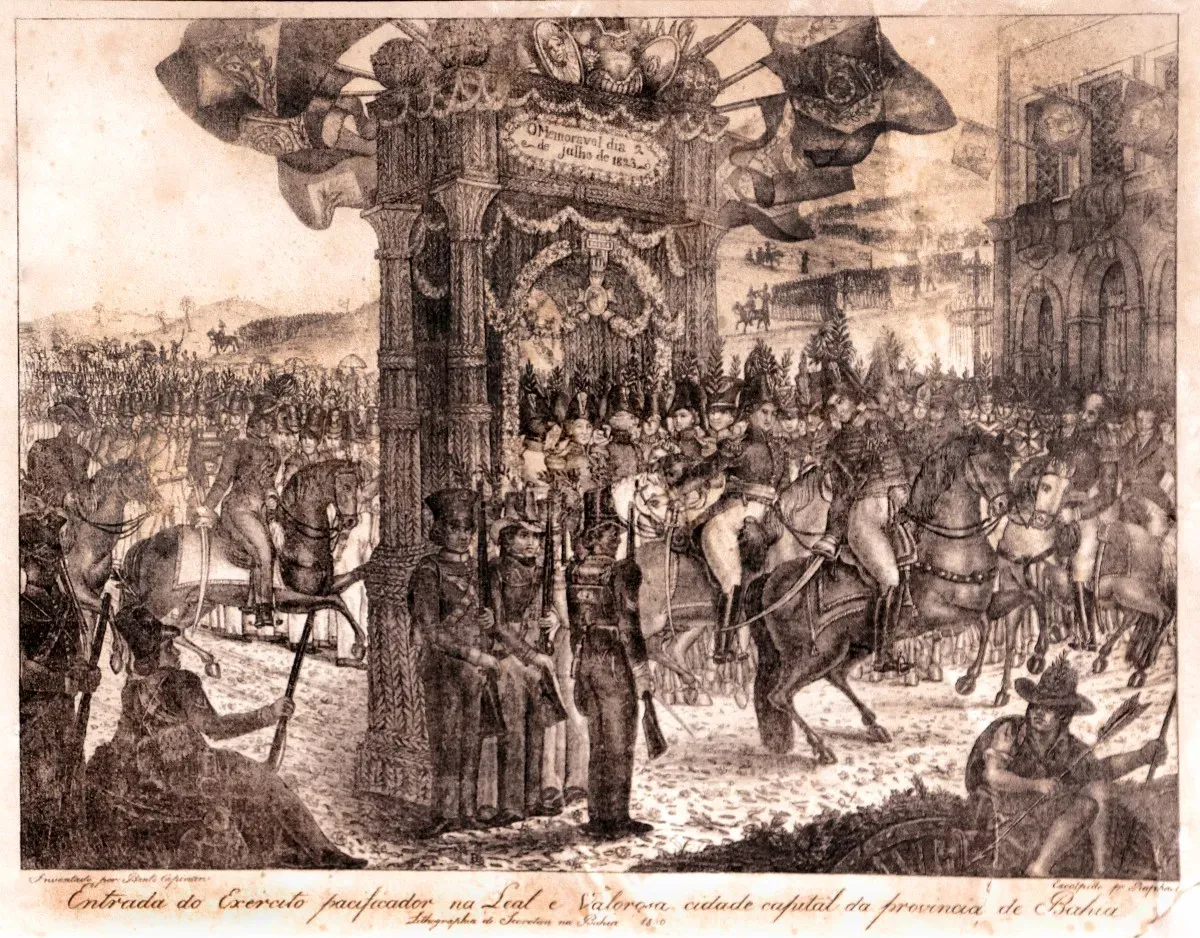
On 19 February 1822, Portuguese sailors stormed the Lapa Convent in Salvador and killed its abbess, Joana Angélica, as she stood in the doorway trying to stop them going after the rebels sheltering inside. That was seven months before Dom Pedro I stood on the banks of the Ipiranga stream and declared “Independência ou morte” - the moment Brazilian schoolbooks treat as the whole story: one prince, one speech, one bloodless afternoon in September 1822. In Bahia the fighting had already started, and it would run for another ten months after Pedro’s cry had faded, ending only when a Portuguese garrison of 4,500 men slipped out of Salvador harbour in the dark, on 83 ships, on the night of 1 July 1823.
The trigger was the one splitting the whole empire that year. Lisbon’s Cortes, alarmed at how thoroughly Brazil had begun governing itself under the exiled Portuguese court - a story that started, aptly, in this same city (The Court That Sailed Too Well) - wanted the colony put back in its place: trade restored to the metropole, the prince regent recalled to Lisbon, home rule reversed. Salvador’s Brazilian population wanted none of it. Brigadier Inácio Luís Madeira de Melo, sent to command the Portuguese garrison in February 1822 specifically to hold Bahia for the Cortes, forced his own inauguration through after Brazilian councillors tried to block it. His troops took the city’s main barracks by force, and in the same days of street fighting stormed the convent and killed the abbess for harbouring rebels. After that, Salvador was two armed camps, not a city with a disagreement.
Sixteen months of siege followed, fought mostly around the edges of the bay: Brazilian militias holding the Recôncavo countryside, Portuguese regulars holding the capital, neither side strong enough to finish the other. The decisive land battle came at Pirajá on 8 November 1822, where a Brazilian brigade under Major José de Barros Falcão was close to breaking under a Portuguese assault when a bugler named Luís Lopes, ordered to sound retreat, sounded the charge instead. The Portuguese, hearing what they took for reinforcements arriving, broke and fled. Bahian folklore has spent two centuries arguing over whether Lopes made a mistake or a choice; either way, Pirajá cost Madeira de Melo his capacity to attack, and the war settled into a blockade he could not break.
Breaking it from the sea took a navy Brazil did not yet have. Thomas Cochrane, a British admiral who had already run Chile’s fleet against Spain, arrived off Bahia in March 1823 to take command of a force that barely qualified as one - converted merchantmen, a handful of frigates, crews of Portuguese defectors and foreign volunteers thrown together in weeks. On 4 May 1823 he took this improvised squadron out against a larger Portuguese fleet, cut through its line, and forced it back into harbour. The battle itself settled little, but it let Cochrane seal the blockade completely, cutting off the food that had kept Salvador’s garrison fed. A fleet assembled that quickly, under a foreign admiral, doing the one job it was built for, is as good a founding moment as the Brazilian navy ever got.
The army outside Salvador looked nothing like the political elite who get the credit for Ipiranga. Maria Quitéria de Jesus fought disguised as a man in an artillery unit until her sex was discovered, after which Dom Pedro commissioned her as an officer rather than sending her home. Antônio and Manuel Rebouças, sons of a freed slave, served the rebel cause as, respectively, secretary to the provisional government and a volunteer soldier - the family later produced the abolitionist engineer André Rebouças. Indigenous councils as far off as Vila Verde, near Porto Seguro, held their own ceremonies acclaiming Dom Pedro months before Salvador fell, using the same language of liberty and citizenship the Rio elite used for itself. None of that fits on a banknote. All of it fought the war.
Madeira de Melo never formally surrendered. Starving, with no relief coming, he loaded his remaining 4,500 troops onto 83 ships on the night of 1 July and sailed for Portugal, carrying off what plate and cash the retreat allowed. Cochrane chased the fleet most of the way across the Atlantic, capturing seven ships before giving up near the Portuguese coast. Brazilian troops entered an empty Salvador the following morning, met, so the tradition goes, by a flower arch built by the sisters of the Convent of Solitude. Roughly 150 Brazilians died in combat across the whole sixteen-month campaign - a modest cost against what it secured. Bahia was one of several provinces, alongside Pará and Maranhão, that could have stayed Portuguese or struck out alone. Had enough of them gone that way, Brazil could easily have splintered the way Spanish America did, into a dozen quarrelling republics instead of one continental state.
Salvador’s fall is still the bigger anniversary in Bahia than the seventh of September is nationally - a local holiday, with parades that retrace the route Brazilian troops marched into the city, held every year since. That imbalance makes sense once you know both stories. Ipiranga gave Brazil a legend simple enough for a banknote: a prince, a river, a single sentence. Salvador gave it the part that actually cost something - a murdered abbess, a wrongly-blown bugle call, a hired admiral, a freed slave’s sons, and 4,500 soldiers slipping out to sea because they had run out of anything else to do. Independence gets dated to whichever moment produces the better speech. Brazil’s was decided by whichever moment produced the empty city.