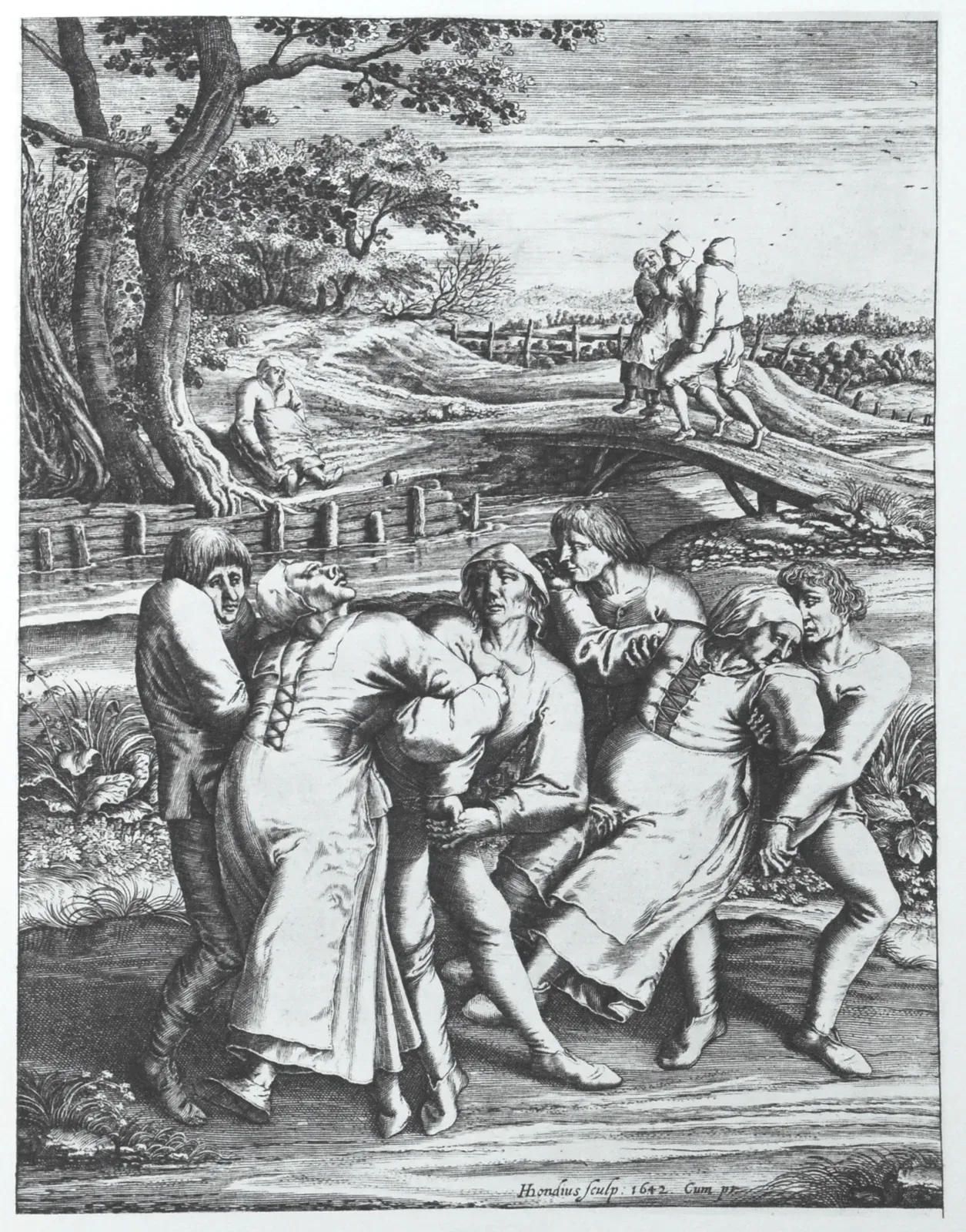
On 24 June 1374, the feast of St. John the Baptist, one of the more bizarre recorded events in history began - people in the streets of Aachen began to dance. They were not celebrating. Contemporary accounts describe them seizing and twitching, jumping uncontrollably, screaming and weeping and laughing. They reported hallucinations. Many collapsed from exhaustion. Some danced until their ribs broke and died. Within weeks, the outbreak had spread to Cologne, Strasbourg, Metz, Tongeren, Flanders, Franconia, Utrecht, and eventually into Italy and the Duchy of Luxembourg. Tens of thousands of people were affected across dozens of cities. The medieval world called it St. John’s Dance, or St. Vitus’ Dance, or choreomania - from the Greek for dancing madness. The name it most deserves, as a diagnosis of collective human psychology, came much later: mass psychogenic illness.
The behaviour recorded in 1374 was not simply eccentric dancing. People paraded through the streets in strange, colourful clothing, carrying wooden sticks. Some walked naked and made obscene gestures. Some had sexual intercourse in public. Others crawled on all fours. Contemporary sources report that participants could not tolerate the colour red and sometimes became violent upon seeing it. They could not bear pointed shoes. They apparently enjoyed having their feet struck. Bystanders who refused to join in were sometimes attacked. These were not the symptoms of a handful of unhinged individuals; whatever was happening, it was moving through communities like a contagion, dissolving the social rules that normally organised people’s behaviour entirely.
The authorities of the age responded in the ways they knew. The clergy performed exorcisms, since the dominant interpretation was demonic possession or divine punishment - a curse sent by St. John or St. Vitus, who was prayed to and petitioned to end the dancing. Neither worked. Municipal authorities in several cities hired musicians to play for the dancers, on the logic that rhythm and music had a long classical tradition as treatment for nervous disorders. The musicians played. More people began to dance. This is not the most embarrassing episode in the history of medicine, but it is close.
None of this happened in a social vacuum. The Black Death had reached Europe from Crimea in 1346 and spent the following years moving through an unexposed continent with lethal efficiency. When the worst of it passed, somewhere between a third and half of Europe’s population was dead. What followed was not clean survival: plague recurred in waves throughout the 1350s, 1360s, and 1370s, with no moment of definitive safety, only successive rounds in which survivors watched the next wave come. Agricultural systems were disrupted. Whole villages had been emptied. The religious structures that had always provided frameworks for understanding suffering had provided nothing useful - the prayers had not stopped the dying, and the flagellants who whipped themselves through European towns as penance had not stopped it either. By 1374, Aachen was a city twenty-five years into a sustained encounter with catastrophe that its explanatory systems could not adequately address.
The leading modern hypothesis for what happened is mass psychogenic illness: a phenomenon in which physical symptoms with no organic cause spread through a group via social contagion. The mechanism is not fully understood, but the pattern is consistent. It tends to strike populations under extreme and sustained stress. It travels through existing social networks and along trade routes - which is precisely what the 1374 outbreak did, following the commercial connections between Rhineland cities rather than spreading in random directions. And it produces genuine physical symptoms: the chest pains, convulsions, and hyperventilation reported were not invented. The body, under sufficient psychological pressure, generates these responses without any external pathogen.
The competing theory is ergot poisoning. Ergots are fungal growths on damp rye grain that produce compounds chemically close to LSD - capable of causing hallucinations, convulsions, and a burning sensation in the extremities known in the Middle Ages as St. Anthony’s Fire. The connection has been proposed for the dancing plagues, the Salem witch trials, and various other medieval episodes of collective strange behaviour. The late fourteenth century was wet and poor, and contaminated grain would have been routine among the people least able to afford clean food. This could explain the hallucinations and convulsions. What it cannot explain is why the behaviour spread systematically through cities rather than being concentrated around particular grain supplies, or why the specific social patterns - the marching, the colour aversions, the communal dynamics - repeated so precisely across different outbreaks in different locations.
Both theories are probably capturing part of what happened. A population under severe chronic stress, with a contaminated food supply, living inside a religious framework that interpreted suffering as divine communication, connected by trade routes that moved people and their behaviour between cities - something in that combination produced, not once but repeatedly across three centuries, episodes in which tens of thousands of people danced in the streets until their bodies failed.
What I find hard to dismiss, thinking about Aachen on 24 June 1374, is the sequence: the Black Death, and then the dancing. These were people who had watched their neighbours die in the millions, who had buried children and priests and lords, who had prayed to God and to saints and had received nothing in return. Twenty-five years on - two full generations living under the shadow of recurring plague, in a world that made no consistent sense - people stood up in the street on a midsummer feast day and began to move in ways they could not control, and would not stop until their bodies gave out.
The dancing was the expression. The plague was the wound. Aachen’s streets fell quiet again, eventually. The wound, as the records make plain, took considerably longer.