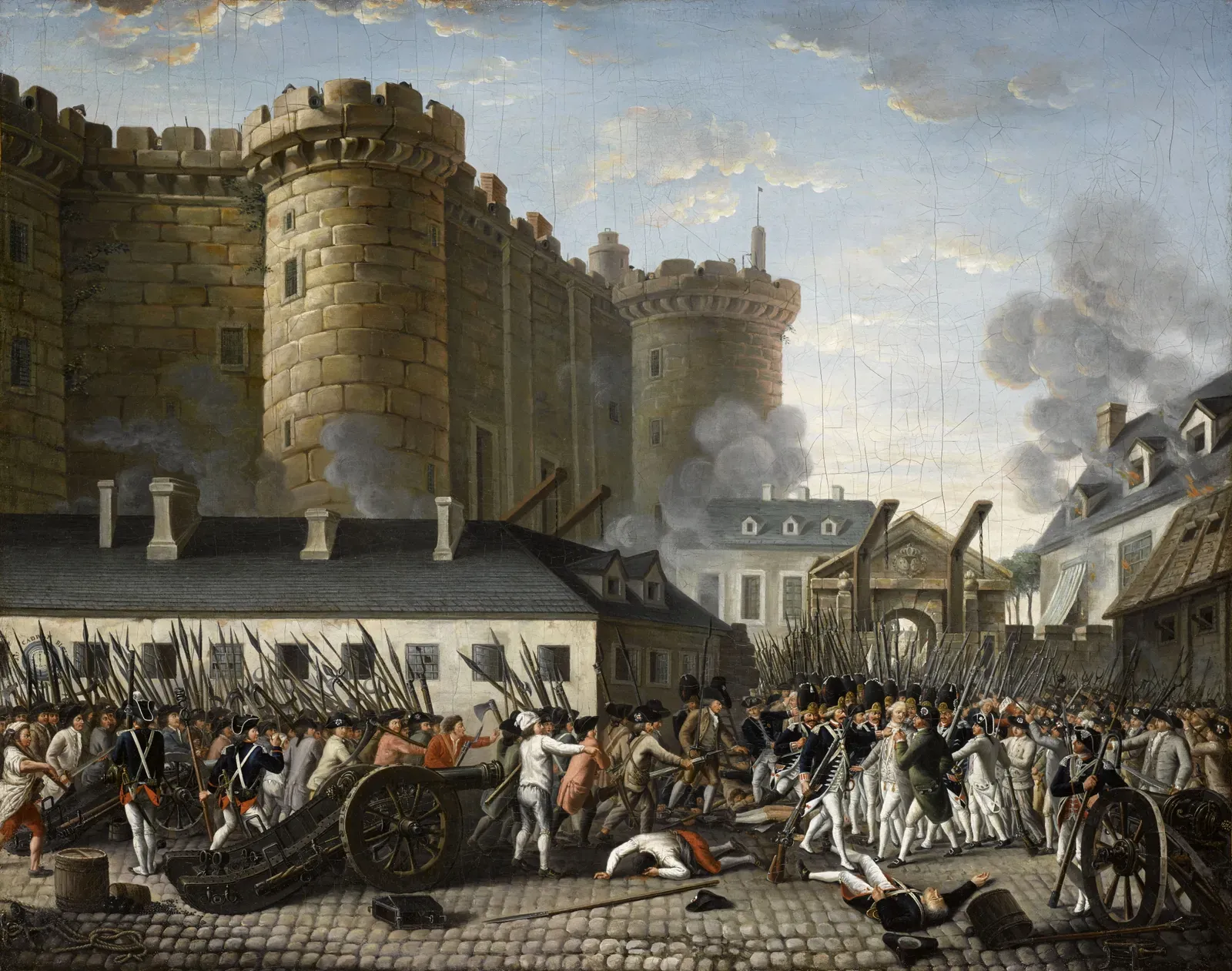
On the morning of 14 July 1789, several thousand Parisians surrounded a medieval fortress on the eastern edge of the city and demanded that its cannon be withdrawn from the walls and its gunpowder handed over. By evening, the governor was dead, dragged through the streets to the Hôtel de Ville and stabbed to death by a crowd that included a pastry cook he had just kicked in the groin. Ninety-eight of the attackers had died taking the building, against one defender. When the gates finally opened, the victors found seven prisoners inside: four forgers, a man who had tried to assassinate Louis XV thirty years earlier, an Irishman held as a suspected spy on his own family’s request, and a count locked up by his father for being a bit too enthusiastic about murder. The Bastille had already been scheduled for demolition before anyone laid siege to it. Paris spent dozens of lives capturing a building the state itself had already condemned.
The context was a country coming apart at the finances. Louis XVI’s government had bankrolled the American Revolution, endured a run of bad harvests, and leaned on a tax system that fell hardest on the people least able to pay it. The Estates General, convened in May to sort out the mess, got bogged down in procedure until the Third Estate broke away in June and declared itself the National Assembly - a body writing France a constitution whether the king liked it or not. He did not like it, but by 9 July he had been forced to accept it, at least on paper. Paris, meanwhile, was watching every session and taking the debates personally.
Then, on 11 July, Louis dismissed Jacques Necker, the finance minister who had shown some sympathy for the Third Estate, and replaced his entire ministry with conservative nobles overnight. News reached Paris the next afternoon, and the city read it correctly as the opening move of a royalist crackdown. More than 10,000 people gathered at the Palais-Royal, where Camille Desmoulins climbed onto a table, pistol in hand, and told the crowd that the Swiss and German mercenary regiments camped outside the city would massacre them by nightfall unless they armed themselves first. Royal cavalry charged protesters near the Tuileries that same afternoon. By the following morning, the crowd had already broken into the Hôtel des Invalides and helped itself to 30,000 muskets - useless without powder, which the commandant there had, in a decision that did not age well, moved to the Bastille for safekeeping a week earlier.
So the crowd that gathered outside the Bastille on the 14th was not looking for prisoners. It was looking for gunpowder, and it was carrying a grudge against a building that had represented arbitrary royal imprisonment for four centuries, regardless of who happened to be inside it that particular Tuesday. Two delegates from the Hôtel de Ville went in to negotiate around midday; a third followed with formal demands. The talks dragged. The crowd, now numbering close to a thousand, grew impatient and surged into the undefended outer courtyard around half past one. Someone climbed onto an adjoining roof and cut the chains on the drawbridge, which crashed down and crushed one of their own. Soldiers on the walls shouted for the crowd to withdraw; in the noise, this was heard as encouragement. Gunfire started, nobody is entirely sure from which side first, and the negotiation became a siege.
It stayed a siege for the better part of four hours, reinforced after three o’clock by mutinous French Guards who arrived with two cannon and set some farm wagons of damp straw alight for cover, which mostly just produced smoke that blinded both sides equally. A force of five thousand Royal Army troops sat on the nearby Champ de Mars and did nothing at all - the single decision, or non-decision, that historians generally blame for the fortress falling. Walled fortresses are good at their job even in 1789: the garrison’s cannon and thick stone did the work you would expect, and the lopsided casualties prove it. De Launay, the governor, offered to surrender in exchange for safe passage, and threatened to blow the whole place up with 250 barrels of gunpowder if he was refused. He was refused. He opened the gates anyway at half past five, having concluded that a garrison with no water supply and dwindling food was not winning this by holding out.
What followed the surrender was not proportionate to anything that had actually happened inside the walls. De Launay was seized and marched toward the Hôtel de Ville under a hail of blows, screaming for someone to finish him rather than prolong it. Someone did, with a knife, repeatedly, in the street. Three of his officers and several of the garrison’s veteran soldiers were killed by the crowd despite having laid down their arms. Jacques de Flesselles, the city’s chief municipal official, was assassinated on his way to what was billed as a trial. Both his head and de Launay’s ended up on pikes, carried through the streets to general acclaim; an English doctor who witnessed it called it “a chilling and a horrid sight” and left immediately. This was not the fury of men who had just watched their friends die for nothing - although 98 of them had. It was the fury of people settling a much older account, on the first man unlucky enough to be standing in front of them when the account came due.
None of this required the Bastille to actually be dangerous, which is the detail that gets lost. The fortress the revolutionaries destroyed was already a relic even to the monarchy: too expensive to garrison for what it did, its planned closure agreed before the mob arrived, its seven inmates so unthreatening that one of them was a count imprisoned by his own family for bad behaviour rather than by the state for political dissent. The Marquis de Sade had been a prisoner there until ten days earlier, removed after he stood at his window shouting to passers-by that the prisoners inside were being slaughtered - a lie, but a lie that primed exactly the audience that showed up on the 14th. The Bastille’s menace was almost entirely retrospective: four centuries of lettres de cachet and disappeared dissidents, condensed into a silhouette on the skyline that had stopped meaning much in practice and never stopped meaning everything in principle.
That is precisely why it worked as the spark it became. When the Duke of La Rochefoucauld told Louis XVI the next morning what had happened, the king reportedly asked, “Is it a revolt?” The duke corrected him: “No, sire, it is not a revolt, it is a revolution.” Within days, the nobility began fleeing the country, the National Guard had a new commander in Lafayette, and rural France was burning château title-deeds in a wave of panic historians call the Great Fear. The demolition contractor who got the job of tearing down the actual walls sold the bricks as souvenirs and turned the chains into medals. Lafayette gave the fortress’s one-pound key to George Washington, who displayed it in New York and Philadelphia; it still hangs at Mount Vernon. France still marks the date as its national holiday.
None of that political weather depended on what was actually inside the Bastille on 14 July 1789. It depended entirely on what the Bastille had come to mean, which is a lesson revolutions keep re-teaching and people keep failing to learn in advance: you can tear down a building that no longer holds anything worth guarding and still call it the day everything changed, because you were never really fighting the building. Ninety-eight people died proving that a symbol, once it has calcified into shorthand for everything wrong with a regime, becomes more dangerous than the substance it was ever supposed to represent - dangerous enough that a fortress already marked for the wrecking ball could still take down a monarchy on its way out the door.