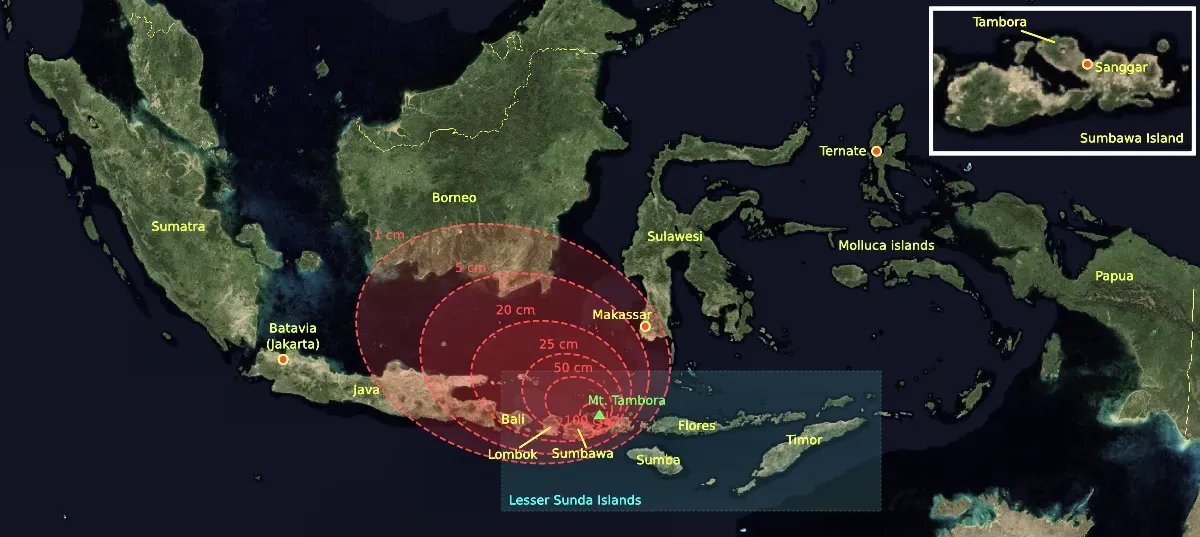
On the evening of 5 April 1815, the Dutch garrison in Java dispatched soldiers to investigate what sounded like distant cannon fire. They found no battle, no ships, no attackers. The noise was Mount Tambora, on the island of Sumbawa, roughly 1,300 kilometres to the east. What the garrison heard was the precursor. The eruption proper came five days later.
On 10 April 1815, Tambora erupted properly - meaning with a column of ash and gas that rose 43 kilometres into the stratosphere, meaning with pyroclastic flows that swept off the mountain at several hundred kilometres per hour and destroyed every settlement within reach, meaning with a sound audible in Sumatra, 2,600 kilometres away. Around 160 cubic kilometres of material were ejected. The Tamboran people - a distinct culture with their own language, their own agriculture, their own sense of themselves as a people - were erased. Their language vanished with them; nobody survived to speak it. Roughly 10,000 people died that night. Eventually the total death toll, including the famine and disease that followed across Sumbawa as ash blanketed every field, would reach an estimated 71,000. It was a VEI 7 eruption - there have been perhaps six events of that scale or larger in the last ten thousand years.
None of that, devastating as it was, is why Tambora still matters.
The reason it matters is what the eruption did to the rest of the world, across the following two years, in places where nobody had heard the sound or seen the smoke or lost a single relative. The enormous quantities of sulphur dioxide that Tambora injected into the stratosphere reacted with water vapour to form sulphate aerosol particles that circled the globe, reflecting and scattering incoming solar radiation. The planet’s average surface temperature dropped somewhere between 0.4 and 0.7°C. That sounds modest. In practice, it meant that the summer of 1816 did not come.
In June 1816, snow fell in Quebec and across New England. Frosts killed crops in July and August from Vermont to Virginia. Throughout Europe the summer was cold, wet, and dark. In Germany and Switzerland, grain prices rose sharply in the spring of 1817, triggering food riots in the streets. In France, the harvest was poor enough to require emergency state intervention in grain markets. In Ireland, oat and potato crops failed, and a typhus epidemic - a disease that reliably accompanies famine - moved through a population already weakened by hunger. In China, cold and flooding in Yunnan destroyed rice harvests and drove farmers off their land entirely. The disruption to monsoon patterns across the Bengal region in 1817 may have contributed to the emergence of a new, more virulent cholera strain - the trigger for what became the first of seven cholera pandemics, which over the following century and a half would kill tens of millions of people worldwide.
One volcanic eruption. Three continents destabilised. A pandemic possibly triggered on the far side of the planet.
There is a literary footnote that makes the picture stranger still. The summer of 1816 kept a group of writers and poets - Byron, Percy Shelley, and the eighteen-year-old Mary Godwin - huddled indoors at a villa on Lake Geneva while the sulphate-dimmed sky produced incessant rain and cold. Byron proposed a ghost story competition. Mary Godwin wrote hers. The creature stitched together from corpses by Dr Frankenstein, brought to life in a world that had no place for it, was conceived during the volcanic winter that Tambora made. J. M. W. Turner’s paintings from the same period, with their extraordinary orange and red saturated skies, are thought to capture the actual optical effects of aerosols in the atmosphere. The mountain gave us, along with the famine, both Frankenstein and some of the most arresting sunsets in western painting.
Now comes the part that we should sit with.
We have satellites, precision agriculture, global supply chains, and real-time data on atmospheric conditions that would have looked like sorcery to anyone living through 1816. We have made ourselves safer from disease, from weather, from ordinary scarcity, than any generation before us. The daily death rate from famine globally has dropped by roughly ninety per cent since the mid-twentieth century. This is a genuine and remarkable achievement.
But not from Tambora.
The global food system is fine-tuned, highly efficient, and profoundly brittle. The margin between production and demand in any given year is narrow. Tambora-scale eruptions are not geological freaks; they occur on average once or twice a century. An equivalent event today would cut growing-season temperatures across the northern hemisphere for two to three years running. Modern crop varieties, engineered for maximum yield under normal conditions, are in many respects less resilient than their ancestors, not more. Global trade can redistribute food across borders, but it cannot create food that was never grown. Emergency stockpiles, where they exist, are measured in months.
There are things you can do about pandemic preparedness: surveillance systems, vaccine platforms, stockpiles, public health infrastructure. For a volcanic winter, the honest menu of options is considerably shorter. You cannot deflect sulphate aerosols. You cannot restart a suppressed growing season. You can build food reserves, develop cold-resistant crop varieties, and maintain famine contingency plans - and some of this work does happen, patchily and under-resourced - but ultimately you are dependent on the geology behaving. So far, it has. The Holocene has been unusually quiet. We have had the run of a geologically calm stretch of history, and we have mistaken the absence of catastrophe for evidence that catastrophe is no longer possible.
The volcanoes are still there. Campi Flegrei, a supervolcano sitting under the western edge of Naples, has been showing significant ground uplift and seismic unrest for decades. Yellowstone last erupted in full 640,000 years ago and remains active. Tambora itself has shown activity in the decades since 1815. These systems operate on timescales that make human civilisation look like an afternoon.
On 10 April 1815, a mountain on a small Indonesian island made a sound heard 2,600 kilometres away and spent the following two years demonstrating, in crop failures and famine records and ice cores that still carry the chemical signature of that eruption, exactly how thin the margin is between a functioning agricultural civilisation and a hungry one. We have since added seven billion people to the planet, optimised our food networks for efficiency rather than resilience, and spent a great deal of time discussing things that will matter considerably less than the harvest if the next Tambora arrives on schedule. The mountain does not know or care about any of this. That is, precisely, the problem.