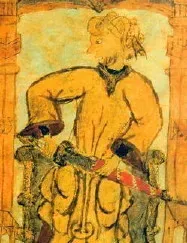
The name “Gibraltar” is Arabic. Jebel al-Tariq: Mountain of Tariq. On 27th April 711, a Berber military commander called Tariq ibn Ziyad crossed the strait from North Africa with roughly 7,000 men. By July he had destroyed the Visigothic Kingdom at a single battle. By 715, most of the Iberian Peninsula was under Muslim rule. The rock still carries his name.
The conquest happened so quickly because the kingdom he was invading had already largely dissolved. The Visigoths had ruled Hispania for roughly three centuries, but they were a thin ruling class - perhaps 1 to 2 per cent of the total population - governing over a Hispano-Roman majority that had little reason to feel loyalty to them. The ruling house was in the middle of a succession crisis. King Roderic had taken the throne in disputed circumstances, apparently through a coup against the family of his predecessor. A rival claimant, Achila II, still held the north-east. The Chronicle of 754, the closest thing to a contemporary account of the conquest, describes Roderic’s own army arriving “fraudulently and in rivalry out of hopes of the Kingship” and fleeing when things went wrong. He was not leading a unified kingdom into battle. He was leading a faction.
According to the later chronicler Ibn Abd al-Hakam, Tariq’s troops crossed largely unnoticed - the locals, he reports, thought the vessels were merchant ships. What happened at the Battle of Guadalete in July 711 is not entirely clear, because the chronicle record is thin and later accounts are thickened by centuries of ideological retelling. What is clear is the outcome: Roderic was killed, his army disintegrated, and the power vacuum this created left, as one historian put it, “the entire land open to the invaders.” Take out the king and the kingdom collapses. That is what happened.
The following year, Tariq’s superior, Musa ibn Nusayr, crossed from North Africa with 18,000 Arab troops. Together they moved north: Seville fell, then Mérida after a siege, then León, Astorga, Zaragoza. Some towns surrendered on negotiated terms, their Christian populations left under Visigothic law, required only to pay tribute and recognise Umayyad authority. Others were stormed. By 719, Barcelona and Narbonne had been captured. By 732, Umayyad armies were deep into France, until Charles Martel stopped them at Tours.
The speed of it is still striking. From the landing at Gibraltar to effective control of most of the peninsula took less than a decade. The Visigothic Kingdom, which occupied all of Hispania and looked formidable enough on a map, could not absorb the shock of losing its army and king simultaneously. Its failure was political as much as military: a ruling class comprising 1 to 2 per cent of the population, already fractured by civil war, had no reserves of loyalty to draw on when the crisis came.
What replaced it was al-Andalus, which at its height under the Caliphate of Córdoba in the 10th century was one of the most sophisticated civilisations in western Europe - its libraries, hospitals, and astronomical observatories far ahead of anything the northern Christian kingdoms could manage. Its ending, the fall of Granada in January 1492, is the other end of the same story, which I covered in The Moor’s Last Sigh.
The resistance to the conquest started almost immediately and in the most unlikely place. In 722, a Visigothic nobleman called Pelagius - Pelayo in Spanish - defeated a Muslim patrol in the mountains of Asturias at a battle the sources call Covadonga. The military significance was minor. The political meaning inflated over time: Covadonga became the symbolic founding moment of the Reconquista, and the small Christian enclave in the Asturian highlands became the kernel from which the northern kingdoms slowly expanded southward over the following seven centuries.
What runs through the whole arc, from 711 to 1492, is the same structural pattern: the internal weakness that enabled the conquest was mirrored in the rule that followed. Al-Andalus was almost never unified. The Umayyad caliphs gave way to the taifa kingdoms - small, competing Muslim principalities that fought each other as readily as the northern Christians pressing down. When they needed reinforcement, they called in North African troops - the Almoravids, the Almohads, the Marinids - who tended to behave as conquerors rather than allies. Granada survived as long as it did by playing Aragon and Castile against each other. When Ferdinand and Isabella married in 1469 and united those crowns, that strategy became impossible.
Tariq ibn Ziyad crossed the strait on 27th April 711 and walked into a kingdom that was already hollow. What he started lasted 781 years. The rock at the entrance to the Mediterranean still carries his name - which is, when you think about it, a more durable legacy than most conquerors manage.