On 28 February 1525, in the Chontal Maya province of Acalan — deep in the jungle of what is now Campeche, hundreds of miles from the ruined capital he had once defended — Cuauhtémoc, the last emperor of the Aztecs, was hanged from a ceiba tree on the orders of Hernán Cortés. He was twenty-eight years old. Cortés had dragged him along on an expedition to Honduras, afraid to leave him behind in Mexico where he might rally an uprising. The pretext for the execution was an alleged conspiracy: Cortés claimed a citizen of Tenochtitlan had revealed that Cuauhtémoc and two other captive lords were plotting to kill the Spanish. Cortés interrogated them, extracted confessions, and ordered the hangings. The account we have from Bernal Díaz del Castillo — a soldier who served under Cortés and liked Cuauhtémoc personally — says the plot was fabricated, the evidence nonexistent, and the executions unjust. According to Díaz, Cuauhtémoc spoke his last words through La Malinche, Cortés’s interpreter: “Oh Malinzin! Now I understand your false promises and the kind of death you have had in store for me. For you are killing me unjustly. May God demand justice from you, as it was taken from me when I entrusted myself to you in my city of Mexico.”
Díaz wrote that afterwards Cortés could not sleep, that he wandered in the dark and fell and injured himself. Guilt will do that to a man. A later account, from the Texcocan historian Ixtlilxóchitl, was blunter still: the three lords had been laughing and joking with one another, and Cortés invented the conspiracy wholesale. The name Cuauhtémoc means “one who has descended like an eagle” — a raptor diving on its prey. By 1525, the eagle had long since been prey himself.
The story of how he got there is one of the most extraordinary military episodes in recorded history, and also one of the most lopsided. In February 1519, Hernán Cortés — a minor colonial official from Cuba, aged thirty-three, with essentially no military experience — sailed for the Mexican mainland with roughly five hundred soldiers, a hundred sailors, thirteen horses, and a handful of small cannon. He had been commissioned by the governor of Cuba, Diego Velázquez, and then had his commission revoked at the last moment. He went anyway. On landing, he did two things that defined everything that followed. First, he acquired La Malinche, a Nahua woman enslaved among the coastal Maya, who spoke both Nahuatl and Chontal Maya, and who became his interpreter and the indispensable link between the Spanish and every indigenous people they encountered. Second, at Veracruz, he scuttled his own ships — eliminating retreat as an option and concentrating his men’s minds wonderfully.
Then he marched inland toward Tenochtitlan, the Aztec capital, a city of perhaps two hundred thousand people built on an island in Lake Texcoco, larger than any city in Spain. On the way, he fought the Tlaxcalans — a confederation that had resisted Aztec domination for generations — beat them in several engagements, and then recruited them as allies. At Cholula, he massacred thousands of unarmed nobles in the central plaza, either as a calculated act of terror or in response to a real or imagined plot. On 8 November 1519, Cortés and his men entered Tenochtitlan and were received peacefully by the emperor Moctezuma II. Within days, Cortés had taken Moctezuma hostage in his own palace. The arrangement held until it didn’t.
In June 1520, while Cortés was away fighting a rival Spanish force on the coast, his lieutenant Pedro de Alvarado massacred Aztec nobles during a festival. The city erupted. Moctezuma was killed — stoned by his own people, according to Spanish accounts. On 30 June 1520, the Spanish fought their way out of Tenochtitlan along one of the lake causeways in a running battle that killed roughly eight hundred and seventy of Cortés’s men and thousands of his indigenous allies. The Spanish called it La Noche Triste.
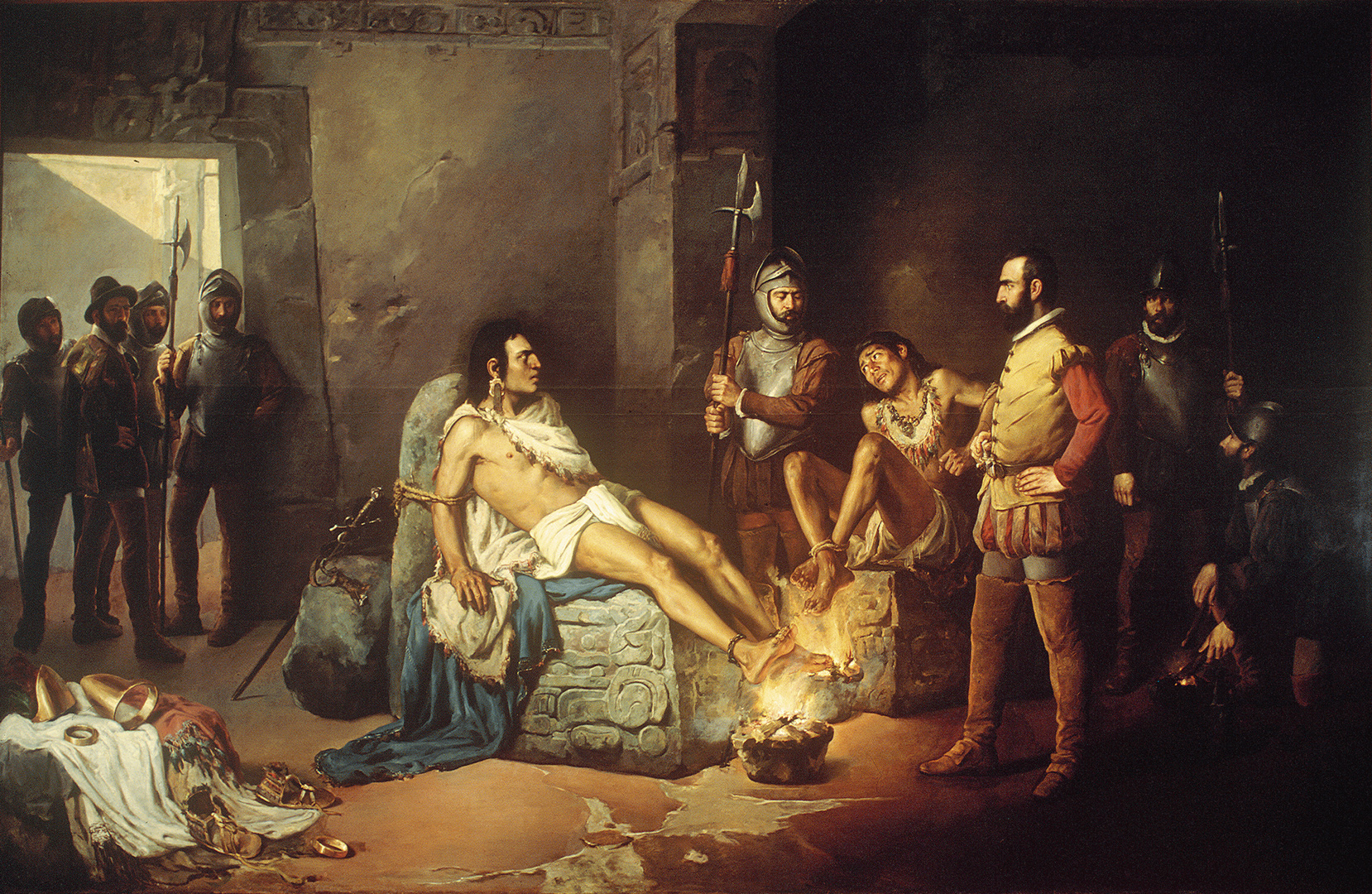
It should have been the end. It was not. Cortés retreated to Tlaxcala, rebuilt his forces, constructed thirteen brigantines in sections and carried them overland to the lake, and in May 1521 began a siege that lasted eighty days. By the time Tenochtitlan fell on 13 August, the city was rubble. Cuauhtémoc — who had become tlatoani after Moctezuma’s successor Cuitláhuac died of smallpox — was captured fleeing by canoe across the lake with his family. He asked Cortés to take a knife and kill him on the spot. Cortés refused, told him he had defended his capital like a brave warrior, and then later had his feet roasted over hot coals to extract the location of Aztec gold. The gold, when found, was far less than the Spanish had expected.
How did five hundred men destroy an empire of millions? The standard answer — superior technology — is part of it but not enough. Steel swords, crossbows, arquebuses, cannon, and horses were sights the Aztecs had never encountered, and the psychological impact of cavalry and gunfire on men who had never seen either was enormous. But the Spanish didn’t conquer Mexico alone. They conquered it with the help of tens of thousands of indigenous warriors who had their own reasons for wanting the Aztecs finished. The Aztec Empire was barely a century old. The Triple Alliance of Tenochtitlan, Texcoco, and Tlacopan, formed around 1428, had expanded through relentless warfare and sustained itself through tribute — goods, labour, and human beings for sacrifice. Subject peoples paid or they were destroyed.
The Tlaxcalans had fought the Aztecs for decades and despised them. The Totonacs of Cempoala resented them. Dozens of other groups saw in the Spanish an opportunity to settle scores that predated Cortés by generations. When Cortés exploited these fractures, he was not manipulating innocents. He was offering an alliance to peoples who understood exactly what they were doing — and who calculated, reasonably, that Spanish overlordship might be preferable to Aztec overlordship. That they were wrong about the long-term consequences does not make them fools. Nobody in 1519 could have predicted what was coming.
What was coming was death on a scale that has few parallels in human history. Smallpox arrived in Mexico in 1520, carried by an African slave in the force sent to arrest Cortés. It killed Cuitláhuac, Cuauhtémoc’s predecessor, within eighty days. It ravaged Tenochtitlan during the siege, killing defenders faster than the Spanish could.
But smallpox was only the beginning. Measles followed in 1531. Typhus — or something the sources describe in terms consistent with typhus — swept through in 1545 and again in 1576. The indigenous population of central Mexico, estimated at somewhere between fifteen and twenty-five million before contact, collapsed to roughly one million by the early seventeenth century. The numbers are debated; the trajectory is not. Old World diseases, against which the populations of the Americas had no immunity whatsoever, did what no army could have done. The military conquest opened the door. Disease walked through it and emptied the continent. Cortés and his five hundred men could not have held Mexico against a population of twenty million. They didn’t have to. The microbes did the holding for them. This is the fact that makes the conquest of the Americas unlike any other imperial expansion in history: the colonisers’ most effective weapon was one they didn’t know they were carrying.
Modern Mexico is the direct product of what Cortés began. The country’s population is overwhelmingly mestizo — a blend of indigenous and Spanish ancestry that is the living genetic record of the conquest. The Spanish language is spoken from the Rio Grande to Tierra del Fuego because of what happened in the decades after 1519. Catholic churches were built on the foundations of Aztec temples, often from the same stones. Mexico City stands on the drained lake bed of Tenochtitlan, sinking slowly into the soft clay because the city that replaced the Aztec capital was never meant for that ground.
And Cuauhtémoc — the twenty-eight-year-old king hanged from a jungle tree — is a national hero. His face has appeared on Mexican coins and banknotes. A monument to him stands on the Paseo de la Reforma in Mexico City, with a bas-relief depicting the Spanish burning his feet. His name remains one of the few pre-Columbian given names perennially popular for Mexican boys: the politician Cuauhtémoc Cárdenas, the footballer Cuauhtémoc Blanco. Cortés, by contrast, has almost no public monuments in the country he conquered. When President López Portillo tried to erect a bust of Cortés in 1981, nationalists attempted to destroy it and it had to be removed from public view. The bones of the conqueror lie in a church in Mexico City under a plain bronze plaque, unmarked for most of the past two centuries to protect them from vandalism. The bones of the conquered are celebrated. That tells you something about what five hundred years can do to a story. Cortés started something on the beaches of Veracruz that reshaped two continents, killed millions, created nations, fused civilisations, and produced a world that neither the Spanish soldiers nor the Aztec warriors of 1519 could have imagined. We are all, in one way or another, still living in it.