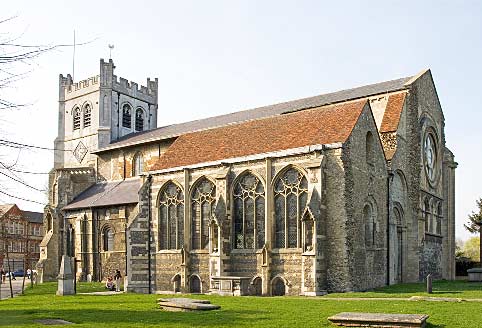
On 23 March 1540, the abbot of Waltham Abbey handed over the set of large iron keys. The monks received their pensions, dispersed, and the buildings began their slow decline into ruin. It was an unremarkable ending for an unremarkable morning - except that Waltham was the last. Close to 900 religious houses had been dissolved across England in five years; this was the final one.
King Harold Godwinson’s bones lay beneath the churchyard. He had rebuilt the church in stone around 1060, reportedly in gratitude for being cured of a paralysis after praying before its miraculous cross, and after his death at Hastings in 1066, his body was brought here for burial. Henry II expanded the site in 1177 as penance for his part in Thomas Becket’s murder, refounding it as a priory of Augustinian canons and eventually as a full abbey - the richest monastery in Essex. Henry VIII himself was a frequent visitor, with a lodge nearby; in 1532, he and Anne Boleyn had spent five days here during their summer progress. Eight years later, his commissioners returned to collect.
The Dissolution of the Monasteries was, as one historian put it, “the greatest dislocation of people, property and daily life since the Norman Conquest.” It definitely affeted the clergy, the most educated class of the English society at that time. Around 12,000 people lived in religious orders across England in the early 16th century - one adult man in fifty. Monasteries controlled appointment to about two-fifths of all parish benefices and owned roughly a quarter of the nation’s landed wealth. What Henry and his chief minister Thomas Cromwell dismantled between 1536 and 1541 was not just a collection of institutions but a social infrastructure built over five centuries.
The legal basis was the Act of Supremacy, passed by Parliament in 1534, which declared Henry the “only supreme head on Earth of the Church of England.” The origins of this act had nothing to do with religion. Henry wanted to annul his marriage to Catherine of Aragon, who had not produced a male heir. Pope Clement VII refused. He had little choice: Catherine was the niece of one of the most powerful monarchs in the world, Charles V, Holy Roman Emperor, whose armies had recently sacked Rome and who was in a position to make the Pope’s life exceptionally difficult. Henry, unable to get what he wanted through Rome, simply removed Rome from the equation.
What makes this remarkable is who Henry had been before. In 1521, Pope Leo X awarded him the title Fidei Defensor - Defender of the Faith - for writing a pamphlet attacking Martin Luther’s theology. The same man who within fifteen years would declare himself head of his own national church had started out as one of Luther’s most prominent royal critics. His break with Rome, when it came, was not theological. He changed almost nothing in doctrine; he changed everything in power.
Continental reformers had attacked the Church from below, driven by genuine conviction about scripture, grace, and the corruption of ecclesiastical authority. Henry’s Reformation ran the other way. Cromwell’s visitors to the monasteries duly catalogued their laxity and vice, but the driving motive was plainer: monasteries controlled a quarter of England’s landed wealth, and Henry needed money. The idea that the Abbot of Glastonbury and the Abbess of Shaftesbury together controlled more land than the King himself was an English proverb, rooted in reality. That had become an intolerable situation for a crown eyeing fortifications along the Channel coast and wars in France.
The consequences were durable. Monastic land flooded onto the market. Nobles, gentry, and merchants bought it, acquiring feudal rights they would never willingly surrender. Henry sold it quickly, needing funds for campaigns in the 1540s, and the families who bought these estates had powerful reasons to resist any Catholic restoration - a restored Church might reasonably claim its property back. Religious principle and financial interest merged, producing a Protestant gentry with a material stake in keeping England Protestant. When Mary I repealed the Act of Supremacy a decade later, she could not, and did not, restore the land.
England’s resulting position in Europe was peculiar. France and Spain remained solidly Catholic; the Holy Roman Emperor was the papacy’s most formidable defender. England found itself in an increasingly defensive posture, perpetually anxious about invasion from one or both Catholic powers. The Spanish Armada, when it came in 1588, would carry a papal banner. Henry’s marriage problem had, within two generations, placed England on one side of a continental divide that would shape its foreign policy for over a century.
The title Elizabeth I took in 1558 was Supreme Governor rather than Supreme Head, a modest adjustment in wording that satisfied some theological sensitivities without changing the underlying arrangement. The British monarch today remains the Supreme Governor of the Church of England - still Defender of the Faith, a title Parliament confirmed in 1544, its origins in a papal grant long since forgotten by everyone who uses it.
Harold Godwinson had been dead for 474 years when Waltham’s abbot signed the surrender document. The monastery built in his memory, expanded as penance for a murder, enriched across five centuries, fell in the end to a divorce that no pope would grant. The English Reformation is, in miniature, a story about what happens when personal need, institutional power, and enormous amounts of land all converge at the same moment. The monks got pensions. The gentry got manors. The Crown got a church. The arrangement, in its essentials, survives.