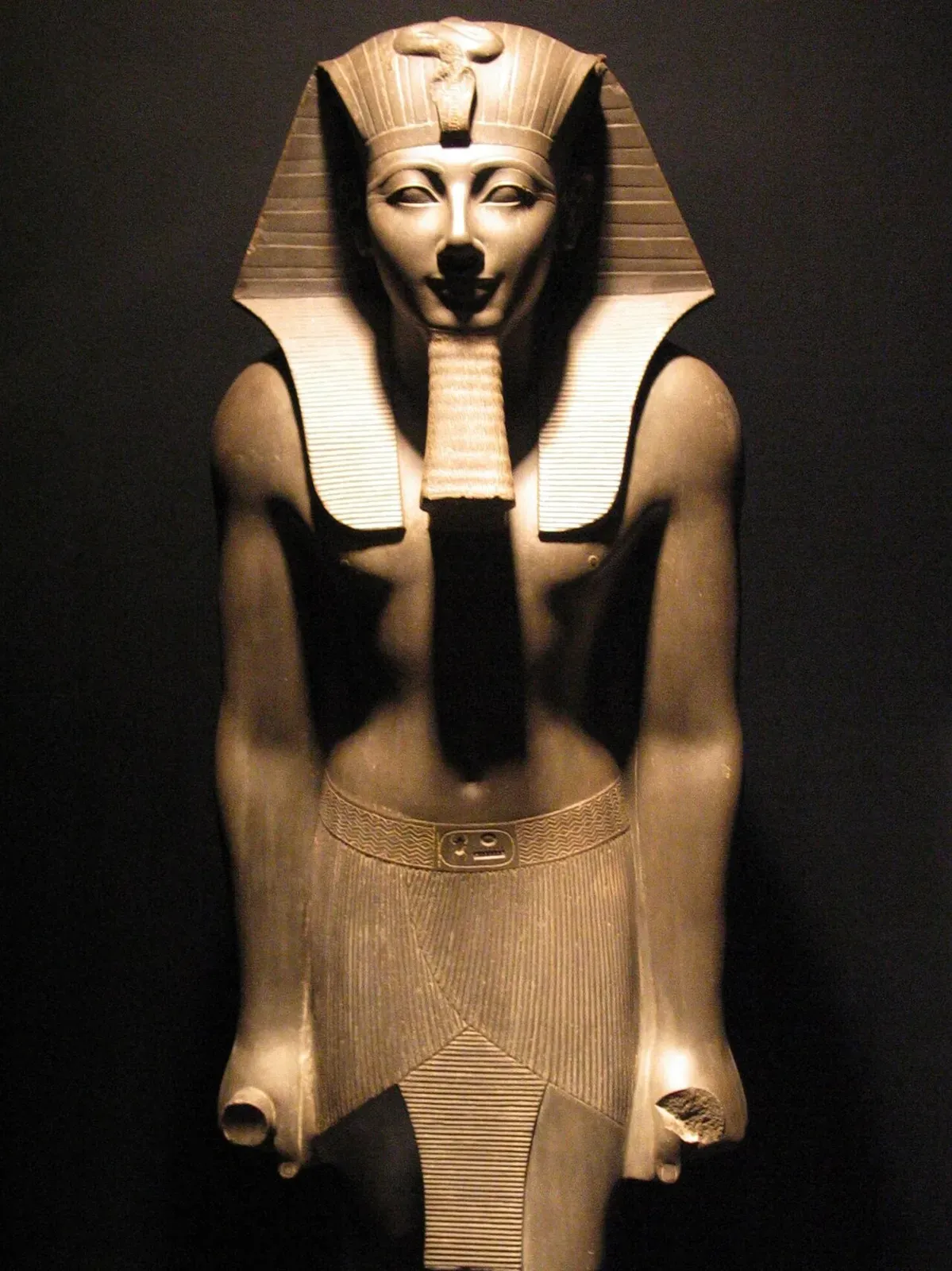
The man history remembers as Egypt’s greatest conqueror - the pharaoh who led seventeen undefeated campaigns, pushed Egypt’s borders to the Euphrates in the north and the fourth cataract of the Nile in the south, and built the largest empire his country would ever possess - spent the first twenty-two years of his reign being managed by his stepmother. This was not a gradual usurpation. It happened at the very beginning, because the very beginning was a child on a throne.
Thutmose III became Pharaoh on the 24th of April 1479 BC. He was, depending on which calculation you trust, either very young or genuinely an infant. His father Thutmose II had died leaving no son by his chief wife Hatshepsut, who was also his half-sister and the daughter of the great Thutmose I. The boy on the throne was the son of a secondary consort - royal enough to inherit, not established enough to rule. Hatshepsut, who was both the chief queen and the most senior royal figure alive, stepped in as regent. This was not unusual. Egypt had a tradition of powerful women governing on behalf of minor kings, and Hatshepsut had the bloodline, the connections, the mindset and the administrative apparatus behind her.
She did not stay a regent for long. Around 1473 BC, roughly six years into the reign, she took the full titles of Pharaoh. The double crown. The false beard. The male pronoun in formal texts, alongside the female. Inscriptions from her reign slide between genders with a flexibility that suggests the scribes were doing their best with a situation that had no official template. She had herself depicted in male regalia on temple walls while her own mortuary inscriptions described her as a woman. The ideology of Egyptian kingship had always centred on the male body of the god-king as the guarantor of cosmic order; Hatshepsut concluded, apparently without excessive hand-wringing, that the ideology was adaptable.
Her twenty-two years in power were competent and profitable. She sent a major trading expedition to Punt - probably the Somali coast - that returned with live myrrh trees, ebony, ivory, and animals. She built extensively at Karnak, including two obelisks sheathed in electrum. Her mortuary temple at Deir el-Bahari, designed by her chief official Senenmut, was cut into the cliffs of the west bank at Thebes with a precision that still reads as architecturally confident three and a half thousand years later. She fought in Nubia. She managed a wealthy, stable state. The record does not suggest incompetence or neglect.
Thutmose, meanwhile, held military roles. He served in the army, participated in campaigns, built the professional knowledge that would define the second half of his reign. Whether this was arranged by Hatshepsut to keep him useful and occupied, or reflects his own initiative, or some combination of both, is not recoverable from the available evidence. What is clear is that when Hatshepsut died, around 1458 BC, he was in his early thirties and operationally ready. He did not need a transition period. Within a year he was marching north into the Levant with an army of around ten thousand men.
What followed was the Battle of Megiddo - the first military engagement in recorded history that can be reconstructed in operational detail, because Thutmose’s scribe Tjaneni kept notes and had them inscribed at Karnak. Seventeen campaigns over twenty years. The Canaanite coalition defeated. The northern border extended to the Euphrates. Nubian tribute flowing south to north. Egyptian hegemony from the fourth cataract of the Nile to the edges of the Hittite sphere. By the time Thutmose III died in 1425 BC, the Egyptian state was receiving annual tribute from over 350 towns and cities across Syria, Canaan, and sub-Saharan Africa. The accounts were meticulous. The Karnak reliefs list the spoils from each campaign: horses, chariots, gold rings weighed to the gram, cedar timber, lapis lazuli.
He managed the empire with a method that reduced the cost of holding it. Local rulers kept their positions, but their sons were taken to Egypt as hostages, educated at the royal court, and absorbed thoroughly enough into Egyptian culture that when they returned home to govern, they did so as Egyptianised administrators. You conquered a place once. After that, with a bit of investment, it ran itself. The tribute from Phoenician ports and Syrian mines funded the continuing expansion of Karnak, including the Akh-Menu festival hall Thutmose built inside the complex - its columns shaped to resemble the tent-poles of the campaign encampments, which was either an aesthetic choice or the pharaoh deciding that the source of the money deserved to be remembered in the design of what it bought.
Then, late in his reign - perhaps thirty years after Hatshepsut’s death, perhaps later - he began removing her. Her names were chiseled from inscriptions. Her reliefs were cut back, the face gone, the royal cartouche replaced with blank stone or with his own image. Statues she had erected at Deir el-Bahari were systematically knocked down, broken up, and buried in a pit. The work was not the fury of an aggrieved stepson settling old scores. It was too organised and too late for that. The most persuasive explanation is administrative: Thutmose was aging, his son Amenhotep II was the designated heir, and a female pharaoh who had ruled for over two decades was an inconvenient precedent. Any future claimant with a credible connection to the royal line could point to Hatshepsut as proof that the rule of succession was not as fixed as Thutmose’s party preferred. Better to remove the example. Not spite but succession management.
It worked, more or less, for three thousand years. Hatshepsut became a gap in the record. The nineteenth century recovered her through hieroglyphic decipherment, when scholars noticed that statues had been removed and names excised and began asking whose they had been. The twentieth century found her broken statues in the Deir el-Bahari pit, identified her mummy from a canopic jar, and reconstructed enough of her reign to establish it as one of the more consequential in the 18th dynasty.
What Thutmose did not anticipate was that his own relentless record-keeping would make her disappearance legible. He built too thoroughly and archived too carefully. The files that documented his campaigns, his tribute lists, his construction projects, his administrative reforms - the same files that preserved his reputation across three and a half millennia - also preserved the blank spaces where her name had been. You cannot remove someone from history by destroying only the monument. You have to destroy everything. And Thutmose III, of all people, was not going to destroy Karnak.
On 24 April 1479 BC, an infant ascended the Egyptian throne and his stepmother began running the kingdom in his place. Twenty-two years later he was finally alone on it. He spent the next thirty years building an empire. He spent some of the years after that trying to ensure the twenty-two came off the record. The empire outlasted him by generations. So did her memory, eventually.