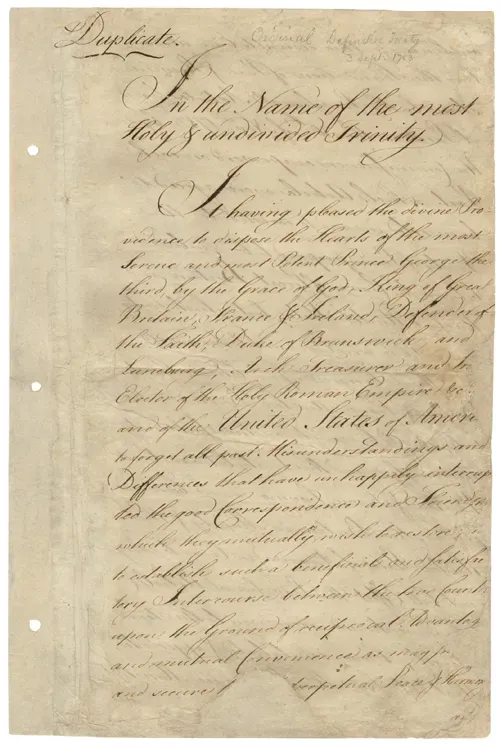
On 14 January 1784, the Congress of the Confederation gathered in the Old Senate Chamber of the Maryland State House in Annapolis and ratified the Treaty of Paris. The document they approved had been signed the previous September at the Hôtel d’York on the Rue Jacob in Paris, and it recorded Britain’s acknowledgement that the United States of America was free, sovereign, and independent. The Revolutionary War was over. The country was real.
What is less often noted is how implausibly good the deal was. Britain did not merely recognise American independence. It ceded all territory east of the Mississippi River, south of the Great Lakes, and north of Florida — a landmass vastly larger than the thirteen colonies that had actually fought the war. The boundary the British drew for themselves, north into Canada, was what one of their own diplomats described as “exceedingly generous.” French Foreign Minister Vergennes, who had spent years funding and fighting to bring Britain to this table, looked at the final terms and was more direct. “The English buy peace rather than make it,” he said. He was furious, and he was right.
The negotiations that produced this outcome were a masterclass in strategic betrayal. France had entered the war in 1778 after the American victory at Saratoga and contributed enormously to the outcome — French loans, French troops, and most critically the French fleet that cut Cornwallis off at Yorktown in 1781. The Franco-American alliance obligated the United States not to negotiate a separate peace. John Jay violated that obligation without hesitation. In September 1782, he told the British directly that the Americans were willing to negotiate alone, cutting France and Spain out of the most consequential discussions. Benjamin Franklin, who had spent years cultivating French goodwill from his salon in Passy, signed off on it. When Vergennes found out what they had done, he wrote to Franklin in barely concealed outrage. Franklin replied with an apology so smooth it contained no actual remorse. The preliminary treaty was agreed by November 30, 1782, before the French knew the full terms.
The man who gave America its continent was a British prime minister nobody remembers. William Petty, the 2nd Earl of Shelburne, ran the negotiations from London with a clear and controversial strategic vision: he wanted to make the United States a commercially dependent partner, not a permanently hostile neighbour. Splitting the American alliance with France was one objective. The deeper one was creating a captive export market. The trans-Appalachian territory, vast and barely populated, would fill with people who would need British manufactured goods for a generation or more. No army to garrison it, no administration to maintain — just a growing population buying from British merchants. His colleagues thought he had lost his mind. Parliament forced him from office in February 1783 partly over the generosity of the terms he had agreed. He lost the argument at Westminster. He won it in history.
The British also handed the Americans something Shelburne understood only partly. The Mississippi border was not just land. It was room. Three million people lived in the United States in 1784, clustered along a coastline. The territory the treaty granted stretched west to a river that drained half a continent. Thomas Jefferson, watching from Paris as American minister, grasped the implication immediately and spent twenty years engineering its completion — the Louisiana Purchase of 1803 doubled the territory again, this time buying from a France that had spent itself broke partly on the war that created the country it was now selling land to. By 1848, through purchase, annexation, and war, the United States reached the Pacific. The process took sixty-four years from the treaty’s ratification, and the initial frame for all of it was drawn at the Hôtel d’York in September 1783.
France came out of its investment in the American Revolution with the island of Tobago and the trading post of Senegal. It had loaned the Continental Congress over a billion livres, sent an army under Rochambeau, and dispatched the fleet of de Grasse that trapped Cornwallis at Yorktown. Its reward was two small territorial gains and a fiscal crisis bad enough to help push it towards 1789. The Revolution it helped finance across the Atlantic contributed, within six years, to a revolution at home. The irony is almost too neat: France destroyed a monarchy trying to sustain a republic, then lost its own monarchy to the debts it ran up in the process.
What the Treaty of Paris actually ratified on that January day in Annapolis was not just a ceasefire but a geometry. The boundaries it drew — ludicrously favourable to a country that had not yet won a single engagement west of the Appalachians — determined everything that followed. The United States would not be a narrow Atlantic republic, diplomatically contained and commercially dependent. It would be a continental one, with a population expanding into territory that made it ungovernable from London even before independence and made it unstoppable once that independence was secured. Shelburne understood this better than his critics and less completely than the outcome warranted. He thought he was creating a trading partner. He was creating something Britain had never encountered and would spend the next two centuries learning to accommodate: a successor.