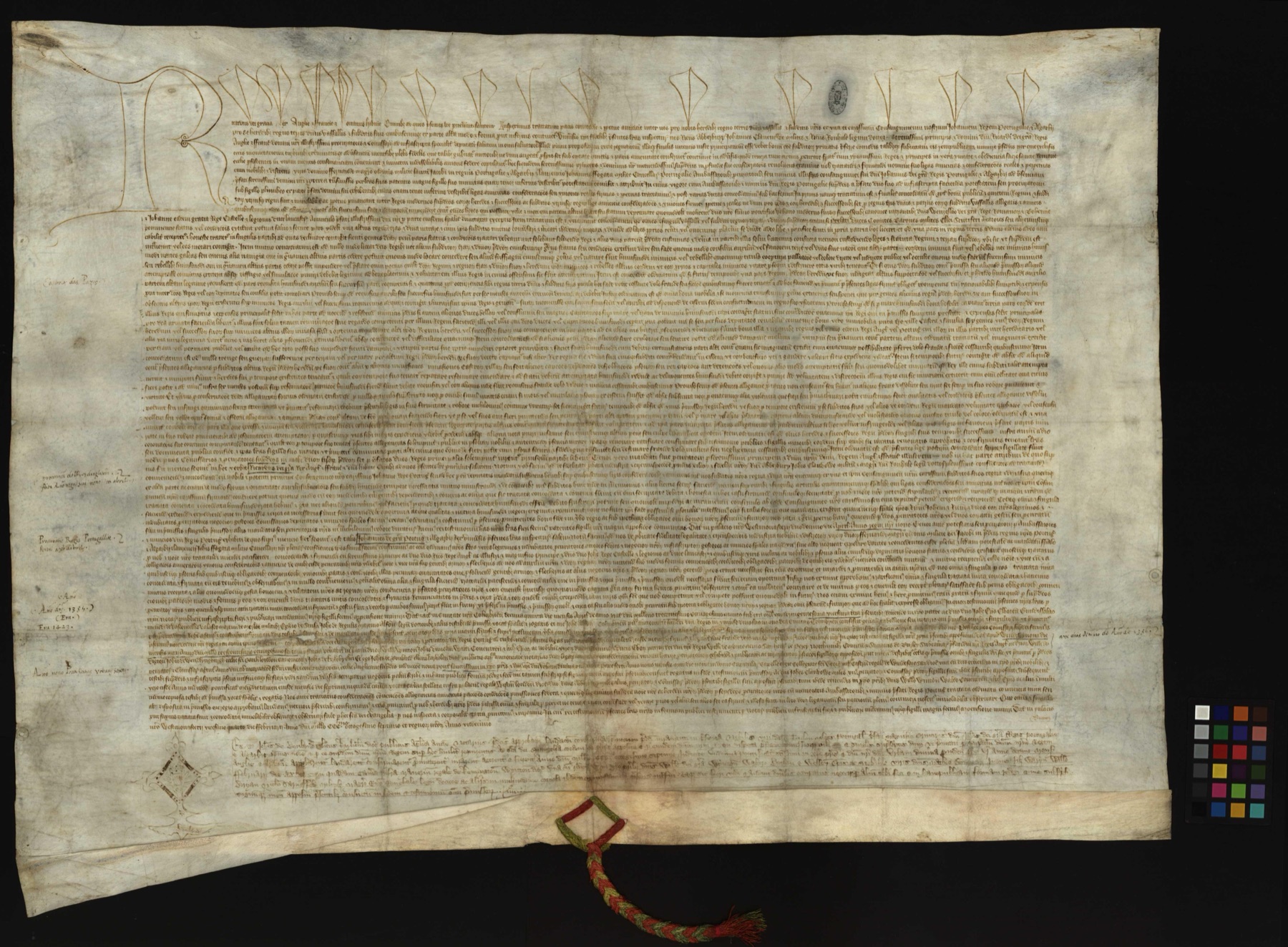
In October 1943, Winston Churchill stood in the House of Commons and described something as “an alliance without parallel in world history.” He was not referring to NATO, which did not yet exist, or to the special relationship with America, which was still being invented. He was talking about a treaty signed in 1386. Britain had just invoked it, for the first time in decades, to request military facilities from Portugal in the Azores. Salazar had agreed. The world’s oldest diplomatic alliance was helping to win the Second World War.
What makes this worth examining is not just the age. It is that the thing actually works.
The alliance has its roots, as many things in English history do, in the Hundred Years’ War. By the 1370s and 1380s, the strategic geometry was clear: France was England’s enemy; Castile was France’s ally; Castile threatened Portugal; therefore Portugal and England had a shared problem. The Portuguese had been receiving English help on and off since 1147, when English crusaders stopped in Lisbon on their way to the Holy Land and helped the first King of Portugal take the city from the Moors. The Treaty of Windsor in 1386 was not the beginning of the relationship but the formalisation of something that had been developing for two centuries.
The immediate occasion was the Portuguese succession crisis of 1383 to 1385. John I of Portugal, the illegitimate son of Pedro I, had taken the throne in a coup after the death of Ferdinand I. Castile claimed Portugal through Ferdinand’s daughter Beatriz, whose husband was the Castilian king. An English contingent of around five hundred archers fought alongside the Portuguese at Aljubarrota on 14 August 1385, where John’s army destroyed the Castilian force and settled the question of who ruled Portugal. John needed to keep that victory from being reversed. England needed an ally against the Castilian-French axis.
The treaty was drafted on 9 May 1386. Its central obligation was mutual defence, stated in plain language: if either king needed the other’s support and asked for it lawfully, the other was bound to provide it. There was no limit of time. The word used was “perpetual.”
John of Gaunt, the Duke of Lancaster - son of Edward III, father of the future Henry IV, holder of a disputed claim to the Castilian throne - landed in Galicia two months later with an expeditionary force. The Castilian nobility declined to rise for him. His army took dysentery. He returned to England with a cash settlement and left behind his daughter. Philippa of Lancaster married John I of Portugal in February 1387, sealing the alliance in the conventional medieval manner. The military adventure was a failure; the marriage was not. Their children became what the poet Luís de Camões called the Illustrious Generation. One of them was Prince Henry the Navigator, who organised Portugal’s early Atlantic expeditions. The Age of Discovery - Vasco da Gama rounding the Cape, Cabral reaching Brazil, the sea route to India - traces its origins partly to a diplomatic marriage arranged so that a medieval English duke could press a dynastic claim he then failed to collect.
The alliance’s most absurd chapter was the Iberian Union of 1580 to 1640, when Philip II of Spain became Philip I of Portugal and the same crown sat on the heads of England’s two principal antagonists simultaneously. English privateers, operating against Spain with official encouragement, captured 299 Portuguese ships returning from the Indies. The oldest allies in the world were, briefly, seizing each other’s cargo. When Portugal broke free from Spain in 1640, England backed the House of Braganza’s restoration. The captured ships were not mentioned.
The Napoleonic Wars offered the alliance’s most consequential activation before the twentieth century. When Napoleon invaded Portugal in November 1807, the British fleet escorted the Portuguese royal family to Brazil. Wellington then fought the Peninsular War from Portuguese soil, constructing the Lines of Torres Vedras outside Lisbon and eventually chasing the French armies out of the peninsula. The campaign that began as a commitment to defend a small Atlantic kingdom became the campaign that led, eight years later, to Waterloo.
In 1890, Britain sent Portugal a written ultimatum over African territorial claims - demanding withdrawal from land that Cecil Rhodes wanted for his Cape-to-Cairo railway. Portugal’s oldest ally threatened it in writing over a strip of territory. The national humiliation contributed, twenty years later, to the fall of the Portuguese monarchy. The alliance survived it anyway, because by 1927, when the British Foreign Office quietly reviewed whether the thing was still worth keeping, they discovered two inconvenient facts: there was no legal mechanism for dissolution, and the Admiralty regarded the Portuguese Atlantic islands as essential base territory that could not be permitted to fall to an adversary. The cost of maintaining the alliance was negligible. The cost of losing access to the Azores was incalculable.
This was the calculation that produced Salazar’s cooperation in 1943. Anthony Eden and Clement Attlee invoked the treaty’s mutual aid provisions. Salazar, who had been sitting out the war in studied neutrality, agreed within days. British and American aircraft began operating from Lajes Field on Terceira Island and Ponta Delgada on São Miguel. Flying time between the United States and North Africa dropped from seventy hours to forty. The mid-Atlantic air gap that had been protecting German U-boats closed. 8,689 American aircraft eventually departed from the Azores alone. Churchill told the Commons on 12 October 1943 that the Anglo-Portuguese alliance was “without parallel in world history.” He was right.
The alliance remains in force. Portugal and Britain were both founding members of NATO in 1949. When Argentina invaded the Falklands in 1982, Portugal offered the Azores to the Royal Navy again - the same islands, the same logic, the same treaty. In 2022, António Costa and Boris Johnson signed a joint declaration in London reinforcing it, citing the occasion of the alliance’s 650th anniversary.
The key to its longevity is not sentiment. Neither country has been especially loyal to the other in any deeper sense than strategic self-interest. England seized Portuguese ships when it was useful. Britain threatened Portugal in writing over African land. Portugal sold tungsten to Germany until 1944. The alliance has survived all of this because it operates as a mechanism rather than a friendship - something you can pick up when you need it, set aside when you don’t, and find intact when you come back. That is precisely what makes it the oldest in the world. Warm alliances burn out. Cold ones last.
The treaty still sits in the archives in London and Lisbon, written in Latin, sealed with lead. It uses the word “perpetual.” Given everything that has happened since, it is hard to argue with the drafting.