At breakfast time on 30 June 1908, a man named S. Semenov was sitting outside his house at the Vanavara Trading Post in Siberia when the northern sky opened and caught fire. His words: “The sky split in two and fire appeared high and wide over the forest.” He felt heat so intense he wanted to tear off his shirt, was thrown several metres by the blast wave, and lost consciousness. His wife led him inside. Vanavara is 65 kilometres from the point directly above the explosion.
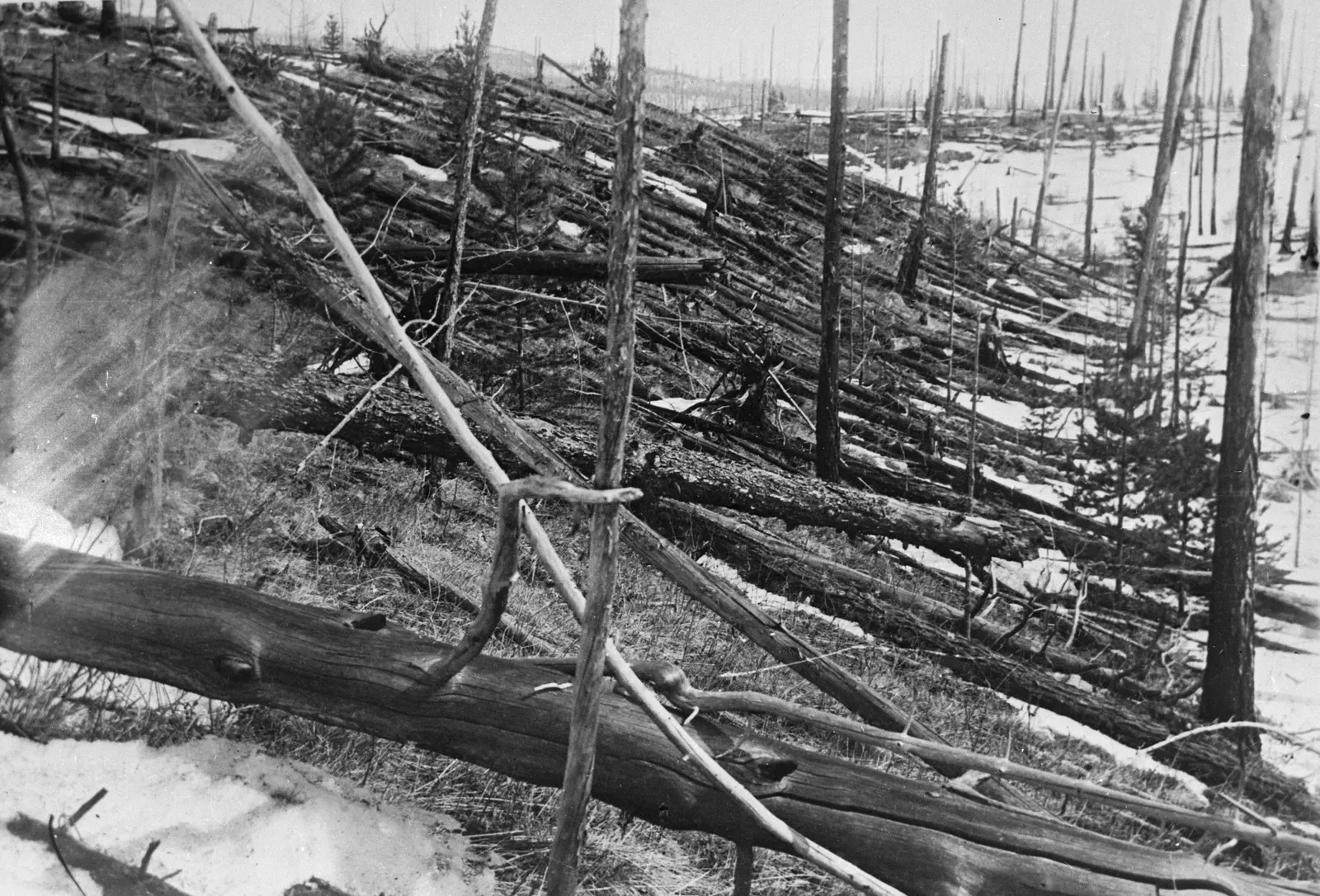
The explosion flattened 2,150 square kilometres of Siberian taiga - roughly the area of greater London. Trees across the zone were stripped of branches and, closer to the edge, knocked flat in radial patterns pointing away from the centre. The shock wave knocked people off their feet hundreds of kilometres away and registered on seismic stations across Eurasia. Air pressure changes from the blast were detected in Germany, Denmark, Croatia, Britain, and as far as Batavia in the Dutch East Indies. For several evenings following the event, night skies from Asia to Europe glowed bright enough that midnight photographs were taken in Sweden and Scotland without flashbulbs.
The death toll was at most three people - possibly zero; the record is ambiguous. By sheer luck the explosion came down over one of the most sparsely populated regions on the planet. Had it arrived a few minutes earlier on the same trajectory, it would have exploded over Canada or the United States.
This much is agreed upon. Almost nothing else is.
The first scientific expedition did not reach the site until 1927 - nineteen years after the event. The region’s isolation was part of it, but Russia’s decade of revolution, civil war, and early Soviet consolidation was the more immediate cause. The mineralogist Leonid Kulik persuaded the Soviet Academy of Sciences to fund a trip by arguing that meteoritic iron from the impact would be economically valuable. He and his team arrived expecting a crater. They found no crater. At the hypocentre - the point on the ground directly below the explosion - the trees were standing upright, scorched and stripped of branches but vertical. Further out, trees lay flat, pointing away from the centre in every direction. The full pattern, eventually mapped from aerial survey in the 1930s, resembled a giant butterfly pressed into the forest floor, 70 kilometres across at its widest.
The absence of a crater has driven the argument ever since. The object did not hit the ground. It exploded in the atmosphere at an altitude of somewhere between 5 and 10 kilometres, with enough force to devastate the forest below while leaving the surface unmarked. Events of this kind - an incoming body that disintegrates explosively before reaching the ground - are called air bursts. Knowing that Tunguska was an air burst is the point of agreement. What was doing the bursting is not.
The mainstream scientific position today is a stony asteroid, roughly 50 to 80 metres across, entering the atmosphere at around 55,000 kilometres per hour and coming apart at altitude. The energy release is estimated at between 10 and 30 megatons of TNT equivalent - in the same range as the 1954 American Castle Bravo nuclear test, which measured 15.2 megatons. Those numbers carry real uncertainty: earlier estimates ranged from 3 to 50 megatons, a spread of a factor of sixteen that tells you something honest about how well we understand what happened.
The comet hypothesis competed seriously with the asteroid explanation for decades, and among Soviet Tunguska researchers had largely prevailed by the 1960s. A comet - mostly ice and dust - would vaporise on disintegration, leaving no material to find, which explains why there is no crater and no surviving fragments of any size. The glowing night skies in the days following the event fit the idea of cometary dust dispersing through the upper atmosphere. In 1978, a Slovak astronomer proposed that the object was a fragment of Comet Encke, whose debris stream the Earth passes through each year in late June. The Tunguska event fell almost exactly at that shower’s annual peak, and the object’s trajectory was consistent with the expected path of Encke debris.
The counter-argument is that a cometary body travelling through the atmosphere on such a shallow path should have broken apart much higher than 5 to 10 kilometres. Microscopic spheres extracted from the soil and from tree resin at the site showed compositions typical of rocky asteroidal material rather than cometary dust. A 2001 probabilistic study based on orbital modelling put the odds of asteroidal origin at 83 per cent. A 2013 analysis of fragments recovered from the Tunguska site was consistent with an iron meteorite. These conclusions are not quite compatible with each other. The debate remains open.
The Kulik expeditions of the 1930s produced 1,500 aerial photographs documenting the full blast zone in detail. In 1975, the Chairman of the Soviet Committee on Meteorites ordered them incinerated as part of a routine disposal of increasingly flammable nitrate film. Positive prints survived in Tomsk. The negatives were gone.
There is a lake 8 kilometres north of the hypocentre called Lake Cheko. In 2007, Italian researchers proposed that it was formed when a surviving fragment of the Tunguska object struck the ground after the main explosion. The lake is bowl-shaped, its long axis points toward the hypocentre, and magnetic readings suggest a chunk of rock beneath its deepest point. In 2017, Russian scientists re-examined sediment cores from the lake floor, calculated a sedimentation rate roughly half the Italian team’s figure, and concluded the lake is at least 280 years old - clearly predating the 1908 event. The Italians dispute the sedimentation calculation. Work continues.
Astronomers estimate that Tunguska-sized events occur somewhere over Earth on average once every few hundred to a thousand years. Smaller air bursts, in the five-kiloton range, happen roughly annually. The 2013 Chelyabinsk meteor was a 500-kiloton air burst over a Russian city of one million, went undetected in advance, and injured more than 1,200 people - mostly from windows shattered by the pressure wave. In 2016, the United Nations proclaimed 30 June the annual International Asteroid Day, to raise awareness of impact risk. Awareness is not a planetary defence strategy.
Semenov was knocked off his feet 65 kilometres from the centre of the largest explosion in recorded human history. The first scientists to investigate the site arrived nineteen years later, expecting a crater and finding standing trees. We have spent well over a century studying what happened and still cannot tell you, with confidence, whether the object was rock or ice, or pin down its energy within a factor of three. That is not a failure of science - Tunguska is a genuinely difficult problem - but it is worth keeping in mind the next time someone suggests we have the near-Earth object situation under control. Something came out of the sky that morning. We were not watching. We are still not entirely sure what it was.