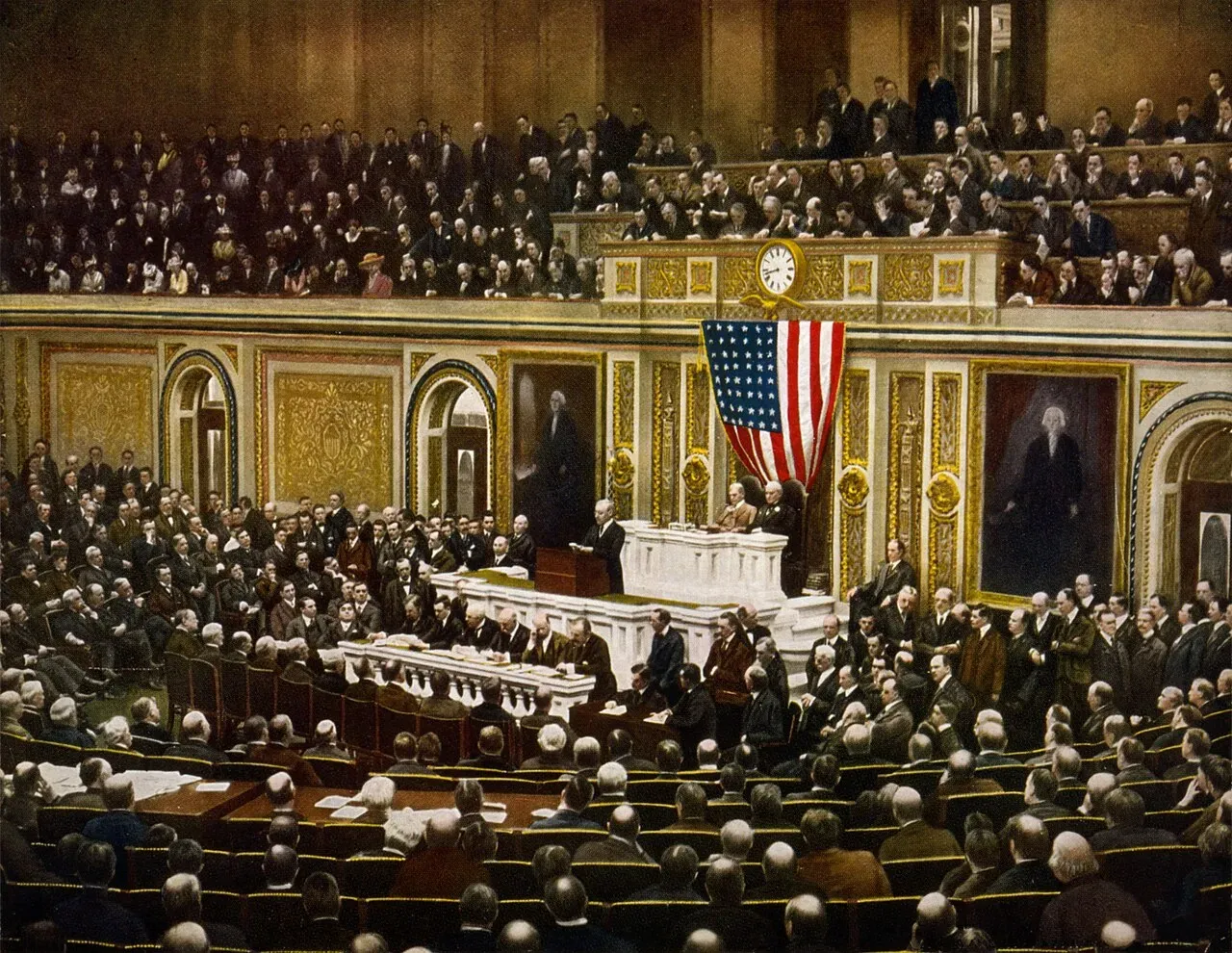
At 3am on 6 April 1917, the US House of Representatives voted 373 to 50 in favour of war with Germany. The Senate had already passed the resolution 82 to 6 two days earlier. President Wilson signed it at 1:11pm. The United States had been at peace since the Civil War. It would now send its men to the trenches of northern France.
The country that voted was not a neutral country in any meaningful sense. J.P. Morgan’s bank had been running Allied procurement since January 1915. American factories were producing three-quarters of British light artillery shells by the summer of 1916; US plants were turning out 15,000 British and Russian rifles every day by early 1917. The loans, the contracts, and the supply lines had been threading the American economy into the Allied war effort for two full years before the vote. What the declaration changed was not the economics. It was the pretence.
Germany had forced the pretence to end. On 1 February 1917, the German government resumed unrestricted submarine warfare, declaring that any ship found in the war zone around Britain would be sunk without warning, neutral or otherwise. The decision was a calculated gamble: naval command believed it could starve Britain into collapse within six months, before any American mobilisation could matter. The calculation was correct about the timing. It was badly wrong about everything else.
Then came the Zimmermann Telegram. On 1 March 1917, American newspapers published the text of a coded message from Germany’s Foreign Secretary Arthur Zimmermann to his ambassador in Mexico City - intercepted and decoded by British intelligence - proposing a military alliance: should the US enter the war, Mexico should attack it from the south, and Germany would help it recover Texas, New Mexico, and Arizona. The message had been sent to a country sharing a 3,000-kilometre border with the United States. Whatever remained of the case for strict neutrality effectively died the day the telegram went public.
The irony is that Wilson had been re-elected in November 1916 partly on the slogan “He kept us out of war.” His opponent, Charles Evans Hughes, had argued for a more assertive American posture toward Europe. Wilson won, narrowly, partly because the electorate preferred the president who was managing to stay out. On 2 April 1917 - five months after the election - he stood before Congress and asked for a declaration of war. The gap between those two moments is a compressed history of how democratic governments move from publicly maintained positions to open conflict: the circumstances shift, and the stated position follows, faster than anyone who voted for the earlier one expected.
There was genuine opposition. Senator Robert La Follette of Wisconsin delivered a long speech against the resolution, arguing that the US had never applied equal pressure to Britain for its own naval blockades, and that the country was being manoeuvred into war on a selective reading of neutral rights. The argument had intellectual merit. It had no political traction. In the House, Jeannette Rankin of Montana - the first woman elected to Congress - voted no. She would eventually be the only member of either chamber to vote against both the 1917 and 1941 declarations of war. The bulk of the opposition came from the Midwest: 9 of Wisconsin’s 11 representatives, 4 of Minnesota’s 10, and scattered members from states with large German-American communities, whose sympathies were complicated by obvious reasons. None of it came close to changing the outcome.
The effect on the battlefield was not immediate. In April 1917, the US Army had fewer than 200,000 men and no experience of industrial warfare on this scale. What America brought first was credit, matériel, and the assurance of eventual mass. By the summer of 1918, American troops were arriving in France at 250,000 a month. Germany launched its Spring Offensive in March 1918 - a last, massive attempt to win the war before that weight became irresistible. It almost worked, but almost does not cut it on the battlefield. By August the German Army was in retreat, and the country behind it had run out of the capacity to continue. The armistice came on 11 November 1918. Germany was not defeated in the field so much as it exhausted the will to keep going.
Wilson went to Paris for the peace conference carrying Fourteen Points: national self-determination, freedom of the seas, open diplomacy, and a League of Nations to arbitrate future disputes. He arrived to find Clemenceau of France and Lloyd George of Britain with different priorities. France had lost 1.3 million soldiers. Britain had lost 744,000. They wanted Germany broken, billed, and unable to start anything again. The Treaty of Versailles, signed on 28 June 1919, imposed the War Guilt Clause - a formal admission that Germany and its allies bore sole responsibility for causing the war - and demanded reparations eventually fixed at 132 billion gold marks, a figure Germany could not pay in full and refused to absorb as legitimate.
John Maynard Keynes walked out of the Paris negotiations and immediately wrote The Economic Consequences of the Peace, arguing that Versailles would produce economic collapse followed by political catastrophe. The book appeared in December 1919. It was right about the diagnosis and right about the timeline. The Weimar Republic, born from defeat and saddled with a war guilt that most Germans rejected as a fabrication imposed by the victors, became the political environment in which every nationalist with a grievance could find an audience. The stab-in-the-back myth - that Germany’s army had gone undefeated in the field and been betrayed by the civilian government - was nonsense. It was also psychologically soothing and politically useful nonsense, and it spread accordingly. The next war started twenty years later, exactly where Keynes had predicted trouble would begin.
The reparations story was not the only fuse the peacemakers lit. Wilson’s principle of national self-determination - the idea that legitimate borders should follow peoples rather than dynasties - sounded unanswerably moral after four years of slaughter fought partly in the name of secret treaties and imperial ambition. Applied on the ground, it meant drawing new states across maps where populations, languages, and churches did not line up with neat lines. Minorities ended up inside frontiers they had not chosen; majorities nursed grievances over kinsmen left on the far side. Twenty years later those mismatches became ammunition. The Sudeten crisis of 1938, when Hitler demanded the German-speaking districts of Czechoslovakia on the grounds that ethnic Germans were entitled to live under Berlin’s rule, was a direct descendant of the same logic dressed in nastier clothes: if nations had a right to self-rule, who counted as the nation, and who got to decide where the border stopped? It was not the only place the argument went wrong. Poland, Romania, Yugoslavia, and the fragments of the Habsburg and Ottoman worlds all contained overlapping claims that diplomacy had papered over in 1919 and that fascists, communists, and local nationalists would reopen for decades. The Middle East received new mandates and old grudges in the same package. Self-determination was not a sham; it was a decent instinct applied to geography that had never been simple. The 20th century spent a long time proving how expensive simplicity can be. The echoes are very much audible in the 21st century, in our own times.
Wilson himself did not live to see any of it. His own Senate rejected the Treaty of Versailles and kept the United States out of the League he had designed. He suffered a severe stroke in October 1919 while touring the country to campaign for ratification, and died in February 1924, having saved France and failed to save the peace.
The vote of 6 April 1917 was probably correct on its own terms. Germany’s submarine campaign was killing American sailors; the Zimmermann Telegram was a genuine hostile act; three years of grinding warfare in Europe was not going to resolve itself while the US watched from a safe distance. But entering the war did not mean controlling what was done with the victory. Wilson could send the troops, but he could not dictate the terms once his allies had their hands on the pen. The world made safe for democracy ran straight through Versailles, and Versailles ran straight to 1939. The slogan was sincere. The consequences were not what the man who coined it had promised.