When the engine stopped, you found out if you were the target.
London was already four years into a war by June 1944, and its population had learned most of the patterns of aerial bombardment. The V-1 added a new mechanism of dread. The weapon announced itself first: a flatulent, grinding rattle from a pulsejet engine running at roughly 50 combustion cycles per second, audible for miles. While the sound continued overhead, you were almost certainly safe. The engine ran until the fuel ran out. When it ran out, a small vane in the nose tripped an elevator mechanism, cut the power, and pitched the bomb into its terminal dive. The silence was the signal. You had perhaps twelve seconds.
On 13 June 1944, one week after the Normandy landings, Germany fired its first V-1s at England. Eleven flying bombs were launched from ramps along the French and Belgian coast. Six crashed near the launch sites, either from mechanical failure or British anti-aircraft fire. One came down in the sea. The four that made it across killed six people, damaged a railway bridge at Bethnal Green, and struck two further locations in Kent and Sussex. By the standards of what followed, the first day was almost an embarrassment. German propaganda announced it as the start of a vengeance campaign. Britain’s newspapers were initially puzzled - the early reports described what appeared to be a pilotless aircraft. The campaign proper began four days later.
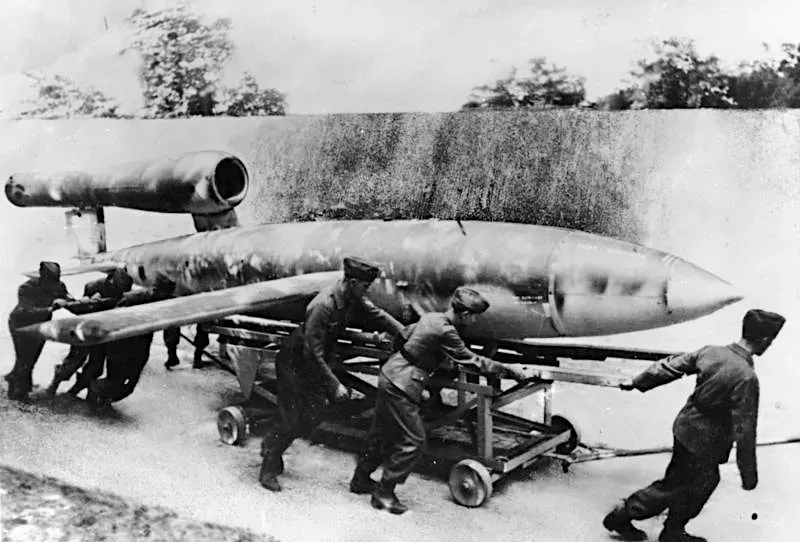
The V-1 - Vergeltungswaffe 1, “Vengeance Weapon 1” - had been in development at Peenemünde, on the Baltic coast, since 1942. The airframe was ruthlessly simple: a stubby delta-winged fuselage just over eight metres long, a pulsejet engine slung above the tail on a boom, and an 850-kilogram warhead in the nose. The guidance system comprised a magnetic compass for heading, a barometric altimeter for height, and a small propeller on the nose that counted revolutions to measure the distance covered. When the counter reached its preset number, the fuel was cut. The engineering was cheap and reproducible: each V-1 cost roughly 5,000 Reichsmarks to manufacture, compared to 250,000 for a conventional bomber. Germany produced around 30,000 of them.
The campaign that followed the 17 June start ran for eleven months, until the last launch sites were overrun by Allied ground forces. Roughly 10,000 V-1s were aimed at Britain, of which around 7,500 crossed the coast and approximately 2,500 reached the London area. The Allies developed a layered defence: fast fighter aircraft - initially the Hawker Tempest and later the Gloster Meteor, Britain’s first operational jet - intercepted V-1s over the Channel; anti-aircraft guns were repositioned in a belt along the Kent coast; and barrage balloons ringed London, strung with cables designed to snag the wings. By late August 1944, the defences were destroying more than 70 per cent of incoming V-1s. But 30 per cent of a very large number is still a great deal of ordnance arriving in one city.
One bomb, a direct hit on the Guards Chapel in Wellington Barracks during a Sunday service on 18 June 1944, killed 121 people and injured 141. Across the entire campaign, more than 6,000 people were killed in Britain and at least 17,000 injured. More than a million homes were damaged or destroyed. The numbers are lower than the Blitz - the German strategic bombing campaign of 1940 and 1941 killed around 43,000 in Britain - but the V-1 achieved something the Blitz had not: it created a state of diffuse, continuous apprehension that outlasted any single raid. A bomber attack came and went. The V-1 could arrive at any hour and from any direction, targeting London in general rather than any specific district, which meant the danger felt inescapably shared across the whole city. Roughly 1.5 million people left London in the summer of 1944 - a larger voluntary evacuation than any since the autumn of 1940.
Disrupting the campaign consumed Allied resources at a moment when they were already strained. Operation Crossbow, the campaign against V-weapon infrastructure, had been running since late 1943. It eventually involved around 118,000 sorties and 36,000 tons of bombs dropped on launch sites, supply depots, and manufacturing facilities, including a series of attacks on enormous concrete bunkers in northern France - the so-called heavy sites at Siracourt, Mimoyecques, and Watten - that were only abandoned after months of sustained bombing proved unable to neutralise them completely. Fighter squadrons were redirected from Normandy to chase V-1s off the Kent coast. Anti-aircraft batteries that might have screened the invasion fleet were anchored along the English shore. None of this was accidental. German planners understood that a weapon incapable of reversing the war could still complicate the process of losing it.
The V-1 was subsonic, unguided in any meaningful sense, and aimed at areas rather than targets. As a precision weapon it was useless; as a terror weapon it had a real effect. What made it historically significant was not what it could do in 1944 but what it proved was possible. A mass-produced flying munition, launched from a fixed ramp, carrying a large warhead several hundred kilometres without a pilot, directed by an automated mechanism toward an approximate destination - that concept did not end with the war. Modern cruise missiles navigate by GPS and can aim at a window rather than a city. The Tomahawk costs several hundred times more than the V-1 and achieves several hundred times the accuracy. The lineage from one to the other involves a great deal of additional engineering and several decades of development, but the underlying category - an autonomous flying bomb that removes the pilot and shifts the risk entirely onto the population at the other end - was demonstrated as operationally viable over the English Channel in the summer of 1944.
The silence that Londoners learned to dread that summer has since been refined into something the target rarely hears coming. Whether that counts as progress depends on which end of it you are on.