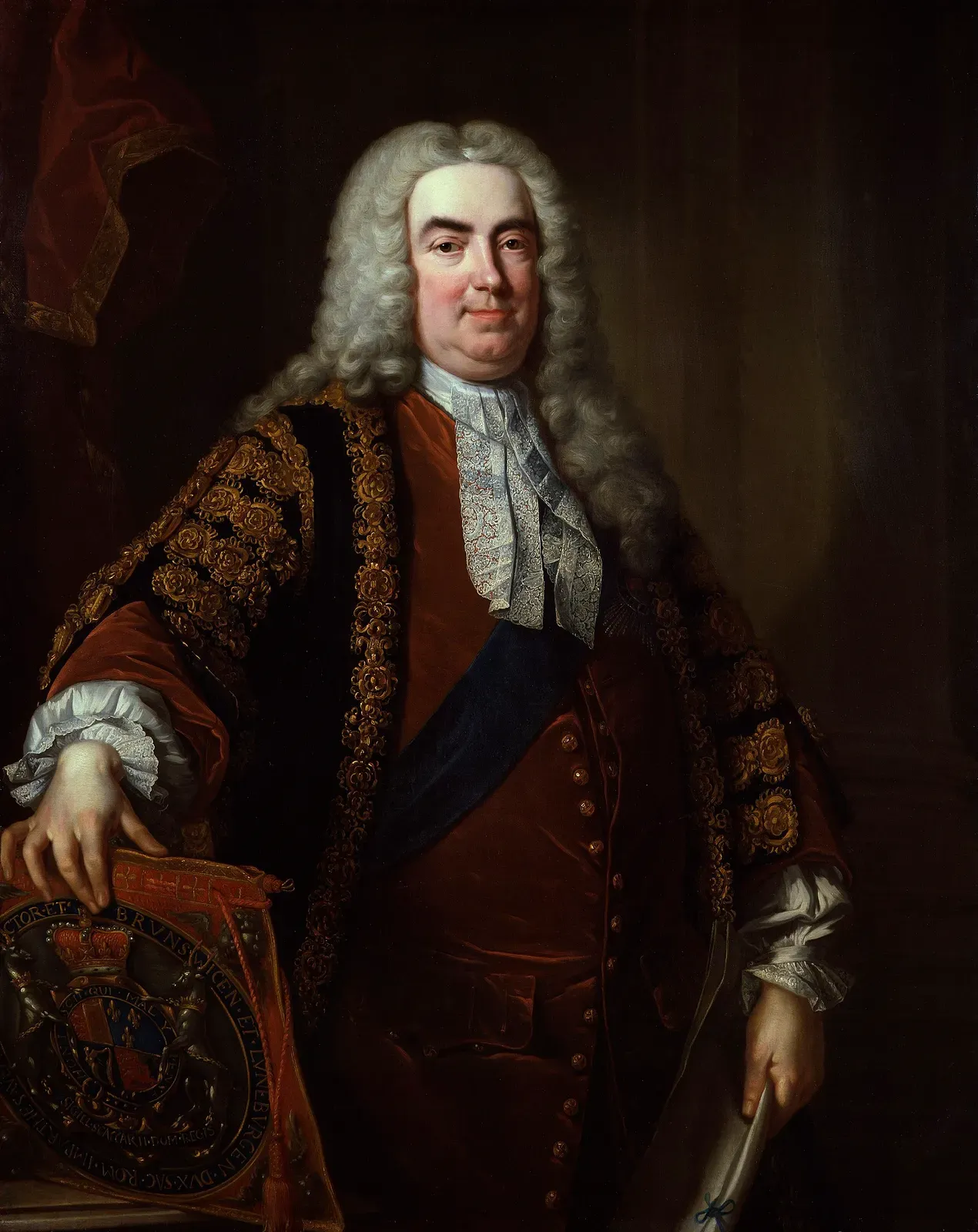
On 3 April 1721, Robert Walpole was appointed First Lord of the Treasury, Chancellor of the Exchequer, and Leader of the House of Commons simultaneously. The three offices together amounted to something that had no name yet, and which Walpole, throughout his twenty-one-year tenure, repeatedly denied holding. “I unequivocally deny that I am sole and prime minister,” he said in 1741, with characteristic bluntness. He was right that no such constitutional office existed. He was wrong that the description didn’t fit him perfectly.
Britain reached this arrangement by accident, in the wreckage of the South Sea Bubble. The Company had promised to absorb the national debt in exchange for exclusive trading rights, sold the public a fantasy of limitless wealth in the Americas, and watched its share price rise from £100 in January 1720 to over £1,000 in August before collapsing. When it did, it took most of the political establishment with it. The Chancellor of the Exchequer had taken bribes. The Postmaster General was implicated. Two senior cabinet ministers were impeached. The crisis exposed how thoroughly the ruling class had been plundering what they were supposed to be managing - a discovery which surprised almost nobody and damaged nearly everyone.
Into this wreckage stepped Walpole. He had invested in the South Sea Company himself and lost money in the crash, but he was not deeply implicated in the corruption, partly because he had been in opposition when the scheme was being hatched. He was the indispensable man: politically capable enough to defend the government, persuasive enough to steady the Commons, and shrewd enough to shield his allies from the worst consequences while appearing to restore order. His enemies gave him the nickname “Screenmaster-General” for protecting the guilty. It was not meant as a compliment. He took the job anyway.
What followed was twenty-one years of continuous dominance - the longest tenure in British prime ministerial history, by a margin that puts it outside normal comparison. He managed two kings, both German-speaking, both alien to the country they ruled, both dependent on Walpole to make Parliament do what they needed. George I barely spoke English; George II wept when Walpole resigned. He outlasted the Jacobite threat, the plots, the rebellions of 1715 and 1719, and came out the other side with the Hanoverian succession secured. He boasted, at the height of the War of the Polish Succession, that “there are 50,000 men slain in Europe this year, and not one Englishman” - a line that reads today as an improbable campaign promise, and one that he actually kept. He cut the land tax from four shillings in the pound to one. He reduced the national debt with a sinking fund and lower interest rates. The country was stable, solvent, and at peace for most of his administration, which is more than most of his successors managed for any part of theirs.
He made enemies of considerable quality. Jonathan Swift, Alexander Pope, John Gay, Henry Fielding, and Samuel Johnson all despised him. Gay’s The Beggar’s Opera was an extended satire of Walpole as a criminal running a protection racket, and became the most popular theatrical production of the decade. Walpole’s response was to pass the Licensing Act of 1737, placing London’s theatres under government censorship. It was the move of a man too powerful to be embarrassed and too vindictive to let it go.
This was not, by any honest accounting, a virtuous man. The Earl of Chesterfield, who knew him well, wrote that “money, not prerogative, was the chief engine of his administration.” He bought votes, rewarded loyalty with patronage, and maintained his majority in Parliament through a system of inducements that his admirers called shrewd management and his critics called corruption. Edmund Burke, who gave the most generous assessment, praised him for governing by “party attachments” rather than outright bribery, but the distinction required some goodwill to sustain. Walpole himself was coarser about it. He reportedly said that “every man has his price” - a remark that may be apocryphal but which his career rendered plausible.
None of which diminishes the scale of what he was. To run a country for two decades, without a written constitution, without a defined office, against the constant fire of the finest literary minds in England, through financial crises, dynastic instability, and the permanent threat of a Stuart restoration - that is not a modest achievement. The office of Prime Minister exists as it does today partly because Walpole invented its conventions: the relationship between the First Lord of the Treasury and the Commons, the need to retain the confidence of the legislature, the mechanics of managing a parliamentary majority. When he finally resigned in 1742, losing a vote by a thin margin, he established the principle that a government must resign when it loses the confidence of Parliament. He did not intend it as a gift to constitutional theory. He simply had no choice.
The contrast with what the office has since become is not merely unflattering. Within living memory: a prime minister who resigned rather than face the consequences of a referendum he called himself; one who lasted forty-four days before the gilt-edged bond market lost patience with her budget; one who lied as a reflex, broke his own lockdown rules, and clung to office until the ministerial resignations became physically impossible to ignore. Walpole’s enemies called him corrupt and lasted twenty-one years. His successors call themselves reformers, patriots, strong leaders, and last, on average, about three years before some combination of their own failures and their party’s impatience removes them.
The title he refused, the office he denied holding, the job that could not remove him for two decades: these are not reminders of a worse and more corrupt past. They are, against all expectation, the standard by which everything since has been measured and found wanting.