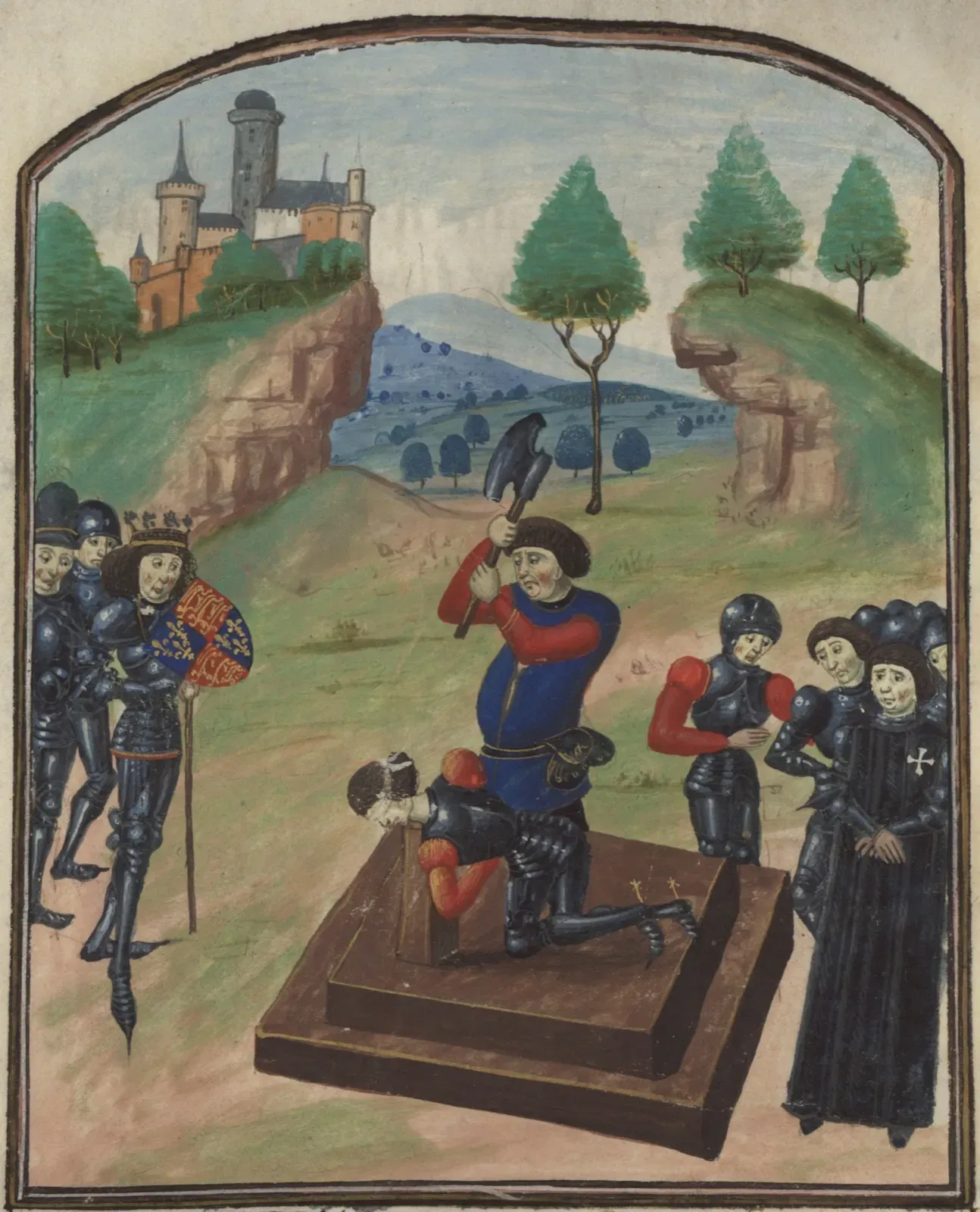
The battle that started the Wars of the Roses lasted roughly an hour. Richard, Duke of York, broke through the barricades at St Albans, killed three of the leading men around the king, and captured Henry VI sitting in a tanner’s house nursing an arrow wound to his neck. Fewer than sixty men died. By the standards of medieval warfare this was barely an engagement - a street skirmish on the morning of 22 May 1455, in a market town thirty miles north of London. What it opened was thirty years of killing.
The dispute was, on its face, a dynastic quarrel about who was most entitled to run a mentally incapacitated king. Henry VI had suffered a near-total breakdown in August 1453, sitting catatonic for seventeen months while the government stalled and his enemies organised. Richard of York, his second cousin and the most powerful magnate in England, had served as Protector during Henry’s incapacity. When Henry recovered in January 1455, the men around him - chiefly Edmund Beaufort, Duke of Somerset - moved immediately to restore the old balance of power and push York back to the margins. York responded by marching an army south. The battle was his answer to an invitation to the royal council.
The Lancastrian claim to the throne rested on descent from John of Gaunt, the fourth son of Edward III. The Yorkist claim rested on an earlier line. The genealogical argument was genuine, though most people around the throne cared less about lineage than about access to royal patronage, control of crown lands, and the profits of government. England had a weak king, a royal court captured by a small faction, and an aristocracy accustomed to resolving such problems by force. The First Battle of St Albans was, from this angle, a standard medieval power struggle. What made it historically abnormal was what came after.
What came after was thirty years of intermittent civil war - not continuous fighting, but cycles of alliance, battle, exile, restoration, and execution that thinned the English aristocracy with remarkable efficiency. The old nobility did not just lose battles; they lost heirs. Attainders stripped defeated families of their lands, which reverted to the crown. The Battle of Towton in March 1461 - fought in a snowstorm in Yorkshire, the bloodiest battle ever fought on English soil - killed somewhere between 9,000 and 28,000 men and effectively destroyed the Lancastrian cause for a decade. Edward IV, York’s son, attainted so many nobles after Towton that the crown absorbed estates on a scale England had not seen since the Norman Conquest. Then Henry VI was restored, then Edward returned, then the whole sequence ran again. By the time Richard III was killed at Bosworth Field in 1485, the English aristocracy had been so thoroughly depleted that Henry Tudor - whose claim to the throne was, by strict hereditary logic, dubious at best - could take the crown essentially because no one left in England was strong enough to stop him.
None of this was what anyone had planned. The men who marched out of St Albans in 1455 were not trying to demolish the feudal order. They were trying to control it. The wars were fought over the throne, not against it - the combatants wanted to sit on it, not abolish it. The consequence of thirty years of trying to capture and hold the throne was that the throne itself became something different. Henry VII inherited a country where the old magnates who had made and unmade kings for two centuries were mostly dead, attainted, or quietly obscure. He could govern England in ways that Edward II and Henry VI could not, because the barons who had previously constrained royal authority had been obligingly killed off by each other.
Henry built on this with deliberate efficiency. He did not call parliaments unless he needed money, and he found other ways to get money. He used the Court of Star Chamber - a conciliar court outside the common law - to prosecute magnates without jury trials. He refused to recreate the network of over-mighty noble affinities that had destabilised every preceding reign. He extended the administrative reach of the crown into the localities by deploying trained lawyers and administrators rather than relying on regional warlords. The men who rose under Henry VII were not the ancient nobility but lawyers, merchants, and gentry who held their position by royal favour and royal need. Thomas Wolsey, son of a butcher from Ipswich, became the most powerful man in England under Henry VIII. That was inconceivable under the old order.
The merchant class filled the gap that the dead barons left. The restoration of reliable law and governance after 1485 meant that trade could expand without the constant threat of noble disruption. The confiscated estates that Henry VII absorbed and redistributed circulated wealth in new directions. Literacy was rising, and print had arrived in England in 1476 - in the middle of the wars - so that by the Tudor peace a reading public existed that had not been there before. The political stability that Henry VII bought with his mean, careful statecraft created the conditions for everything that followed: Henry VIII’s court, the English Reformation, Elizabeth I’s reign, Shakespeare, Drake, Raleigh, the beginnings of empire.
None of this was inevitable. Henry Tudor’s victory at Bosworth depended on the betrayal of Richard III by the Stanley family at the critical moment - a last-minute defection that could have gone the other way. The Tudor dynasty that produced England’s golden age was, at its origin, a coalition of people who had decided that Richard III was worse than the alternative. It survived its first generation through Henry VII’s specific and unglamorous gifts: financial competence, a reflexive suspicion of everyone, and the refusal to die young.
On 22 May 1455, Richard of York broke through a barricade in St Albans and captured a king who could barely hold a conversation. He had solved nothing. The wars that followed his morning’s work killed thousands of Englishmen, extinguished dozens of noble lines, and handed the country - exhausted and depleted - to a Welsh upstart with a questionable genealogy. What Henry Tudor did with that inheritance, and what his grandchildren made of what he built, is why we remember the roses at all. Nobody fought for thirty years to build Tudor England. It was assembled from the wreckage left by people fighting for something else entirely.