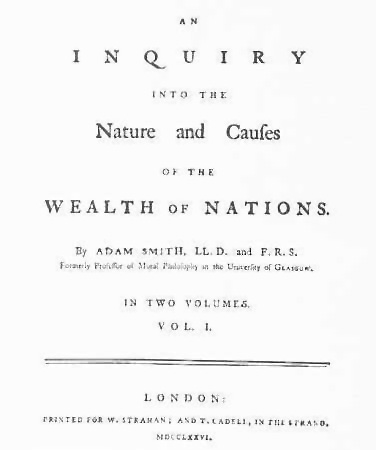
On 9 March 1776, a Scottish moral philosopher named Adam Smith published a two-volume book with the ungainly title An Inquiry into the Nature and Causes of the Wealth of Nations. He had been working on it, off and on, for seventeen years. It ran to almost a thousand pages. It sold out its first edition within six months. What it replaced was not, strictly speaking, a rival theory. It was the absence of one.
Before Smith, the dominant framework for thinking about national wealth was mercantilism: the idea that a country prospers by accumulating gold and silver, running trade surpluses, and using colonies to extract raw materials and absorb manufactured goods. The state set prices, monopolies received charters, and trade was managed as a zero-sum contest in which someone else’s gain was necessarily your loss. The physiocrats — a French school that briefly held serious influence — had proposed something different: that all real wealth derived from agriculture, that manufacturers and merchants merely circulated what farmers produced, and that the correct policy was, therefore, to tax land and leave everything else alone. Both theories had the virtue of coherence. Neither had much contact with what was actually happening in Britain in 1776, which was the early stages of the Industrial Revolution.
Smith was not an economist. The word did not yet exist in its modern sense. He was a professor of moral philosophy at Glasgow — the author, seventeen years earlier, of The Theory of Moral Sentiments, a book about sympathy and the foundations of ethical judgement. This matters because it explains what The Wealth of Nations actually is: not a technical manual for maximising output, but a sustained argument about how human behaviour, left to operate freely, tends to produce outcomes nobody planned. His intellectual project was moral before it was economic. He wanted to understand what holds societies together, and he thought markets were part of the answer.
The book’s best-known argument begins with a pin factory. Ten workers, each performing a separate step in the manufacture of pins — drawing the wire, straightening it, cutting it, sharpening the point, attaching the head — can produce 48,000 pins in a day. One worker attempting the whole process alone would struggle to make twenty. This is the division of labour: the insight that specialisation multiplies output, that an economy of specialists trading with each other will outproduce an economy of self-sufficient generalists. It sounds obvious now. It was not obvious in 1776, and Smith was the first person to state it as the organising principle of economic life rather than a curiosity of manufacturing.
From the division of labour, Smith derived a theory of prices. Each specialist produces a surplus he needs to exchange for everything else he needs. Prices emerge from this exchange, and they signal — to buyers and sellers who may know nothing about each other — where effort is wanted and where it is wasted. No central authority needs to coordinate the process. Individual self-interest does it instead: the baker bakes not from benevolence but because bread earns him money, and yet the city gets fed. The metaphor Smith reached for — an “invisible hand” guiding individual actions toward collective benefit — appears in the book exactly once, almost in passing. It was not meant to be the summary of an ideology. It became one anyway.
His critique of mercantilism was thorough and, for the time, radical. Trade is not zero-sum, he argued: if Britain sells cloth to Portugal and Portugal sells wine to Britain, both countries are better off than if each tried to produce both. Monopolies granted by the Crown — the East India Company being the most conspicuous example — did not make Britain rich; they transferred wealth from consumers to shareholders while suppressing the competition that drives prices down and quality up. High tariffs and export bounties benefited domestic producers at the expense of everyone who bought their goods. The Navigation Acts, which forced colonial trade through British ships, were a protection racket dressed up as economic policy. Much of this was uncomfortable reading for people who held East India stock or sat for rotten boroughs.
Where Smith was wrong — and he was wrong in ways that mattered — the errors mostly came from the same place as his insights. His labour theory of value held that the price of a good reflects the labour required to produce it. This was an intelligible first approximation in 1776. It became a problem when economists tried to explain why a glass of water costs less than a diamond even though water requires far less labour, or why wages differ between industries doing comparable work. The answer — that prices reflect marginal utility, not embedded labour — was worked out by Jevons, Menger, and Walras nearly a century later, in the 1870s, and it required discarding a significant part of Smith’s framework. Karl Marx, working in the British Museum fifty years after Smith’s death, took the labour theory of value and built Das Kapital on it. This is the book’s strangest legacy: the founding text of free-market liberalism supplied the central mechanism of the most sustained critique of free-market liberalism in history.
Smith also underestimated monopoly. He saw it as an aberration — the result of government privilege, correctable by removing charters and lowering tariffs. He did not anticipate that industries with high fixed costs and network effects tend to consolidate into monopolies without any government assistance at all, and that the remedy is not simply deregulation. He said little about externalities: the costs that private transactions impose on people who are not party to them. He assumed, without much examination, that the pursuit of self-interest could be relied upon to produce socially beneficial outcomes across most of the economy most of the time. Nineteenth-century industrialists found this assumption convenient and cited him accordingly. The children in the coal mines were, by any honest reading, a counterexample Smith had not prepared for.
None of this diminishes what the book achieved. Before The Wealth of Nations, economic policy was statecraft run on intuition, tradition, and the lobbying of whatever interest groups happened to have the king’s ear. After it, there was at least a framework — imperfect, contested, repeatedly revised, but a framework — within which the arguments could be made. Corn Laws could be debated not just as matters of political preference but as questions with answerable economic consequences. Free trade had a theory behind it. The relationship between wages, prices, and investment had a logic that could be examined. Ricardo extended it. Mill refined it. Marshall formalised it. Keynes argued with it. Friedman argued back. The argument is still going.
Smith died in Edinburgh in 1790, having had time to see his ideas reach parliament, inform Pitt the Younger’s budget, and begin reshaping British trade policy. He reportedly told his friends he had done little in his life. He was wrong about that too. Not about everything — but about that.