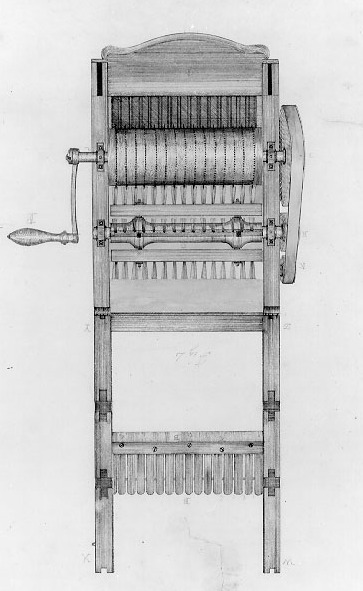
Eli Whitney never got rich from the cotton gin. He spent the better part of a decade in court fighting planters who copied his design freely — and without remorse — built winning arguments about why his patent was invalid, and continued copying. Whitney formed a company with his financial backer Phineas Miller, charging planters a share of the cotton produced rather than a licensing fee, and spent years suing anyone who ignored the arrangement. The courts eventually ruled in his favour, but only in 1807, one year before the patent expired. The great economic transformer of the nineteenth century made its inventor almost nothing. What it made everyone else is a different, much darker story.
Whitney was twenty-eight years old and a recent Yale graduate when he went south in 1793 to tutor on Catherine Littlefield Greene’s Mulberry Grove plantation, outside Savannah. He arrived in a region already organised around cotton and already frustrated by it. The problem was short-staple cotton — the variety that grew across Georgia and the Carolinas — whose fibres locked around their seeds with a tenacity that made separation by hand agonising and slow. A worker could clean roughly one pound of lint per day. Whitney built his first working model within weeks of arriving. The device was, by the standards of consequential inventions, almost absurdly plain: a wooden cylinder studded with wire teeth, which grabbed the cotton fibres and dragged them through a metal grid with slots too narrow for the seeds to pass. A second cylinder fitted with brushes swept the clean lint clear before the mechanism could jam. His model processed fifty pounds a day. He filed for a patent on 28 October 1793; it was granted on 14 March 1794. History assigned the invention to Whitney alone, though a 1883 pamphlet, Woman as Inventor, claimed — with some plausibility — that Greene herself had suggested the brush component that made the thing work. Alas, iin 18th century women were not taken seriously as, well, inventors.
The transformation that followed was explosive. The United States produced around 3,000 bales of cotton in 1790. By 1800 that figure was 100,000. By 1820, it was 335,000. By 1850, it was almost 3 million. Cotton became the country’s dominant export — roughly sixty per cent of total American exports by the 1850s — feeding an insatiable appetite in Britain’s textile mills and turning New Orleans, Mobile, Charleston, and Galveston into some of the wealthiest ports in the world. The South was King Cotton’s kingdom, and it ran on people. Enslaved people. The gin had cheapened the processing of cotton dramatically, but it had done nothing for the harvesting. That still required hands — moving down rows, pulling bolls, filling sacks under a Southern sun. As plantations expanded to meet demand, so did the need for those hands. The enslaved population of the United States stood at around 700,000 in 1790. By 1850 it was 3.2 million. The domestic slave trade — which even slaveholders of an earlier generation had sometimes described with unease — became a vast commercial operation. An estimated one million people were forcibly moved from Virginia, Maryland, and the Carolinas to the cotton fields of Alabama, Mississippi, and Louisiana between 1790 and 1860, separated from their families and sold south in what historians have called the second Middle Passage.
Whitney’s surviving letters record his belief that mechanising the processing stage would reduce the economic case for slavery. He got the logic exactly backwards. By making cotton enormously profitable, he made the picking stage — the one he never mechanised, the one that would not be mechanised until the 1930s — worth any investment. Every profitable bale justified another acre; every additional acre required more labour that only slavery, in the South’s political economy, could supply at scale. In the 1780s, gradual emancipation had been a live conversation in Virginia and Maryland. Jefferson and Madison spoke of slavery as an institution in natural decay. Whitney’s wooden box ended that conversation as surely as any law. By 1861, the institution was valued at approximately three billion dollars — comparable to the entire gross domestic product of the United States — and four million people were in bondage. The Civil War fought partly over its survival killed around 620,000. Whitney died in 1825, sixteen years before the first shots at Fort Sumter, knowing none of this. What he had built in a Georgia workshop in 1793 — wire teeth, a wooden drum, a brush — turned out to be one of the most consequential machines in American history. Not because it worked brilliantly, but because of the human labour it made too profitable to give up.