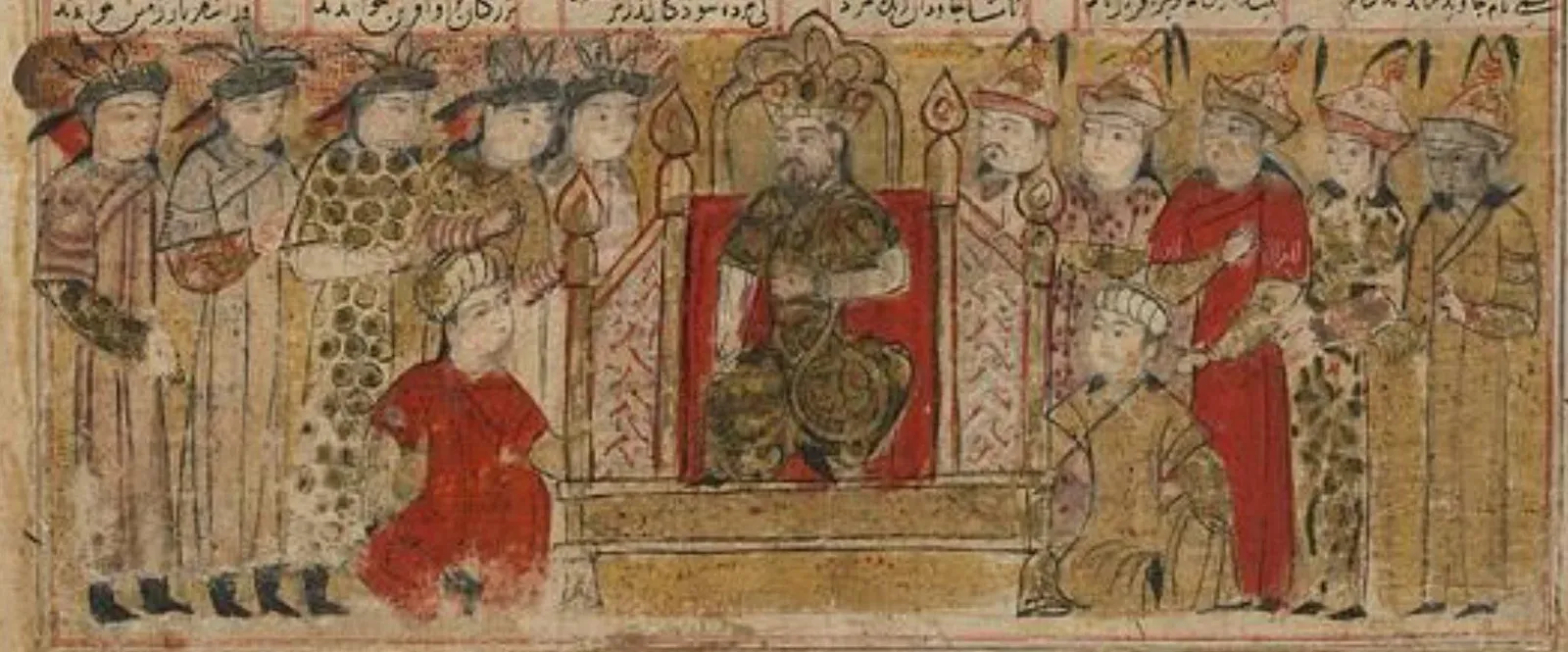
On 16 June 632, the nobles of the Sasanian Empire gathered at Istakhr in Fars province and placed a crown on the head of a boy of roughly eight years old. The ceremony took place at the Temple of Anahita, the same sacred site where Ardashir I had been crowned four centuries earlier when he founded the dynasty. The symbolism was deliberate. The Parthian and Persian noble factions who had spent four years tearing the empire apart in a succession crisis had finally agreed on a compromise candidate - a child distant enough from every rival faction to be acceptable to all, and powerless enough that the great families could govern through him. What they were attempting to sell was renewal. What they were actually crowning was an ending.
Yazdegerd III inherited an empire that had already been dying for decades. The long war with Byzantium under Khosrow II, which had begun with spectacular Sasanian victories - Jerusalem captured in 614, Egypt taken, Constantinople itself threatened - had ended in catastrophic defeat. Heraclius counter-attacked through Armenia, destroyed the Persian army at Nineveh in 627, and Khosrow was overthrown and murdered by his own son in February 628. What followed was not recovery but a succession crisis of almost comic brutality: seven rulers in four years, each installed and displaced by competing factions of the nobility and the Zoroastrian priesthood. The plague that swept the empire during this period - the same pandemic that had devastated the Byzantine world - removed still more of the administrative and military personnel the state depended on. By the time the nobles settled on Yazdegerd, the central government at Ctesiphon could barely collect taxes, the army was fragmented among regional commanders with their own loyalties, and the treasury was empty.
The boy at Istakhr was not expected to rule. He was expected to legitimise whoever ruled in his name. This arrangement has precedents across history - child emperors are a recurring feature of collapsing dynasties precisely because they pose no threat to the factions who install them - but it requires a functional state apparatus behind the throne to work even nominally. The Sasanian apparatus was not functional. The great noble houses - the Karen, the Mihran, the Spahbed families who had supplied the empire’s generals and administrators for generations - were more interested in their own territorial power than in imperial unity. The Zoroastrian clergy, which under earlier shahs had been a pillar of state ideology, had become entangled in factional politics and economic privilege in ways that alienated both the nobility and the general population. The empire Yazdegerd nominally governed was less a unified state than a collection of provinces held together by a shared dynasty and a shared religion, both of which were failing simultaneously.
The timing could hardly have been worse. In the same month that Yazdegerd was crowned at Istakhr, Muhammad died at Medina. The Rashidun Caliphate that Abu Bakr assembled in the months that followed was not, in 632, an obvious threat to the greatest empire in western Asia. The Arab tribes had been fighting each other and raiding their neighbours for generations. But the political vacuum in Arabia that Muhammad’s unification had briefly filled was now occupied by a state with extraordinary military energy and a religious ideology that made expansion a duty rather than merely an opportunity. The Sasanian frontier in Mesopotamia, already weakened by decades of war and administrative collapse, was not prepared for what came next.
The first serious Arab incursions into Sasanian territory began within a few years of Yazdegerd’s coronation. The Battle of al-Qadisiyyah in 637 destroyed the main Sasanian field army and opened the road to Ctesiphon. The capital fell. Yazdegerd fled east - to Fars, then Kerman, then Sistan, then finally to Marv in Khorasan, each move a further admission that the empire he nominally ruled was contracting around him. The Battle of Nahavand in 642, which Persian tradition remembers as the “Victory of Victories” in bitter irony, broke what remained of organised Sasanian military resistance. After Nahavand, the Arab conquest of the Iranian plateau was a matter of time and negotiation rather than major battles.
What followed Yazdegerd’s flight was not a clean end but a long dissolution. Local Persian governors surrendered on terms, retaining administrative authority under Arab overlordship. The great noble families adapted - some fought, some submitted, some simply continued governing their provinces under new masters. Yazdegerd himself, still a young man in his twenties, was killed in 651 at a mill near Marv, reportedly by a local landlord to whom he owed money. The last King of Kings of the Sasanian dynasty died not in battle but in debt, in a village in the far east of what had been his empire. It is a detail that captures the scale of the collapse more vividly than any account of military defeat.
The standard reading of Yazdegerd’s reign treats him as a tragic figurehead - a child who happened to be shah when history turned against Persia. This is not wrong, but it is incomplete. The Sasanian Empire did not fall because the Arabs were invincible. It fell because it had spent its strength and its legitimacy in ways that left it unable to respond when a new power arrived at its borders. The civil war that produced Yazdegerd’s coronation was not an unfortunate interruption of imperial stability. It was the expression of a deeper structural failure: a dynasty that had governed through a coalition of noble families and religious institutions lost the ability to manage that coalition when the costs of its ambitions exceeded its capacity to pay them.
What the Arabs conquered was not a flourishing civilisation at its peak but a state in terminal decline - exhausted by war, fractured by faction, depopulated by plague, and governed by a child. The conquest was rapid because the empire was already hollow. This is worth stating plainly because the narrative of Islamic expansion sometimes treats the fall of Persia as a clash of civilisations in which a vigorous new faith defeated a decadent old one. The vigour was real. The decadence was also real. But the decisive factor was that the Sasanian state had already done most of the work of destroying itself before the first Arab armies crossed the Euphrates.
The aftermath, however, was not the erasure of Persian civilisation. It was its absorption. The administrative practices of the Sasanian bureaucracy - the divan system, the land-tax registers, the provincial governorships - were taken up by the Umayyad and Abbasid caliphates with minimal modification. Persian became the language of administration across much of the Islamic east. The Barmakid family, descendants of the Buddhist administrators of a Buddhist monastery in Balkh, ran the Abbasid bureaucracy for two generations and helped build Baghdad into the intellectual capital of the medieval world. Zoroastrian astronomical and medical texts were translated into Arabic. The cultural synthesis that produced the Islamic Golden Age was, in substantial part, a Persian inheritance wearing Arab governance.
Yazdegerd’s son Peroz took the diaspora route. After his father’s death, he sought refuge at the court of the Tang Emperor in China, where Sasanian princes were received with honours appropriate to fallen royalty of a recognised great power. The Tang records treat the Sasanian embassy seriously - not as refugees from a minor border kingdom but as representatives of a civilisation that had governed western Asia for four centuries and whose fall was an event of world-historical significance. Peroz died in exile. The Sasanian line continued in China for several more generations, a footnote that nonetheless measures the geographical reach of what had been lost.
On 16 June 632, the nobles at Istakhr placed a crown on an eight-year-old boy and called it renewal. Within nineteen years the dynasty was extinct, the Zoroastrian imperial state was gone, and the Iranian plateau was under the rule of the caliphate. Yazdegerd III achieved nothing as a ruler - he was never in a position to achieve anything - but his reign marks the hinge between two eras with unusual precision. The boy crowned at the Temple of Anahita in the year Muhammad died was the last shah of pre-Islamic Iran. What came after was not Persian civilisation destroyed but Persian civilisation absorbed, transformed, and sent back out into the world in forms that would shape Central Asia, South Asia, and the Mediterranean for centuries. The empire fell. The culture is still here today.