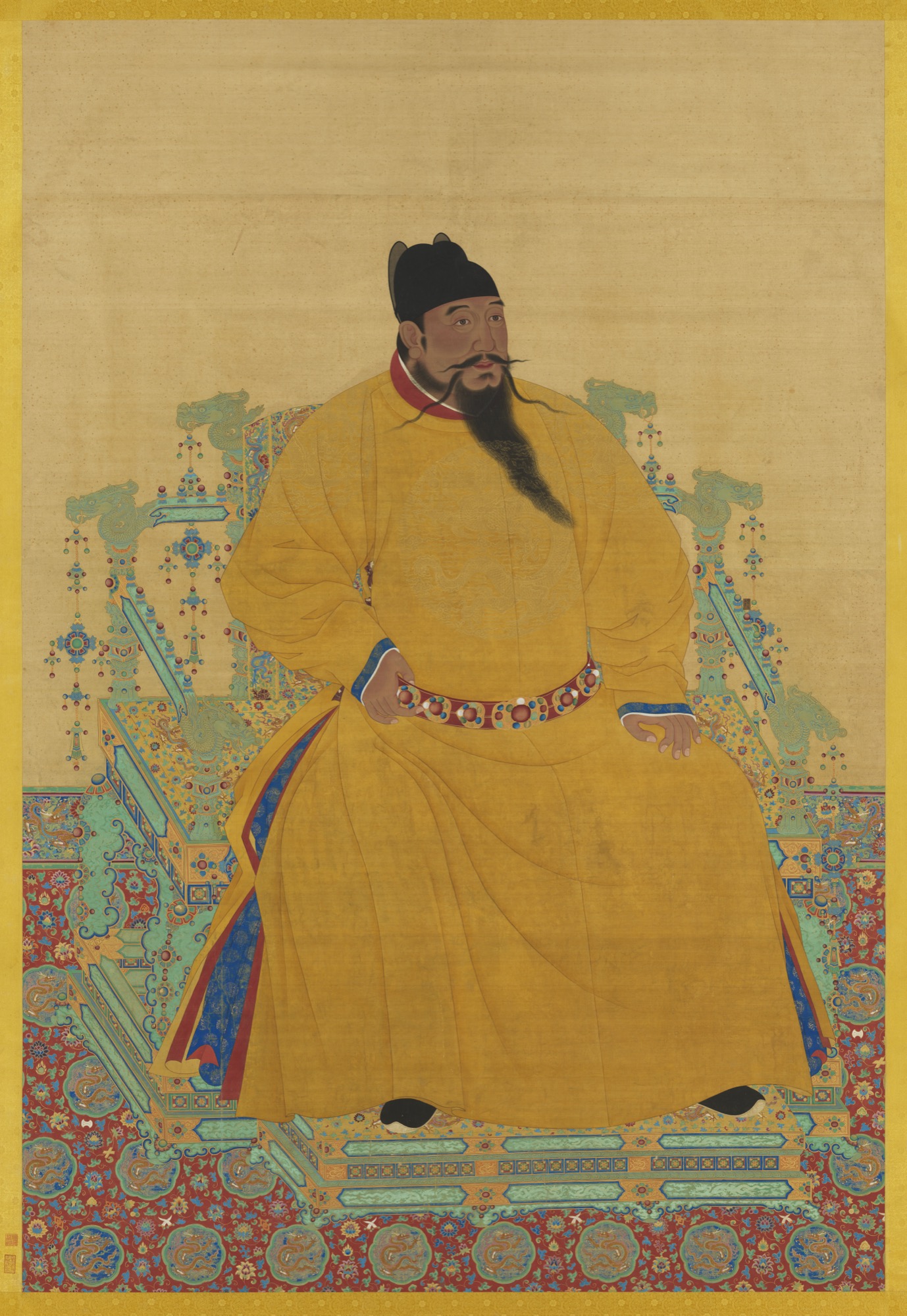
On 13 July 1402, soldiers picking through the wreckage of the imperial palace in Nanjing pulled three bodies out of the ashes, burned past recognition, and declared them to be the Jianwen Emperor, his wife, and his son. Four days later, on 17 July, the man whose army had set that fire crowned himself the new emperor of the Ming dynasty. He took the era name Yongle - “Perpetual Happiness.” Within weeks he had erased his nephew’s entire reign from the official calendar, as if it had never happened. He spent the next 22 years proving that a usurper with enough ambition can out-build almost anyone in Chinese history, and that the two facts have nothing to do with each other.
Zhu Di was the fourth son of the Hongwu Emperor, the peasant rebel who had founded the Ming dynasty in 1368. Zhu Di never expected the throne. He was sent north at twenty to hold Beiping - the future Beijing - against the Mongols, and he spent the next two decades doing exactly that: training his own guard troops personally, riding on punitive expeditions into the steppe, capturing enemy commanders in battle and absorbing their men into his own ranks. He was good at it. By 1398, when his father died, Zhu Di was the most capable soldier in the imperial family and commanded the northern border almost alone.
The throne went instead to his nephew, Zhu Yunwen, a nineteen-year-old grandson elevated by a father’s death and the rules of primogeniture. The new Jianwen Emperor’s advisors immediately set about doing what nervous regimes do to overmighty relatives: they exiled some princes, put others under house arrest, and drove at least one to suicide. Zhu Di, ruling the north with his own loyal army, was judged the most dangerous of the lot. The court began quietly transferring his troops to men it trusted more.
In August 1399, Zhu Di rebelled. He insisted, then and for the rest of his life, that he wanted nothing for himself - he was only rescuing the emperor from corrupt ministers, in the grand tradition of dynastic self-justification that fools nobody and satisfies everyone anyway. He called it the Jingnan campaign: clearing away disorder. What followed was three years of civil war in which the government held every material advantage - more men, more money, more territory - and lost anyway, because its generals were slow and indecisive and Zhu Di’s were not. By the summer of 1402 his army had crossed the Yangtze without a fight, after the government’s own fleet commander defected, and marched on a capital that had already been betrayed from the inside by Zhu Di’s own brother and cousin. Nanjing fell on 13 July with barely a battle. In the chaos, the palace burned.
Whether the Jianwen Emperor actually died in that fire is a question nobody has ever settled. The official verdict - three bodies, one royal family - was convenient, and convenient verdicts issued by the winning claimant to a throne deserve exactly the scepticism they got. Within a few decades, a rival tradition had taken hold: that the young emperor escaped the flames disguised as a Buddhist monk and lived out his life in hiding. Zhu Di, for his part, spent years afterwards hunting for him anyway, which is not what a man does when he is entirely sure of what he saw in the ashes.
Certain or not, it didn’t stop the coronation. Zhu Di declared himself emperor on 17 July, then set about making sure the Jianwen Emperor had never really reigned at all: he abolished the Jianwen era retroactively, stretched his father’s Hongwu era to cover the missing years, and destroyed the government’s own archives except for financial and military records. The official chronicle of his father’s reign was rewritten and rewritten again over the next sixteen years until the 1418 edition finally said what Zhu Di needed it to say - that he had been the favoured son all along, groomed as heir, born to the legitimate empress rather than, as most historians now think, a concubine of Mongol or Korean origin. History, in his hands, was simply another territory to be conquered.
Those who wouldn’t cooperate paid for it. The scholar Fang Xiaoru, the most respected Confucian mind in the empire, was ordered to draft the proclamation legitimising the new reign. He refused, and kept refusing through an exchange that has survived because it is genuinely quotable: asked to model Zhu Di’s rule on the Duke of Zhou, who once served as loyal regent for a child king, Fang asked where that child king was now. “He died in his own fire,” Zhu Di said. Fang asked why the child’s own son hadn’t been enthroned instead. Told that the extermination of nine degrees of his kinship awaited him if he kept this up, Fang reportedly answered: give me ten. The court obliged, dragging in his students and colleagues as an unprecedented tenth category of condemned kin. Altogether 873 people were executed for one man’s refusal to hold a pen. Fang himself died by waist-severing, and - according to the more dramatic accounts - used his own blood to write the character for “usurper” on the floor before he went.
That is the founding violence of the reign, and I don’t think it should be softened. But it is also not the whole of it, which is what makes Zhu Di such an infuriating figure to sum up. Over the following two decades he moved the capital from Nanjing to Beijing and built the Forbidden City from nothing, mobilising hundreds of thousands of labourers. He restored the Grand Canal, lifting rice shipments to the north from roughly two million dan a year to five million within two years of its reopening. He commissioned the Yongle Encyclopedia, a compilation of nearly the entire textual heritage of China running to over 22,000 chapters, assembled by more than two thousand scholars - the largest encyclopedia on earth for the next five centuries. And he sent the eunuch admiral Zheng He on treasure fleets of hundreds of ships and tens of thousands of men as far as East Africa, decades before any Portuguese caravel would manage the same distance in the other direction.
He personally led five campaigns into Mongolia and died returning from the last one, in August 1424, probably felled by a stroke. He never did resolve, to anyone’s satisfaction including his own, exactly whose bodies had burned in that palace 22 years earlier. He called his reign Perpetual Happiness and spent it building an empire on a fire he had started and a question he could never quite put out.