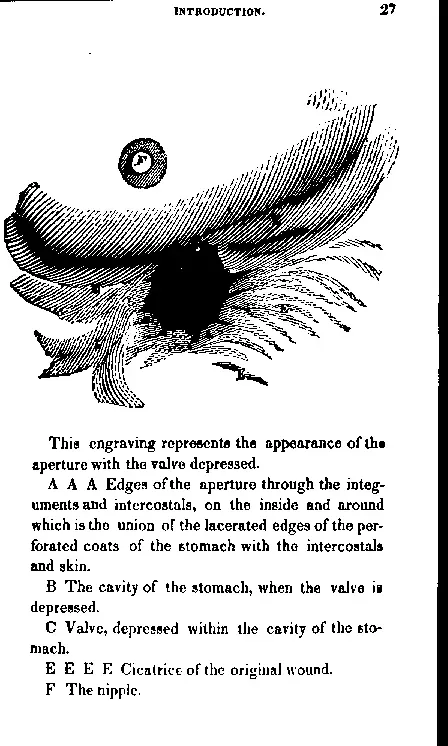
On the morning of 6 June 1822, a musket discharged at close range inside a fur trading post on Mackinac Island, and the contents of Alexis St Martin’s stomach became visible to the naked eye. The blast tore through his left side, broke several ribs, and left a hole in his abdomen that the attending surgeon, William Beaumont, did not expect him to survive. St Martin was twenty years old, a French-Canadian voyageur in the employ of the American Fur Company, in excellent health - and suddenly open to scientific scrutiny in a way no human being had been before.
He survived. The wound healed around its edges, but never closed completely. What formed was a gastric fistula: the stomach lining had fused with the skin surface, leaving a permanent aperture roughly two centimetres wide. Food went in one end and could come out the other. Beaumont, an army surgeon posted at the nearby Fort Mackinac, watched this development with growing interest. He had kept St Martin alive through the first improbable weeks, administering enemas when the young man could digest nothing at all, monitoring him as, after 17 days, food finally began to stay down. What he now possessed - and he understood this quite clearly - was an opportunity that might never come again: a living man with a window into his own stomach.
The experiments Beaumont conducted over the next decade were extraordinary and, depending on how you feel about consent, more than a little troubling. He tied small pieces of food to silk threads, lowered them through the fistula into St Martin’s stomach, and withdrew them at intervals to observe how far digestion had progressed. He collected gastric juice by having St Martin lie on his side and let it drain. He measured temperature, timing, and the effect of emotional stress on the rate of digestion. He performed roughly 200 experiments across multiple sessions between 1822 and 1833. The arrangement required St Martin’s physical cooperation throughout. He gave it under a contract - Beaumont had the illiterate voyageur sign an agreement to work as a live-in servant, a role that included the experiments as a condition of employment. St Martin chopped wood, carried loads, performed domestic duties, and occasionally lay still while Beaumont pushed things into his stomach and wrote notes.
To say the arrangement was coercive would not be wrong. St Martin had been a charity case - Beaumont had paid for his care when no one else would. He had no education, no other patron, and a wound that made regular employment difficult to imagine. The contract was not a negotiation between equals. Beaumont himself recorded in his notes that St Martin submitted not out of gratitude but out of practical necessity. And yet “coercive” doesn’t quite cover the full picture, because St Martin eventually walked away. In June 1834, he wrote to Beaumont from Canada, refusing to return. The reason was his wife’s objections. Beaumont, posted to St Louis, spent the rest of his career trying to get St Martin back; St Martin spent the rest of his life refusing. He lived to seventy-eight, outliving Beaumont by twenty-seven years. Whether he was a victim, a patient, a servant, or something the 1820s had no word for remains genuinely ambiguous.
What Beaumont published in 1838 - “Experiments and Observations on the Gastric Juice, and the Physiology of Digestion” - was a landmark. His 51 conclusions included findings that remain accurate: that digestion involves a churning mechanical motion; that gastric juice is secreted by the stomach lining rather than produced elsewhere; that vegetables are digested more slowly than meat; that emotions directly alter the rate of digestion; and, most significantly, that gastric acid contains hydrochloric acid, confirming a theory that had been contested since William Prout proposed it in 1824. Before Beaumont, the process of digestion was poorly understood and heavily theorised. His work replaced the theorising with data extracted, literally, from a living human body.
When St Martin died at Saint-Thomas, Quebec, in 1880, his family made one final decision in his name. They delayed his burial for several days - until the body had decomposed enough to be useless - to prevent medical men from digging him up. Beaumont was long dead by then, but the fear was not irrational: the eminent physician Sir William Osler had already been trying to secure St Martin’s stomach for the Army Medical Museum in Washington. The family buried him in an unmarked grave, then later in a proper one, having made certain that no one would ever look inside Alexis St Martin again.
There is something almost satisfying about that ending. St Martin spent roughly ten years as a living laboratory, his wound serving a medical project he had not chosen and could not fully comprehend. He left when he could. He lived his life. And when he died, his family drew a line that Beaumont, in his ambition, had never quite managed to draw himself. The stomach that had made William Beaumont famous stayed in the ground where it belonged. Science got its 51 conclusions. Alexis St Martin got the rest.