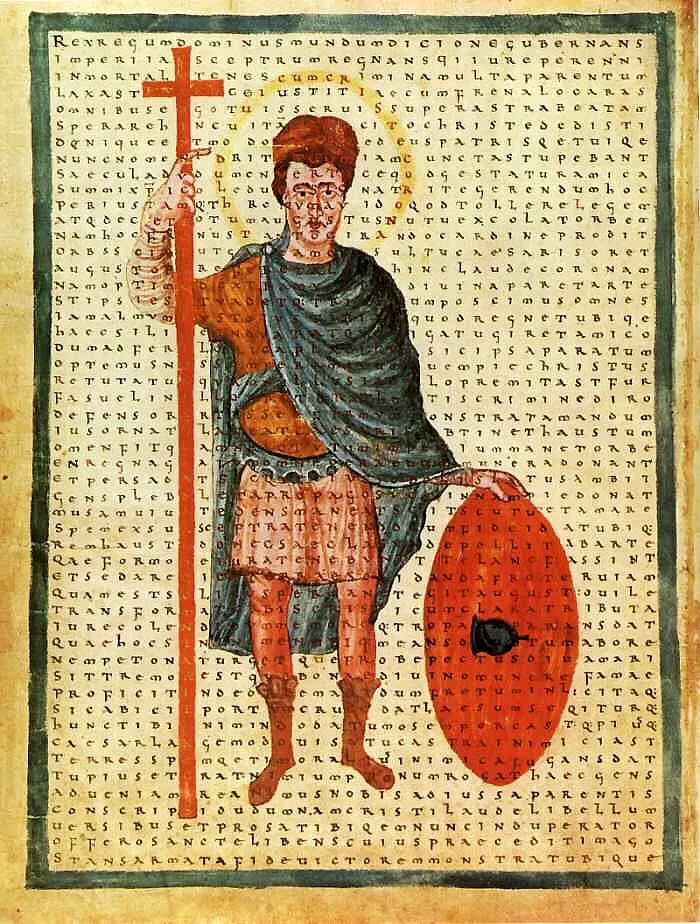
Barcelona fell on 4 April 801, and the man who took it entered the city preceded by priests singing psalms. History would call him Louis the Pious - not as a compliment. He performed public penance twice during his reign: once in 822 for ordering his nephew blinded, and again in 833 when his own sons forced him to prostrate himself before the assembled bishops of the realm and confess to crimes no secular ruler of the time would have bothered acknowledging. He was deposed by those sons in a field outside Soissons in an episode so catastrophic to everyone involved that contemporaries named it the Field of Lies. He is generally ranked unfavourably against his father, found wanting in precisely the qualities Carolingian rulership was supposed to require.
None of that had happened yet when he rode through Barcelona’s gates at twenty-two. He had spent seven months starving a city into surrender.
Barcelona had been in Muslim hands since around 717, when the Umayyad forces that swept through the collapsing Visigothic kingdom took it along with most of the Iberian peninsula. For eighty years it sat on the northern frontier of al-Andalus, a garrison town on the Mediterranean coast just south of the Pyrenean passes. The Frankish advance south had been grinding: Pepin the Short took Narbonne in 759, pushing the border to the mountains. Charlemagne attempted to press beyond them in 778 and suffered the worst reverse of his career - his rear guard destroyed in the pass of Roncevaux, the catastrophe that eventually gave birth to the celebrated Song of Roland. The frontier stayed at the Pyrenees for twenty years. Louis was born that same year, 778, while his father was on campaign in Iberia. He was installed as King of Aquitaine at the age of three and grew up on the frontier his father could not cross.
The opening appeared in 797, when Zeid, the Muslim governor of Barcelona, rebelled against the Emirate of Córdoba and briefly handed the city to the Franks before Córdoba retook it in 799. The episode revealed something useful: the Emirate was not stable. Al-Hakam I, who had ascended the throne in 796, was fighting for his position against his own uncles, Sulayman and Ubayd-Allah, who had contested the succession after the death of Hisham I. Barcelona was a problem the Emirate was in no position to prioritise.
On 20 August 800, an army assembled under Louis’s command - drawn from Aquitaine, Gascony, Burgundy, and Septimania, equipped with siege weapons, and divided into three corps. The first, under Rostaing of Girona, laid siege to the city itself. The second, under William of Gellone, Count of Toulouse, and Adhemar of Narbonne, positioned itself between Lleida and Zaragoza to block any relief force from Córdoba. The third, under Louis, secured the Roussillon valley to the west.
The Muslim wali inside the walls - Sa’dun al Ruayni - recognised early that a long siege was coming and slipped out of the city to seek reinforcements from Córdoba. The Franks intercepted him on the road. He was sent to Charlemagne’s court at Aachen, where he spent the rest of his life in exile. A man called Harun assumed command of Barcelona.
Through the winter of 800-801, the siege held. William of Gellone spent the months ravaging the lands around Lleida and Huesca, denying any relief force a forward base. Louis moved forward from Roussillon in February 801 to tighten the encirclement. By April, the city had been cut off for six months. Harun accepted terms on the 4th, worn down by hunger, deprivation, and relentless attack.
The entry was staged with some care. Priests and clergy went first, singing psalms. Louis processed to a church to give thanks. The conquest was framed as a restoration - a Christian city returned to a Christian ruler - which, in the politics of the Carolingian frontier, was precisely what it was meant to look like. Bera, the son of William of Gellone, was appointed the first Count of Barcelona. The city became the capital of the County of Barcelona, anchor of the Hispanic Marches, the Carolingian buffer zone pressed between the Pyrenees and the Emirate.
What the County of Barcelona eventually became is rather more than a buffer. Through centuries of dynastic marriage and Reconquista expansion it grew into the heart of the Crown of Aragon - and then into the capital of a Catalan civilisation that defined itself, with considerable persistence, as neither straightforwardly Spanish nor French. The city’s distinctness, which anyone who has spent time there notices, runs deep; but its medieval Christian history begins in a Carolingian administrative unit founded on an April morning in 801 by a king who had spent the previous winter in the mountains.
Louis inherited everything when his brothers died - Pepin in 810, Charles the Younger in 811 - and became co-emperor with Charlemagne in 813, sole ruler in 814. What followed was a long, difficult reign of church reform, failed succession planning, and civil wars fought by his own sons. He was deposed, restored, deposed again, and died in 840 with the empire nominally intact but ungovernable in any meaningful sense. Three years later, the Treaty of Verdun divided it permanently into the rough predecessors of France and Germany.
The name he carries - the Pious - was not, in medieval usage, simply praise. A king who confessed too much, deferred too readily to his clergy, and wept over his failures in public was not obviously the model of Carolingian leadership his father had embodied. The comparison with Charlemagne was always present and never flattering.
Except for this: on the morning of 4 April 801, Louis had done something Charlemagne had attempted and failed. He had pushed the frontier beyond the Pyrenees and taken the largest city on the Mediterranean coast of Iberia. The priests went first. The psalms echoed down streets that had been Muslim for eighty years. Barcelona was Frankish, and the man who made it so was twenty-two, and nobody had given him his epithet yet.